

Lebanon’s Foreign Ministry decision to revoke the appointment of Iran’s new ambassador to the country, Mohammad Reza Sheibani, is seen as a significant and unusual step. But tensions between Lebanese Foreign Minister Youssef (Joe) Rajji, who has been in office for only a year, and senior Iranian officials and Hezbollah leaders in Lebanon are not new.
After a series of confrontations and incidents, the relatively new minister has once again drawn the anger of the Iran-backed Hezbollah group. Rajji took office with the announcement of Lebanon’s new government in February 2025. By March, just a month later, he had already angered Hezbollah and prompted a response from the group’s secretary-general, Naim Qassem, after saying Hezbollah gives the international community an excuse not to pressure Israel.
Gallery
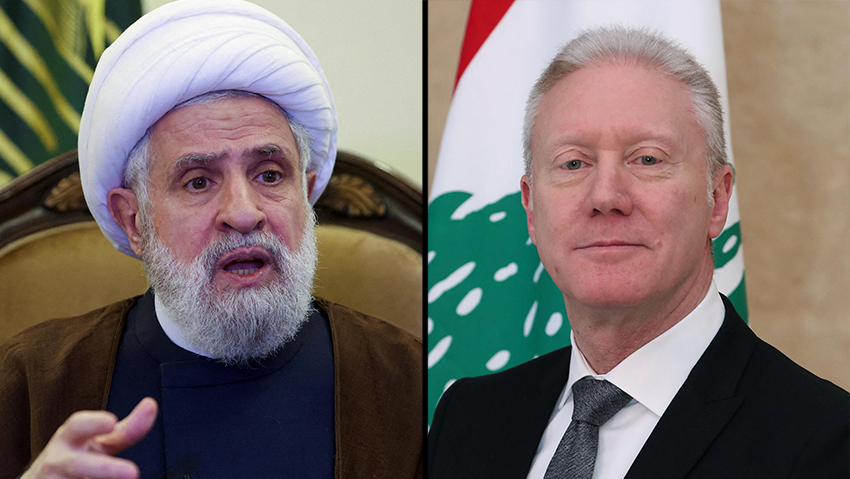
Lebanese foreign minister and Hezbollah secretary-general
(Photo: AFP PHOTO / Lebanese Presidency, REUTERS/Aziz Taher)
Following his latest decision, he again provoked Hezbollah’s ire.
“A reckless and humiliating step. It does not serve Lebanon’s supreme national interests, its sovereignty or its national unity,” the terror group said in a sharply worded statement. “This is a clear submission to external pressures and dictates. The foreign minister has chosen to align himself with a position that, through his words and actions, serves only the enemy.”
Hezbollah accused Rajji of “working to weaken the Lebanese state,” saying he is “pushing for further concessions to the enemy and paving the way for placing Lebanon under American-Israeli tutelage.” The group described the decision as “a major national and strategic mistake” that undermines national unity, deepens internal divisions and places the country on “a highly dangerous path of dependency, weakness and vulnerability.” Hezbollah called on the president and prime minister to demand that Rajji immediately reverse the decision.
In an interview on March 9, 2025, Qassem said: “I think the foreign minister is the one giving Israel the excuse and telling it there are people in Lebanon who justify the various attacks. It is not appropriate for such an idea to come from any government official, especially a foreign minister.”
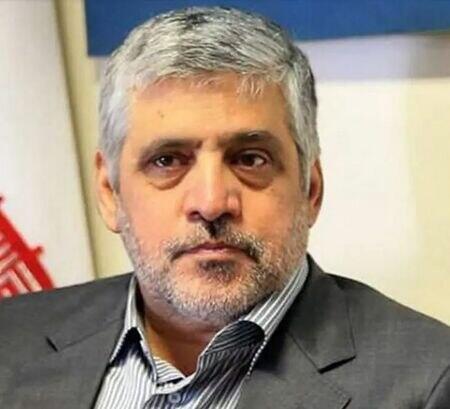
Mohammad Reza Sheibani
Since then, there have been repeated verbal clashes between Rajji and figures aligned with the Shiite-Iranian axis, including Hezbollah. Rajji is part of Lebanon’s new leadership, led by President Joseph Aoun and Prime Minister Nawaf Salam, which is seeking to distance the country from Iranian influence even as Tehran continues its efforts to maintain it.
Rajji has also clashed with Iran’s previous ambassador to Lebanon, Mojtaba Amani — the same ambassador who reportedly carried a Hezbollah pager, was wounded in the pagers operation and was flown to Iran for medical treatment. In April 2025, Lebanon’s government expressed anger at Amani after he “crossed a red line” in a post on X, prompting Rajji to summon him for a meeting.
In that post, Amani criticized plans to disarm Hezbollah, writing: “While the United States continues to supply the Zionist enemy with the latest weapons and missiles, it prevents countries from arming themselves and strengthening their armies and pressures others to reduce or destroy their stockpiles under various pretexts.”
He added: “Once countries submit to disarmament demands, they become vulnerable to attack and occupation, as happened in Iraq, Libya and Syria. We in Iran are aware of this conspiracy and its threat to the security of the region’s peoples and warn others against falling into the enemies’ trap.”
At the time, Rajji’s move against Amani was described as “unprecedented.” Now, with the expulsion of the new ambassador, another precedent has been set.

Rajji is portrayed on social media as a 'Zionist agent'
In November 2025, after statements by senior Iranian officials, including Foreign Minister Abbas Araghchi, that were seen as interference in Lebanon’s internal affairs, Rajji wrote on X: “Dear Iranian Foreign Minister Abbas Araghchi, I was truly inclined to believe your claim that Iran does not interfere in Lebanon’s internal affairs — until your supreme leader’s adviser appeared to tell us what really matters in Lebanon and warned us of the consequences of disarming Hezbollah.”
Rajji was referring to remarks by Ali Akbar Velayati, an adviser to Iran’s supreme leader Ayatollah Ali Khamenei, who was quoted at the time as saying Hezbollah’s presence had become “more important to Lebanon than bread and water.”
In early December 2025, anger in Lebanon toward Tehran grew after a report on the official website of Iran’s supreme leader claimed that 30% of Lebanese army personnel are active in Hezbollah. Later that month, Rajji declined an invitation from Araghchi to visit Tehran following indirect exchanges between them. He apologized and said he was not refusing dialogue, but that “the atmosphere is not suitable,” proposing instead a meeting in a mutually agreed neutral third country.
Rajji, born in 1962, is married with three children and previously served as Lebanon’s ambassador to Jordan. He has held a series of diplomatic posts, including at Lebanon’s embassy in Morocco and as head of political and economic affairs at the Lebanese Embassy in Washington.
Despite his opposition to Iranian influence in Lebanon and his claim that Iran is dragging the country toward war through its directives to Hezbollah, Rajji is not seen as pro-Israel. Last week, at an emergency meeting in Riyadh of Arab and Muslim foreign ministers, he said: “Lebanon calls on the Security Council and influential countries to compel Israel to implement Resolution 1701 and the ceasefire agreement, to end repeated violations of Lebanon’s sovereignty and to fully withdraw to recognized borders.”
He reiterated Lebanon’s position that “there is no alternative to negotiations and diplomatic solutions to address conflicts and prevent further escalation.” He added that the president had launched an initiative to enter direct negotiations with Israel “to establish stability, end the conflict and reach solutions that preserve Lebanon’s sovereignty and rights and lead to security, stability and peace.”
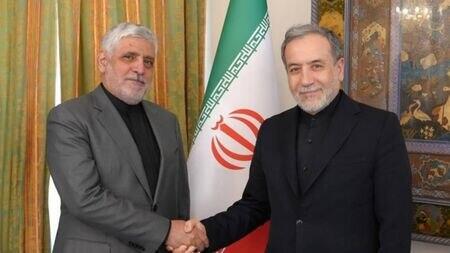
From left: the expelled Iranian ambassador and the Iranian foreign minister
Following the announcement of the Iranian ambassador’s expulsion, Arab and Lebanese media focused on which Lebanese officials were aware of Rajji’s decision and whether it had been coordinated. The Foreign Ministry said the move was directed at the ambassador himself, stating: “Revoking the Iranian ambassador’s approval does not constitute a severing of diplomatic relations with Iran and resulted from his violation of diplomatic norms and obligations. He made statements that interfered in our internal politics and government decisions.”
Hezbollah condemned the decision and called on Rajji to reverse it. The Amal movement — a Shiite political party allied with Hezbollah — said: “This critical national moment requires everyone, especially officials, to act to strengthen unity and national solidarity in the face of Israeli aggression.” It called for the decision to be rescinded “to prevent the country from entering a political and national crisis.”
Criticism of Rajji’s decision from Hezbollah and Iran supporters has continued. The expulsion comes after other significant steps by Lebanon, including banning Hezbollah’s military and security activities, expelling members of Iran’s Islamic Revolutionary Guard Corps found in the country and requiring visas for Iranian citizens entering Lebanon.
The issue has also sparked debate on social media across the Arab world. Some users praised Rajji’s decision, portraying him as having “kicked out” the Iranian ambassador, while others accused him of cooperating with Israel and not representing them. One user wrote: “They expel him, and he responds by staying. Where are the security and defense forces?”
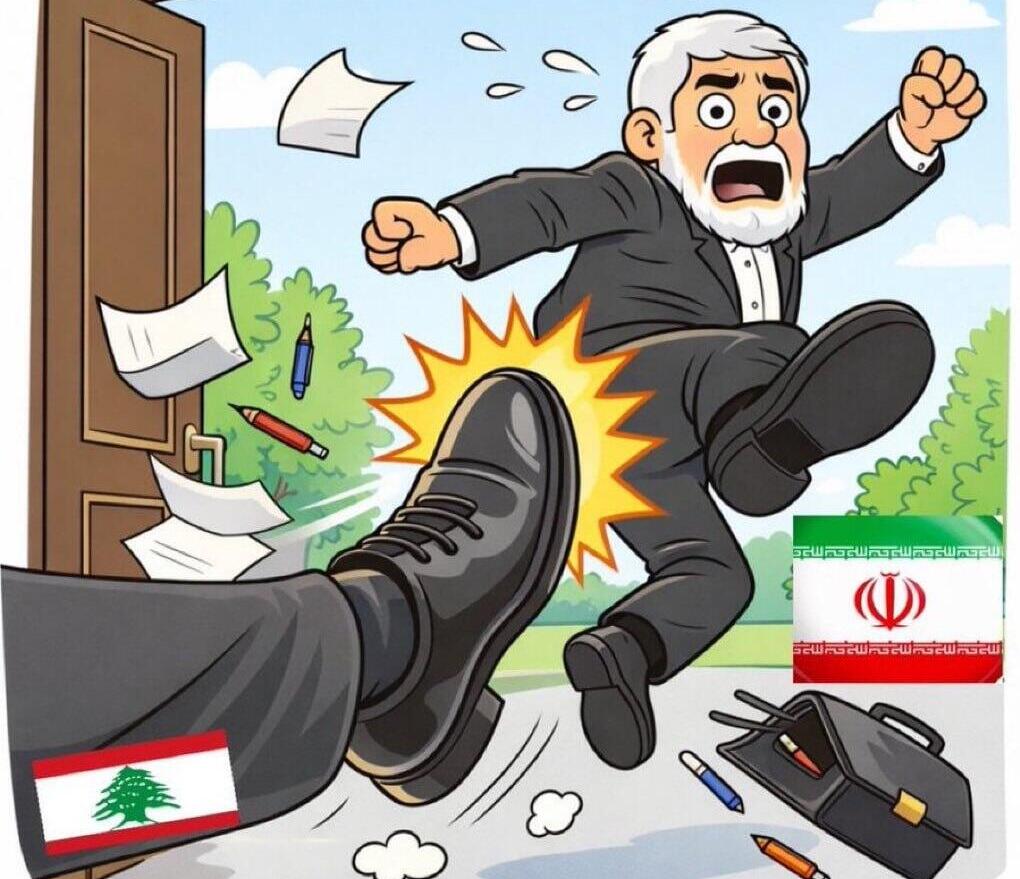
The Iranian ambassador in a Lebanese cartoon
Rajji is not the only official to act against Iranian influence over the past year. In February 2025, alongside the funeral of former Hezbollah leader Hassan Nasrallah, President Aoun met Iranian parliament speaker Mohammad Bagher Ghalibaf, who had arrived for the funeral, and told him: “We are tired of others’ wars on our land. Countries should not interfere in the internal affairs of other countries.”
In August 2025, Aoun told Iran’s then-national security council chief Ali Larijani, who was killed last week, that “no group in the country is allowed to possess weapons or rely on support from foreign actors,” underscoring his opposition to foreign interference.
Even before the current government took office, there were unusual instances of Lebanese anger over Iranian involvement. In October 2024, the government led by Najib Mikati protested after Ghalibaf said Tehran was ready for French-mediated negotiations on Resolution 1701 regarding southern Lebanon. Mikati stressed that any negotiations would be conducted solely by the Lebanese state.
First published: 03:56, 03.28.26