


One of the capabilities enabling the Israeli Air Force to sustain its sorties and strikes deep inside Iran is aerial refueling. The distances involved are vast, and the air force’s ability to carry out attacks depends heavily on precise midair refueling.
“There’s a level of complexity that requires maximum precision,” said Maj. (res.) A., a pilot in the Israeli Air Force’s 120th Squadron, the refueling squadron, in a special interview with ynet and its parent newspaper Yedioth Ahronoth.
Aerial refueling during Iran campaign
(Video: IDF)


“Our job is to provide flexibility to the fighter jets. I’m part of a chain that ensures operational continuity. The order comes down to the squadron, and there are people whose role is to plan the flight path, determine which aircraft we’ll meet along the way and how much time we have,” he said.
The missions, A. explained, vary significantly from flight to flight. “We have to meet the aircraft at a specific point and release them at exactly the right point. The refueling window is only a few minutes. Along the way, there are threats we have to deal with, and weather conditions also play a role. There’s a very specific moment when the connection between the aircraft can happen — it’s a matter of seconds.”
The procedure itself unfolds in several stages. According to A., “On our crew — flying a relatively old aircraft that is now entering its seventh decade of service — there is an aircrew member called the ‘boomer.’ He connects the boom, the fuel pipe, between the two aircraft. He has only a few seconds to execute that precisely. After that, the planes maintain a constant speed and the refueling process lasts several minutes. The point is that the process also has to end at a precise location. Only once that happens do we move on to the next aircraft or the next mission.”
According to IDF data, the air force has carried out over 550 aerial refuelings over the Middle East since the start of Operation Roaring Lion, transferring roughly 5 million pounds of fuel. That volume represents more than 50% of the total refuelings conducted during last June's Operation Rising Lion.
The differences between the operations are clearly visible, including in the activity of the 120th Squadron. “You have to understand — just as we prepared for this battle, the Iranians prepared as well. They made many changes after Rising Lion,” A. said. “The intelligence picture we knew is not the same as it was then. The refueling fleet is much smaller than the strike fleet, so every refueling aircraft that isn’t operational affects the readiness of the entire force, and we can’t take that lightly. In Roaring Lion, everything is happening at very high intensity, which demands sharpness and adds complexity.”
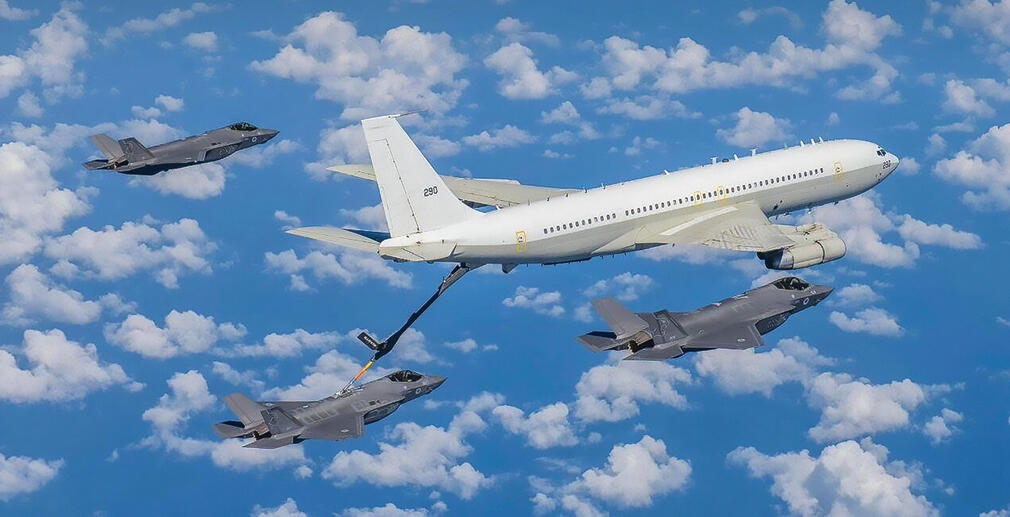
To cope with the large operational volume, the IDF is also relying on U.S. refueling aircraft, dozens of which are stationed at Ben Gurion Airport.
Lt. H., an operations officer in the 120th Squadron, also spoke about the complexity of the current fighting. “There’s no doubt that the past few days have brought many challenges, and we’re working around the clock,” she said. “For me as an operations officer, and for the soldiers, it means being constantly focused on the mission — while also dealing with the situation at home, just like all Israeli citizens are experiencing.”
“Our connection with the aircrews is continuous. Every time they return to the ground, we conduct a joint debrief — understanding what worked well, what needs improvement and what is required to maintain the pace of operations and the stamina needed over time. We’re working at an even higher tempo than during Operation Rising Lion. There was very significant early preparation that allowed us to enter the operation at full intensity.”
The refueling aircraft crews include both active-duty pilots and reservists who dropped everything to return to service. A. described the sense of mission — and the difficulty of keeping the secret in the days before the campaign began, even from his immediate family.
“The tension was clear and very present,” he said. “But when you know what’s coming and when you’re going into reserve duty, it’s different. The hug I gave my wife and children was longer this time, that’s for sure.”
He added that although there is always concern, the sense of mission outweighs it. “You do think about what might happen. We’re entering enemy territory, and that carries risks. But there’s also a sense of pride and privilege in taking part in an operation like this. It’s a historic mission that will be recorded in the history of the Israeli Air Force. It gives you emotional fuel.”
“I go out on a mission knowing I have a wife and children behind me who I need to care for,” he said. “And when you land and realize that the aircraft you refueled struck the threat and destroyed it, you feel pride and satisfaction.”