

Turkish Foreign Minister Hakan Fidan announced Friday that Ankara has decided to sever all economic and trade ties with Israel and close its airspace to Israeli aircraft, deepening a diplomatic rift over the war in Gaza.
Fidan told parliament the move follows a series of measures Turkey has taken in recent months in protest of Israel’s military campaign. But his statement left some ambiguity: Turkey had already declared an economic cutoff earlier this year, and his remarks on airspace sounded more like a reference to existing restrictions than a new policy.
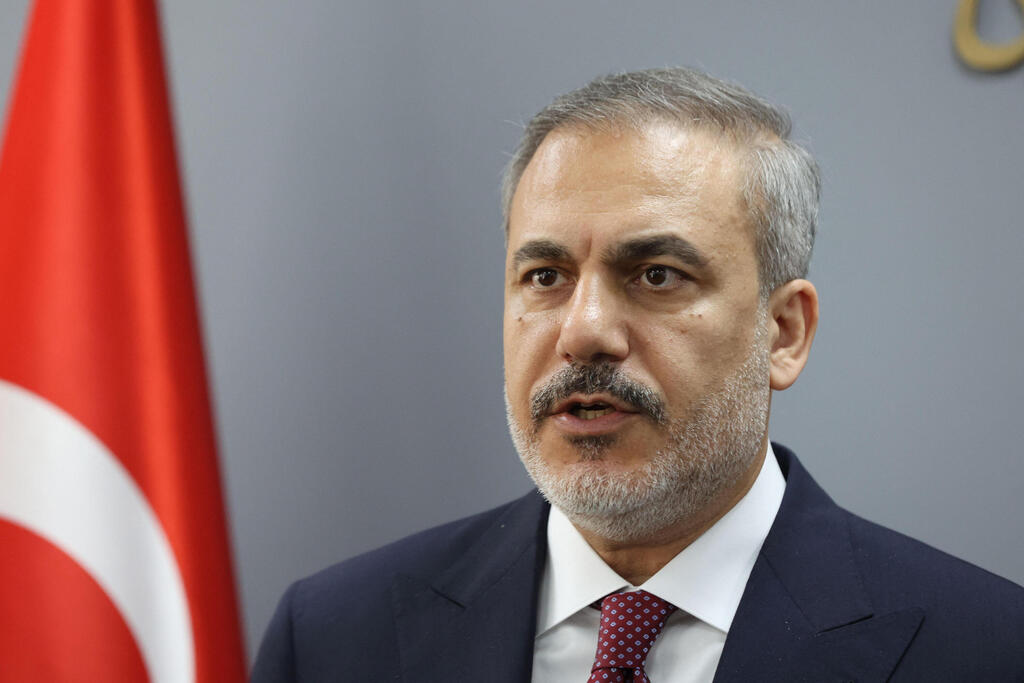
Turkish Foreign Minister Hakan Fidan
(Photo: ANWAR AMRO / AFP)
So far, Israeli carriers and aviation authorities said they had not received any official notification from Turkey. Israeli airlines mainly use Turkish airspace for flights to Georgia, and Israir, which operated a flight to Batumi on Friday, said operations were continuing as scheduled. “Our flights are operating normally with no changes,” the airline said, adding it was in contact with the Civil Aviation Authority and would update passengers if circumstances changed.
In his speech, Fidan also accused Israel of deliberately making Gaza uninhabitable “to force its people to leave.” He further charged that Israel opposes the emergence of a “new and strong Syria” and vowed Ankara would not allow such a policy to continue.
The tensions came days after Prime Minister Benjamin Netanyahu, in a rare move, publicly recognized the Armenian genocide. The remark, made unexpectedly during a podcast interview with U.S. commentator Patrick Bet-David, was the first time Netanyahu had acknowledged the mass killings of Armenians by Ottoman Turks during World War I as genocide. “I just did it. Here you go,” Netanyahu said when pressed on why Israel had not recognized it before.
Prime Minister Benjamin Netanyahu, in a rare move, publicly recognizes the Armenian genocide on Patrick Bet-David's podcast
(Video: PBD PODCAST)


The Turkish Foreign Ministry responded by accusing Netanyahu of trying to “exploit the tragedies in the past for political purposes,” adding that “Currently on trial for his role in the genocide committed against the Palestinian people, Netanyahu is seeking to cover up the crimes perpetrated by himself and his government. We condemn and reject these remarks which are contrary to the historical and legal facts.”
Israel-Turkey relations have long swung between cooperation and confrontation. Prior to the war, ties were on a path of improvement that peaked with a meeting between Netanyahu and Turkish President Recep Tayyip Erdogan. But since the Gaza war erupted, relations have unraveled: Erdogan has hosted Hamas leaders in Turkey, compared Netanyahu to Hitler and both governments have recalled their ambassadors, leaving relations at a low-level diplomatic channel.