

In El Salvador, President Nayib Bukele calls himself “the world’s coolest dictator.” This weekend, his government moved one step closer to removing the irony.
With the backing of loyal lawmakers in parliament, Bukele’s party passed sweeping constitutional reforms that abolish presidential term limits and extend future terms from five to six years. Another clause—previously requiring a runoff if no candidate won a majority—was also erased. The next election, once scheduled for mid-2029, will now be held in March 2027, giving Bukele the chance to run again, earlier and for longer.

Only three lawmakers opposed the changes. One of them, Marcela Guadalupe Villatoro Alvarado, stood in parliament and declared: “Democracy in El Salvador is dead.”
Bukele, 44, remains broadly popular. His signature achievement—the dramatic drop in violent crime—has defined his presidency. Elected in 2019 and again in 2024 with 85% of the vote, Bukele credits his sweeping anti-gang campaign for transforming El Salvador from “the murder capital of the world” into what he calls “the safest country in the Western Hemisphere.”
Benefits of a subservient judiciary
But his path to re-election in 2024 was made possible only after judges, appointed by his party, overturned a constitutional ban on consecutive presidential terms. With his party dominating parliament, those judges had been installed after a legislative vote in 2021 ousted their predecessors, who were seen as among the last institutional checks on executive power.
Get the Ynetnews app on your smartphone: Google Play: https://bit.ly/4eJ37pE | Apple App Store: https://bit.ly/3ZL7iNv
Opponents now say the latest constitutional overhaul marks another step away from democracy and toward indefinite rule. “Unlimited reelection brings the consolidation of power,” Villatoro warned. “Nepotism rises. Corruption rises. Political participation is frozen.”
Bukele’s rise has drawn comparisons to Venezuela’s descent into autocracy. His popularity—boosted by a years-long state of emergency—has helped him centralize authority across nearly every state institution. Nearly 88,000 people have been arrested under the emergency powers, most accused of gang-related crimes. Human rights groups say thousands were detained arbitrarily and more than 400 have died in custody.
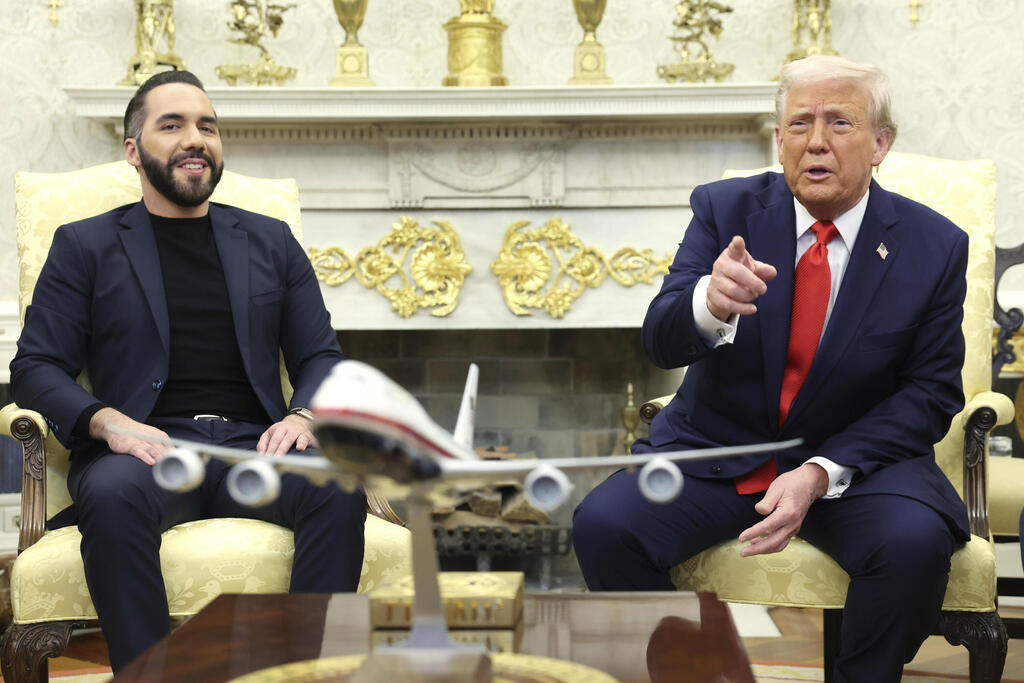
Bukele with Trump at the Oval Office
(Photo: Pool via AP, REUTERS/Evelyn Hockstein)
In May and June, his government began arresting critics, including prominent human rights lawyer Ruth López, known for exposing corruption cases. The wave of detentions forced dozens of activists and journalists to flee the country. One of El Salvador’s leading human rights organizations announced in July it would relocate operations abroad, citing a “wave of repression.”
Bukele has shown little interest in appeasing international critics. In 2021, he made El Salvador the first country to adopt bitcoin as legal tender, defying warnings from the International Monetary Fund. On social media, where he speaks directly to millions of followers, he describes himself alternately as “dictator of El Salvador” and “the coolest dictator in the world.” At a recent speech marking the first year of his second term, he said he doesn’t care if people call him a dictator.
Every crisis in an opportunity
For years, El Salvador was gripped by staggering violence—its cities ruled not by mayors, but by gang leaders, its streets thick with fear. Homicide rates ranked among the highest in the world, and successive governments seemed powerless. In that vacuum of insecurity, Nayib Bukele emerged not just as a politician, but as a promise: young, defiant, unburdened by the corruption of the old parties. His vow to crush the gangs resonated across a weary nation, and his swift, brutal campaign delivered immediate results—murders dropped, extortion ebbed, and public spaces reopened.
But the same fear that fueled his ascent also fueled acceptance of exceptional measures. Since taking office, Bukele and his allies have reshaped the country’s political and judicial institutions. After securing a majority in parliament, they replaced top judges and the attorney general. The reconstituted Supreme Court paved the way for Bukele’s 2024 run. Now, with term limits abolished, there are no legal barriers to reelection.
His alliance with Donald Trump, who returned to the U.S. presidency in January, has only deepened. This year, Bukele offered to detain 252 Venezuelans the U.S. accused of gang ties—without public evidence—in exchange for $6 million. They were held for months in a massive prison built for gang members. Many later reported torture and sexual abuse during their detention.
Human Rights Watch official Juanita Goebertus responded to the latest developments with a warning: “This is how it starts—with a leader who uses his popularity to entrench himself—and it ends in dictatorship.”
Bukele, paternal grandparents were Palestinian Christians who emigrated to El Salvador from Jerusalem and Bethlehem in 1921, was born in San Salvador in 1981, the son of a businessman with interests in textiles, pharmaceuticals, and advertising. As a young man, he joined his father’s companies and studied law, though he did not finish his degree. His political career began in local government, first as mayor of a suburb, then of the capital.
In 2019, he broke the country’s long-dominant two-party system, which had endured since the end of the civil war. Soon after taking office, he ordered police and soldiers to occupy parliament—a chamber then controlled by the opposition—to pressure lawmakers into approving a loan for his anti-crime initiative.
He communicates frequently through X, where he has more than 7 million followers and often posts in English. He is married to psychologist and ballet dancer Gabriela Rodríguez, with whom he has two children. His inner circle includes his brothers Karim, Yusef and Ibrahim. Several of his former classmates also serve in his administration.
Bukele’s public image is one of control, charisma, and confrontation. His critics see something else: a calculated dismantling of democratic norms, cloaked in digital charm and populist momentum.