

The Church of England’s governing body has voted overwhelmingly to encourage engagement with a Palestinian Christian document that accuses Israel of genocide, describes the Jewish state as a “colonial enterprise built on racism” and portrays the Hamas-led Oct. 7 massacre as the product of decades of Israeli oppression.
The General Synod approved the motion despite warnings from Britain’s chief rabbi and leading Jewish organizations that the document, known as Kairos II, contains falsehoods, erases Jewish history and could seriously damage Jewish-Christian relations.
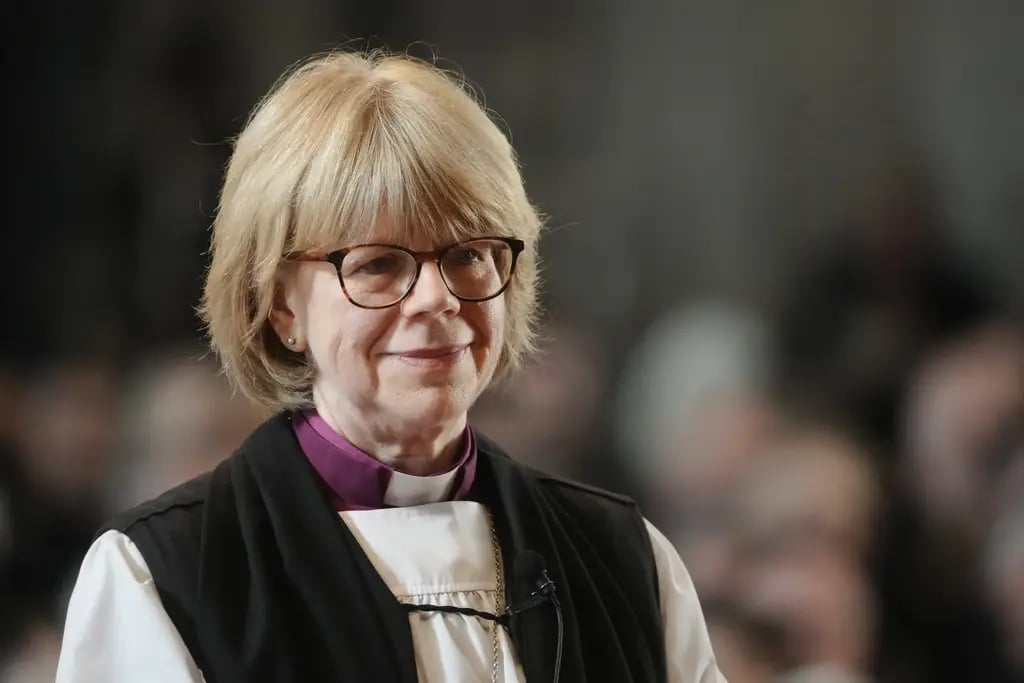
Archbishop of Canterbury Sarah Mullally
(Photo: AP)
The motion does not adopt the document’s allegations as church doctrine or require agreement with them. Instead, it calls on churches across England to “hear” Kairos II and several earlier Palestinian Christian declarations as “heartfelt expressions of the lived experience of Palestinian Christians.”
That wording was introduced through amendments after the original motion called on the church to “receive” the documents.
The measure passed comfortably in all three houses of the Synod. Among bishops, 25 voted in favor, none opposed and five abstained. Among clergy, 115 supported the motion, 20 opposed and 30 abstained. Among lay members, 113 voted in favor, 27 against and 35 abstained.
Kairos II, formally titled “A Moment of Truth: Faith in a Time of Genocide,” was drafted in November 2025 by the Palestinian Christian Ecumenical Initiative.
It describes Israel’s campaign in Gaza as genocide, portrays the country as a racist colonial project and argues that “occupation,” “apartheid,” “settler colonialism” and what it calls Jewish supremacy are central to the conflict.
The document also calls for boycotts, divestment and sanctions against Israel, rejects Christian Zionism and presents the Oct. 7 attack as having emerged from decades of injustice, displacement and the blockade of Gaza.
Ahead of the vote, Chief Rabbi Sir Ephraim Mirvis urged Synod members to reject the motion, calling Kairos II “deeply concerning.”
“It is truly shocking that a document which purports to speak in the name of truth contains so much falsehood,” he said.
After the vote, Mirvis called the decision shameful and said Kairos II reduces the conflict to “a single, warped narrative.”
“This is a sad day for Jewish-Christian relations,” he said.
Phil Rosenberg, president of the Board of Deputies of British Jews, also called the motion “highly problematic,” warning that the document’s distortions and erasure of Jewish identity would deepen division.
Supporters of the motion argued that engagement did not amount to endorsement.
Archbishop of Canterbury Sarah Mullally said the document reflected Palestinian pain and trauma, while also acknowledging the concerns of Jewish leaders and reaffirming the church’s opposition to antisemitism.
Palestinian church officials welcomed the decision, saying it carried particular weight because of the Church of England’s influence in British public life.
The vote ultimately encourages clergy and congregations to study Kairos II, even as Jewish leaders warn that doing so risks legitimizing a text they view as hostile to Zionism and deeply damaging to interfaith trust.