

U.S. Vice President JD Vance said Thursday that keeping oil and gas prices low for Americans is the Trump administration’s top priority in its confrontation with Iran, ahead of ensuring Tehran never obtains a nuclear weapon, as Washington continues to emphasize economic pressure while weighing a possible return to an interim understanding with the Islamic Republic.
“That's goal number one: Keep oil and gas cheap for Americans all over our country. And obviously, goal number two is ensuring that Iran never gets a nuclear weapon,” Vance told Fox News when asked what an end to the confrontation with Iran would look like.
Vance on US goals in Iran
(Video: Fox News)


“The thing I can say with confidence is I think this ends with the United States in a stronger position, with Iran not having a nuclear weapon, and with the Strait of Hormuz returned to a place where oil and gas prices are stable for the American people,” Vance said.
He said the administration was using its available tools “very selectively, very strategically” to achieve President Donald Trump’s objectives, including ensuring Gulf states can continue supplying oil and gas to the global economy and helping stabilize energy prices.
“That’s obviously important to the United States,” Vance said, noting that oil prices had fallen significantly from peaks reached during the first days of the conflict.
Vance said he was confident the administration was making progress on both its energy and nuclear objectives but cautioned that the confrontation remained inherently unpredictable.
“The Iranians themselves are unpredictable, and they sometimes don’t honor the commitments they’ve made to us,” he said.
His comments underscored the administration’s more cautious approach to Iran, centered on intense economic pressure.
Treasury Secretary Scott Bessent, speaking separately to Newsmax, said the administration was preparing measures of unprecedented severity against Tehran.
“We are going to apply measures like have never been seen in the history of the economic isolation of a country,” Bessent said. He described the strategy as “a combination of economic isolation like the world has never seen before and the continued blockade in the Strait of Hormuz that will keep anything from going in or out of the Iranian ports.”
The comments come amid discussions in recent days about returning to a memorandum of understanding between Washington and Tehran, although a senior Iranian official said Wednesday that “no progress has been made.”
Trump this week also characterized the current strategy as an effort to secure an economic victory over Iran.
“They’ve got 300% inflation. They have no value. Their currency has almost no value. Economically, they are a mess,” Trump said in an interview. “We control their money, what they had, which is a lot. They had a lot, and we have total control of it. I'm their banker.”
New tariffs target imported drones
Trump, meanwhile, announced tariffs on imported drones and components, including products from several key U.S. allies, arguing that the United States has become overly dependent on foreign suppliers for technology with national security implications.
The White House said a 100% tariff based on value would be imposed on drones “of a certain size or with certain capabilities that are particularly sensitive for national security purposes.” Smaller drones would face a 25% tariff.
Drones and components imported from the European Union, Japan, Liechtenstein, South Korea, Switzerland and Taiwan will face a 15% tariff, while those imported from Britain will be subject to a 10% levy.
Trump said Commerce Secretary Howard Lutnick had examined the effects of drone imports and determined that penetration by foreign manufacturers was substantial and that the United States had become overly dependent on them.
Trump said that dependence posed “a security and safety risk” and that American manufacturers were not producing enough drones to meet national security requirements.
The White House said the tariffs would take effect in 21 days, although tariffs on drones not considered particularly sensitive would take effect in 180 days.
Trump orders Navy back toward steam catapults
Trump has also directed the U.S. Navy to abandon a sophisticated electromagnetic system used to launch fighter jets from its newest aircraft carriers and return to steam-powered catapults, a change senior Navy officials have resisted for years and that is expected to cost billions of dollars, The Wall Street Journal reported.
Trump signed a national security memorandum directing the change, which would affect future ships in the Gerald R. Ford class of aircraft carriers.
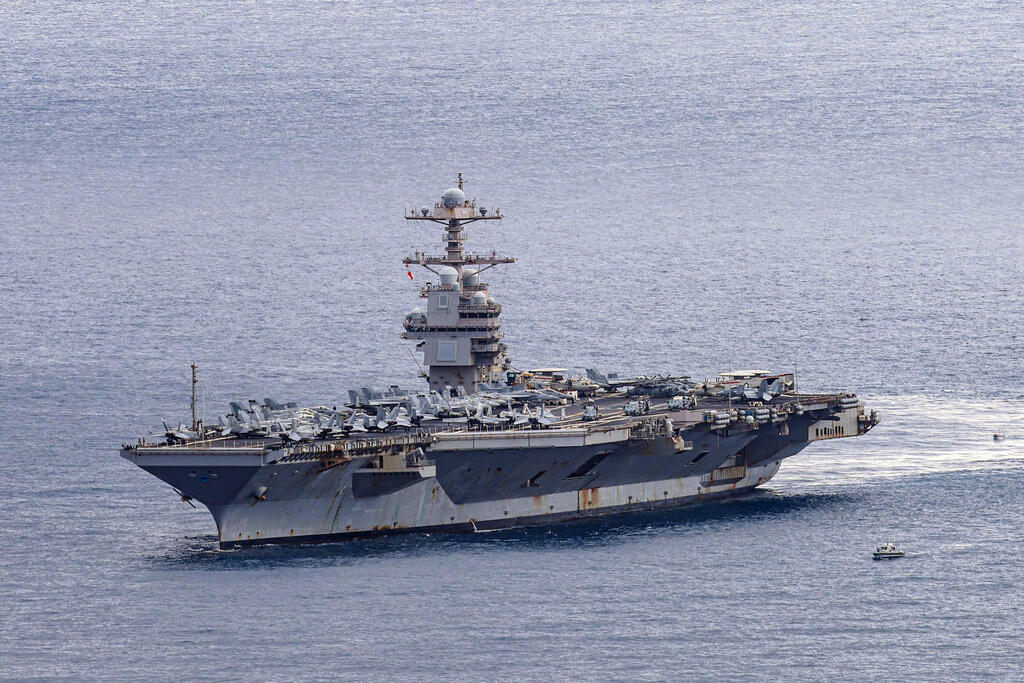
USS Gerald R. Ford
(Photo: METAXAKIS / AFP)
The move fulfills a pledge Trump made nearly a decade ago to return to steam technology after hearing a sailor praise the older system during a ship visit in his first term.
Trump has repeatedly criticized the Electromagnetic Aircraft Launch System, or EMALS, used aboard the Ford-class carriers. In a 2017 interview with Time magazine, he said he had instructed the Navy to return to “goddamned steam.”
Senior Navy and defense industry officials have resisted such a change because of the enormous cost and engineering challenges involved in removing a system that was integral to the Ford-class design, according to the Journal.
Under the new directive, the Navy would redesign the fourth carrier in the class, the future USS Doris Miller, as well as subsequent ships. The first three carriers — the USS Gerald R. Ford, the future USS John F. Kennedy and the future USS Enterprise — would retain their electromagnetic launch systems.
“They’re not nearly as good, too complex,” Trump said of the electromagnetic system at an event in Pennsylvania last month.
The national security memorandum also includes directives intended to improve submarine maintenance and repair and encourage foreign investment in the U.S. shipbuilding industry as the Navy seeks to expand its fleet.
“This decision will result in carriers that are enabled by battle-tested steam and hydraulic systems that are more resilient and robust than the present, more exquisite, follow-on systems,” the White House said.
The administration said the move would also revive parts of the maritime industrial base that are easier to expand.