


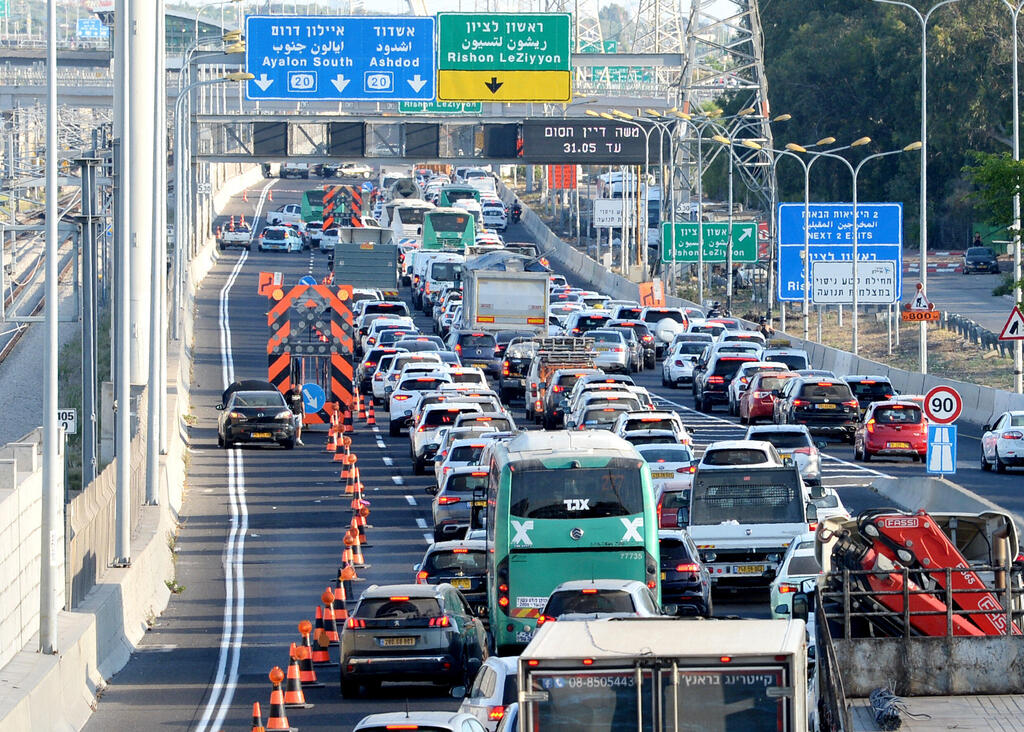
On Highway 44 near Tzrifin and the entrance to the Beit Dagan interchange, drivers often inch along at an average speed of just 5 kilometers per hour during the morning rush. That compares with a general average of about 25 kph and a posted speed limit of 80 to 90 kph.
The bottleneck is one of many that have turned traffic congestion into a nationwide problem. In response, Netivei Israel, the state-owned company responsible for planning and building highways, has issued 17 new tenders with a combined value of about 8 billion to 9 billion shekels ($2.1 billion to $2.4 billion). The projects aim to accelerate construction and ease major transportation choke points within the next few years.

Traffic congestion has worsened over time, not only in central Israel. With extensive public transportation construction expected over the coming decade, disruptions are likely to intensify, leaving many private car drivers traveling at little more than a brisk walking pace during peak hours.
Several of the largest projects target corridors where congestion is most severe. On Highway 44 between Beit Dagan and Ramla, average morning speeds are measured at about 25 kph, dropping to roughly 5 kph near the Beit Dagan interchange due to traffic lights and long wait cycles. In the afternoon, conditions improve slightly, with speeds of 30 to 50 kph, though congestion remains heavy near the exit from Beit Dagan toward Nir Zvi.
A planned upgrade to that section, with an estimated cost of about 2 billion shekels, includes a full overhaul of the highway, construction of two interchanges, removal of signalized intersections, lane widening and traffic separation. The project also includes a continuous public transportation lane, a bus terminal, bicycle paths and landscaping. Officials say the goal is to allow safer, uninterrupted traffic flow along a corridor serving rapidly growing residential and employment areas.
Highway 4, between the Hadarim interchange and Raanana South, is also among the most congested stretches in the country. Morning speeds there range from 10 to 25 kph, with travel times of up to 40 minutes for a roughly 9-kilometer segment, largely due to merging traffic from nearby interchanges and the connection to Route 531.
A project costing about 1.2 billion shekels will complete a continuous network of public transportation lanes from northern Sharon to central Israel and replace the Raanana Central junction with an interchange. The plan is intended to improve the speed and reliability of public transportation while reducing congestion on both urban and intercity roads.
Additional projects are advancing in the Sharon region, including a bypass around Kfar Yona and upgrades to Route 57, at a cost of about 2 billion shekels. Work is also planned to upgrade Highway 4 between Ilanot Forest and the Beit Lid junction. Morning speeds in that section currently range from 15 to 30 kph due to bottlenecks and frequent left turns. The plan includes eliminating intersections, adding public transportation lanes, grade separations and infrastructure for pedestrians and cyclists.
(Photo: Kobi Koankes)
Further projects are moving ahead on Highway 40, including a high-occupancy vehicle lane between Lod and Givat Brenner and upgrades to southern sections at a cost of hundreds of millions of shekels. Work is also planned on Routes 446, 60 and 89, where peak-hour speeds often fall below 30 kph.
Government officials stress that the initiatives are not an immediate solution. However, they say the scale of the investment and the accelerated tender process are intended to shorten timelines and gradually return time lost daily to congestion.
Transportation Ministry Director-General Moshe Ben Zaken said the state is acting on several fronts simultaneously. Alongside road improvements, he said, the government is investing in mass transit systems, expanding continuous public transportation lanes and increasing service frequency and connectivity.
“It is impossible to keep widening roads indefinitely,” Ben Zaken said. “To truly improve traffic in high-demand areas, there must also be a broad shift to public transportation that provides a real alternative to private vehicles.”
If construction proceeds as planned, officials say some of today’s most congested corridors could look very different within a few years. On Highway 44, for example, the full upgrade — including two new interchanges, lane expansions, a continuous public transportation lane, a bus terminal and bicycle paths — is expected to cost about 2 billion shekels.
Netivei Israel CEO Nissim Peretz said traffic volumes on many of the affected corridors far exceed their original design capacity, leading to low speeds and widespread congestion during peak hours.
“The new projects will allow much more continuous traffic flow, the removal of traffic lights and the construction of interchanges, alongside public transportation lanes that give real priority to passengers,” Peretz said.