

The New START treaty, the last remaining nuclear arms control agreement between Russia and the United States, expired two days ago. The pact limited the number of nuclear warheads the two countries could deploy on missiles, submarines and bombers. On Friday, in a series of posts on X, formerly Twitter, on the subject, US Undersecretary of State Thomas G. DiNanno revealed that China conducted a nuclear weapons test in 2020.
In the posts, DiNanno sharply criticized the conduct of Beijing and Moscow. “New START was signed in 2010 and its limits on warheads and launchers are no longer relevant in 2026 when one nuclear power is expanding its arsenal at a scale and pace not seen in over half a century and another continues to maintain and develop a vast range of nuclear systems unconstrained by New START’s terms,” he wrote.
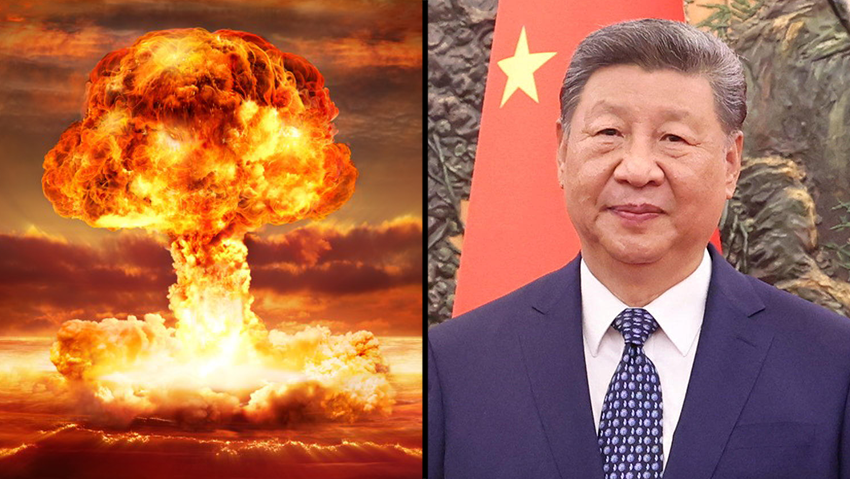
President Xi Jinping
(Photo: China Daily via REUTERS, Shutterstock)
According to DiNanno, “Almost all of the U.S. deployed nuclear forces were subject to New START while only a fraction of Russia's much larger stockpile was…exactly zero Chinese nuclear weapons were covered by New START.” He also issued a warning: “No longer constrained by the political-military circumstances of 2010 and the treaty they yielded and in response to the destabilizing behavior of these other countries, the United States can now finally take steps…to strengthen deterrence on behalf of the American people and our allies.”
DiNanno detailed the alleged Chinese nuclear test, which he said took place in 2020. “China has conducted nuclear explosive tests, including preparing for tests with designated yields in the hundreds of tons… China has used decoupling – a method to decrease the effectiveness of seismic monitoring – to hide its activities from the world. China conducted one such yield producing nuclear test on June 22, 2020,” he said. At the time, countries around the world were grappling with the COVID-19 pandemic, which broke out in China and spread globally.
He added that “this confluence of factors – serial Russian violations, growth of worldwide stockpiles, and flaws in New START’s design and implementation – gives the United States a clear imperative to call for a new architecture that addresses the threats of today, not those of a bygone era. As throughout our history, the United States has maintained a willingness to seek strategic stability and arms control arrangements that are verifiable, enforceable, and contribute to the security of the United States and her allies. What we are proposing is not talks for the sake of talks—with this effort, the United States is looking for meaningful progress based in concrete actions.”
China’s show of force near Taiwan, December 2025


The executive secretary of the Comprehensive Nuclear-Test-Ban Treaty Organization, which monitors nuclear activity worldwide, told CNN that no incident matching the profile of a nuclear test was identified on June 22, 2020, contradicting the US official’s claim. The organization’s head, Robert Floyd, said later analyses also did not determine that such a test took place.
Pentagon: China to reach 1,000 nuclear warheads by 2030
New START was signed in 2010 and capped the number of nuclear warheads that Russia and the United States were allowed to deploy operationally at 1,550, out of more than 5,000 each possessed, and limited their missiles and bombers to 800. Another provision allowed short-notice inspections at the powers’ bases to verify compliance, but those inspections stopped after the outbreak of the COVID-19 pandemic in 2020 and were never resumed. Russia announced in 2023 that it was ending inspections entirely, amid rising tensions with the United States and the West over the war in Ukraine, though it pledged to continue complying with the treaty’s limits.
The treaty’s restrictions were widely seen as a critical confidence-building measure between the nuclear powers and as a safeguard against a dangerous arms race. The agreement was originally set to expire in 2021, but when President Joe Biden entered the White House, he quickly reached an agreement with Russian President Vladimir Putin to extend it by five years.
Last month, President Donald Trump addressed the issue in comments that appeared to downplay its urgency, telling The New York Times that if the treaty were to lapse, it would do so, adding that a better agreement could be reached. Some have defended Trump’s call for a new treaty. Rafael Grossi, director general of the International Atomic Energy Agency, told The New York Times that the existing treaty does not address emerging technologies, including hypersonic missiles, underwater nuclear weapons and potential space-based arms.
During his first term, Trump also demanded that any new agreement replacing New START include limits on China, which is rapidly expanding its nuclear arsenal. Estimates put China’s stockpile at about 600 nuclear warheads, and the Pentagon assesses that the number will grow to 1,000 by 2030.
China’s arsenal remains far smaller than those of Russia and the United States, a disparity Beijing has cited in calling efforts to include it in such limits unreasonable. Still, the pace of China’s nuclear buildup has drawn Washington’s attention. A Pentagon report in December highlighted not only the growth of China’s long-range weapons, but also its highly accurate short-range systems, which could be used in a confrontation with Taiwan.