


Houthi attacks on Saudi Arabia escalated Tuesday, triggering alerts around Mecca and Jeddah for the first time in the current round of fighting, as well as in Taif, and raising new questions about the value of Riyadh’s recently signed defense pact with Turkey and Pakistan.
The attacks came after the Iran-backed Houthis reported a series of Saudi strikes in Yemen and vowed retaliation. But the symbolism of alarms sounding around Mecca is particularly striking. Islam’s holiest city, birthplace of the Prophet Mohammed and home to the Kaaba, also gave its name to the defense agreement signed just last month by Saudi Arabia, Turkey and Pakistan. Under the pact, an attack on one of the three countries is to be considered an attack on all of them.
Gallery
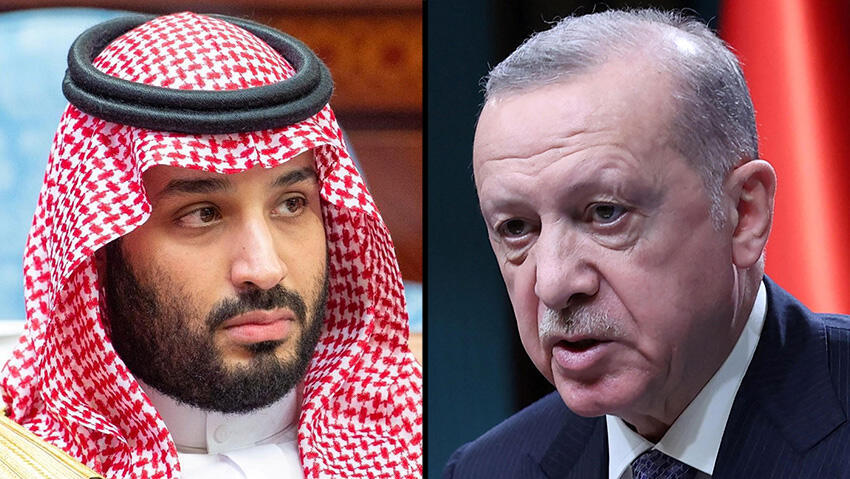
Turkish President Recep Tayyip Erdogan and Saudi Crown Prince Mohammed bin Salman
(Photo: AFP, Reuters)
So far, however, Riyadh’s two partners have limited their response to statements of condemnation and support rather than direct military assistance.
Pakistan’s Foreign Ministry issued a statement over the weekend strongly condemning drone attacks launched against Saudi Arabia’s East-West oil pipeline in the Riyadh and Medina regions, which damaged the pipeline and wounded civilians.
“The attacks and targeting of civilian infrastructure constitute a violation of international law and of Saudi Arabia’s sovereignty and territorial integrity, and pose a serious threat to peace, security and stability in the region,” the ministry said.
Islamabad reiterated what it called its firm support for Saudi sovereignty, territorial integrity, security and prosperity.
Turkey issued a similar condemnation after the pipeline attack, denouncing drones launched from Iraq against Saudi territory. “We reiterate our support for Saudi Arabia’s sovereignty and territorial integrity, and commend the Saudi authorities for their restrained approach aimed at preventing an escalation of regional tensions,” Ankara said.
A day later, Saudi Crown Prince Mohammed bin Salman spoke by phone with Pakistani Prime Minister Shehbaz Sharif. Riyadh said they discussed efforts to reduce regional tensions, and that Sharif condemned the Houthi attacks and praised Saudi restraint.
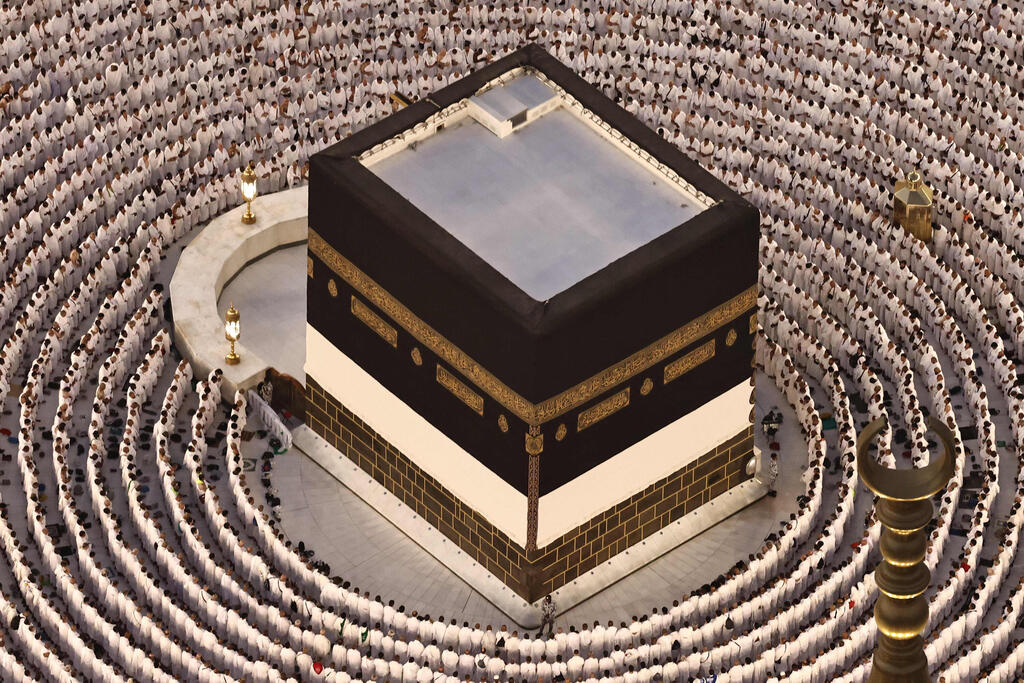
The Kaaba in Mecca
(Photo: Zain JAAFAR / AFP)

Houthi rebels in Sanaa, Yemen
(Photo: AP)
The attacks, however, have continued. Alerts were reported around 1 a.m. Tuesday in Abha and Khamis Mushait, followed later by warnings in AlUla, Jazan, Abha, Jeddah, Taif and Yanbu.
Turki al-Maliki, spokesman for the Saudi-led coalition backing Yemen’s internationally recognized government, said the Houthis were continuing to attack civilian targets inside Saudi Arabia.
He said missile and drone strikes on Khamis Mushait, Abha and Taif on Monday lightly to moderately wounded 13 civilians and damaged seven homes and two vehicles.
Dr. Yoel Guzansky, a former Israeli National Security Council official and senior researcher who heads the Gulf program at Israel’s Institute for National Security Studies, said the alerts around Mecca carried unusual symbolic significance.
“This is both the most important city in Islam and the place where, a month ago, the ‘Mecca alliance’ was signed, which is supposed to protect Saudi Arabia,” Guzansky told ynet.
“We see the two other countries that signed the alliance, Pakistan and Turkey, making excuses. One of the excuses is that the agreement has not been ratified. That shows they did not think it through, at least on the Turkish and Pakistani sides.”
He said Riyadh was disappointed enough that Mohammed bin Salman was now turning to Egypt and President Abdel Fattah el-Sisi for support.
“I think this is a catastrophe from the Saudi perspective,” Guzansky said. He argued that a series of Saudi moves had helped create the current crisis, including the expulsion of Emirati forces from Yemen, Saudi attacks on forces loyal to the United Arab Emirates, threats to retake Hodeidah and even Sanaa, and troop buildups along the border.
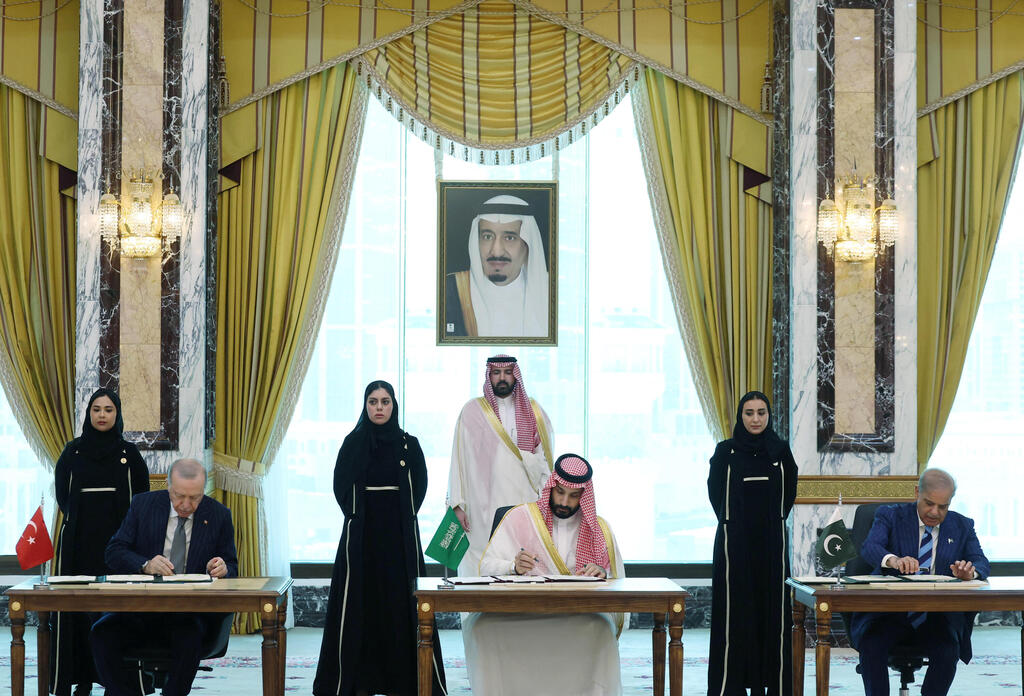
Signing of the agreement in Mecca last month
( Photo: Murat Cetinmuhurdar/Turkish Presidential Press Office/Handout via REUTERS )
Saudi attacks in Iraq in late July were followed by strikes on the East-West pipeline, he noted, while Houthi advances in Yemen have now given the group effective control over the Bab el-Mandeb Strait.
“They are in strategic embarrassment, and this is a terrible Saudi military failure,” Guzansky said. “Bab el-Mandeb has been taken from them. Saudi oil exports are now blocked through Hormuz and Bab el-Mandeb, and the Houthis are also threatening the northern Red Sea.”
‘Israel should help quietly’
Guzansky argued that Israel should offer discreet assistance to Saudi Arabia, but avoid launching independent military operations against the Houthis as long as Israel itself is not being attacked.
“As long as the Houthis are not attacking us now, there is no need to give them a reason to attack us,” he said.
He said Israeli assistance could include missile-defense capabilities, but should be provided quietly to avoid embarrassing Riyadh or provoking further regional opposition. “Imagine an Israeli system protecting Mecca and Medina against attacks by other Muslims,” he said. “That would be a greater achievement than many others we could seek.”
He added that Israel should not make normalization with Saudi Arabia a condition for assistance. “First of all, help them now, quietly,” he said, while warning against deploying Israeli naval forces to Bab el-Mandeb and becoming directly entangled in the fighting.
The escalating confrontation between the Houthis and Saudi Arabia comes as Yemen’s civil war has also resumed after roughly four years of reduced fighting.
Houthi forces made major gains last week, rapidly seizing large stretches of Yemen’s southwestern coastline and effectively taking control of the strategic Bab el-Mandeb Strait, one of the world’s most important maritime chokepoints.
The fighting has triggered large-scale displacement. The UN refugee agency said Tuesday that more than 100,000 people had now been displaced within Yemen, while thousands more had fled across the sea to Djibouti in the Horn of Africa. “Humanitarian access remains a significant challenge,” the agency said, citing insecurity, damaged roads, communications disruptions and restrictions on movement.
For Saudi Arabia, the escalating attacks are now testing far more than its defenses. They are also exposing how much practical support Riyadh can expect from a military alliance that, only a month after being signed in Mecca, has yet to show that its promise of collective defense extends beyond declarations of solidarity.