


A new report by IMPACT-se, an international research and policy institute that reviews school curricula worldwide, found that Palestinian textbooks for the 2025–26 school year remain largely unchanged and continue to include extensive anti-Israel and antisemitic incitement, despite explicit commitments made by Palestinian Authority President Mahmoud Abbas to the United States, the European Union and French President Emmanuel Macron.
The 400-page report, released from the institute’s offices in London, analyzed 290 textbooks and 71 teacher guides across all subjects and grade levels, from first through twelfth grade, in schools in the West Bank, Gaza and east Jerusalem. The findings, the researchers said, show a consistent pattern: the incitement persists, the hostility continues and promised reforms were not implemented.
Gallery
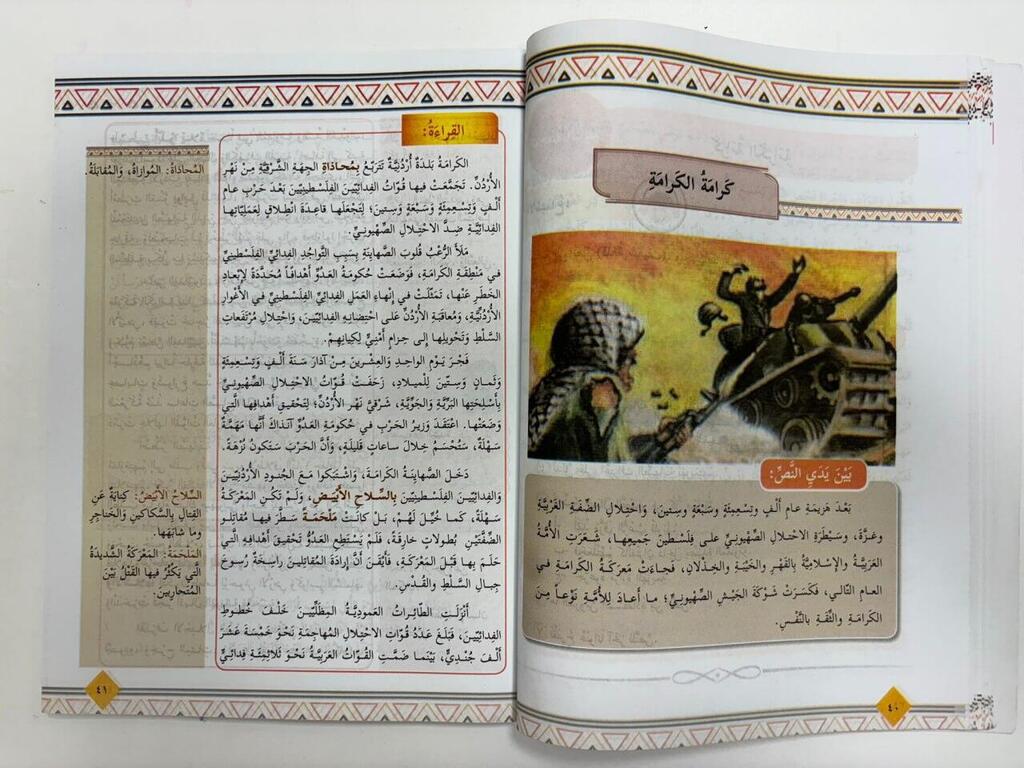
An Arabic language textbook that drills reading comprehension and grammar through a grotesque text praising suicide bombers
In Arabic language materials, the report cites a poem urging students to “return to the cities of Israel with weapons in hand,” which the researchers say echoes the violence of the October 7 attacks. Another Arabic textbook for eighth grade uses reading comprehension exercises that praise suicide bombers, describe attackers “wearing explosive belts,” and glorify Palestinians “cutting the throats of Israelis,” alongside illustrations of Palestinians shooting Israeli soldiers. Fifth-grade students study Dalal Mughrabi, who led the 1978 Coastal Road massacre that killed 38 Israeli civilians, including 13 children, as a heroic role model.
An Islamic education textbook includes a lesson portraying Jews collectively as immoral, dishonest and manipulative. A Palestinian civics book produced by the Palestinian Authority omits Israel entirely from its maps and teaching materials.
The report also found that core science subjects are used to normalize violence. Newton’s laws of motion are taught in a seventh-grade science book through an illustration of a child firing a slingshot. An eleventh-grade biology lesson on the bladder and nervous system is paired with an image of a Palestinian boy depicted as having been shot by Israeli soldiers. Chemistry lessons include references to “chemical solutions” used by Palestinian prisoners on hunger strike.
A Palestinian history textbook portrays the United States as an “evil empire,” according to the report.
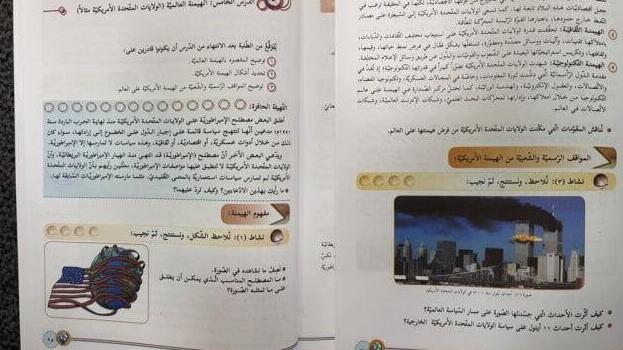
A Palestinian history textbook portrays the United States as an 'evil empire'
Beyond the educational content, the findings raise political concerns tied to promises the Palestinian Authority made to the European Union. In July 2024 the PA signed a reform agreement with the EU that included commitments to remove incitement from textbooks. The EU publicly pledged that textbooks for grades 1 through 4 and grade 12 would be fully cleared of problematic material by September, the start of the school year. Last month Dubravka Šuica, the EU commissioner responsible for funding to the PA, said that money had been released based on effective implementation of these reforms.
However, IMPACT-se researchers say the 2025–26 textbooks remain almost entirely the same as previous years, aside from minor design edits and slightly shortened volumes that do not change the underlying content.
Marcus Sheff, the institute’s CEO, and Eric Agassi, its deputy CEO, stressed that while Palestinian officials tell American and European partners that reforms have been completed, the printed textbooks and the official online portal of the Palestinian Education Ministry reveal otherwise.