

Former Mossad chief David Barnea revealed new details Thursday about Israel’s military operation against Iran and the 2024 explosive pager attacks targeting Hezbollah operatives in Lebanon, describing how Israeli intelligence sought to protect its agents inside Iran, the tense minutes before the pagers detonated and the strategic calculations behind both operations.
Speaking at the Priority Summit conference, Barnea said the Mossad deliberately released an official video showing its operatives conducting missions inside Iran on the opening morning of Operation Rising Lion, Israel’s June 2025 military campaign against Iranian nuclear and military targets.
Footage released by the Mossad at the start of Operation Rising Lion in June 2025 shows Israeli intelligence operatives conducting covert missions inside Iran. Former Mossad chief David Barnea said the video was deliberately published to trigger mass arrests and make it harder for Iranian authorities to identify actual Israeli agents
(Video: Mossad)


The video, which prominently displayed the Mossad’s insignia, was intended not merely to publicize the operation but to overwhelm Iranian security services with potential suspects, making it harder to identify actual Israeli agents, he said.
“One of the reasons we immediately released an official video on the morning of Operation Rising Lion, with the Mossad logo, was to protect the agents who were there,” Barnea said. “We wanted to make sure they arrested so many people in Iran that they wouldn’t be able to separate the wheat from the chaff and would eventually release everyone. Incidentally, that is exactly what happened.”
According to Barnea, Iranian authorities arrested 21,000 people on the second day of the fighting.
“You have to imagine that when you arrest 21,000 people, even if you’ve caught an agent or two, eventually you have to release them because everyone’s story will be the same: I was walking down the street, I was driving a car, they arrested me,” he said. “And in the end, they released everyone.”
The figures and the account of the releases could not be independently verified.
Barnea also said some of those arrested or executed in Iran on allegations of working for Israeli intelligence had never been associated with the Mossad.
“Some of the people being hanged in Iran on accusations of being Mossad agents — I have to ask who they are,” he said. “They tell me, ‘Listen, we don’t know either.’”
He described them as innocent people whom Iranian authorities had wrongly identified as Israeli operatives.
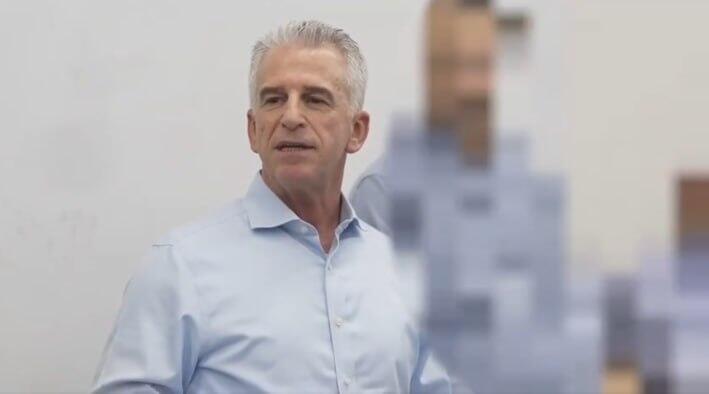
Former Mossad chief David Barnea
(Photo: Mossad)
“Just unfortunate people whom they decided were our agents, but who never worked for the Mossad, and probably never worked for any other intelligence organization either,” he said.
Barnea claimed that 99.9% of Mossad agents had never been exposed.
He said operatives who participated in the campaign continued to live in Tehran, despite their involvement in the Israeli operation.
“I can’t tell you they’re here with us, but they’re there in Tehran, still living their good lives, knowing in their hearts that they served a noble purpose — not for the State of Israel, but for themselves,” he said.
Agents knew of Iran attack weeks before Israeli pilots
Barnea described the extraordinary secrecy surrounding the preparations for Operation Rising Lion, saying that even Israeli fighter pilots were unaware of their impending missions when they were summoned to their squadrons.
“Nobody in the world knew we were going to attack in Operation Rising Lion,” he said. “And to tell the truth, even our pilots didn’t know they were going to attack when they were called to their squadrons.”
By contrast, he said, dozens of Mossad operatives had been deployed inside Iran weeks before the operation, fully aware of their assignments and the impending military campaign.
“But many dozens of our agents were dispatched knowing they were going to carry out an operation, weeks before it began,” he said. “And they kept that secret entirely to themselves, in their hearts.”
Barnea said he personally approved every operative assigned to the mission, accepting responsibility for their reliability and their ability to maintain secrecy.
“Every one of those agents had to receive the green check mark that I personally had to give each one,” he said. “I meet them, I talk to them, I hug them, I encourage them, and I have to trust them.”
He said the stakes extended far beyond operational success.
“You have to sign off that this secret won’t leak,” he said. “When I say I sign off on each one, I’m staking my head on it.”
‘What happens if it doesn’t work?’ Netanyahu asked before pager attack
Barnea also offered a detailed account of the final minutes before the September 2024 operation in which thousands of pagers used by members of Hezbollah, the Iran-backed Lebanese terrorist group, exploded nearly simultaneously.
The attacks, followed a day later by explosions involving Hezbollah walkie-talkies, killed and wounded people across Lebanon and severely disrupted the organization’s communications network.
Barnea said he was sitting in the underground military command center at 3:20 p.m., alongside Prime Minister Benjamin Netanyahu, the defense minister, the IDF chief of staff and the head of Military Intelligence.
The operation was scheduled to begin at 3:30 p.m.
“The prime minister turns to me and says, ‘Tell me, what happens if it doesn’t work?’” Barnea recalled.
He said it was the first time he had seriously contemplated that possibility, just 10 minutes before the operation was to begin.
“My heart is pounding, and I tell him, ‘There’s no such possibility. Everything is fine,’” Barnea said. “After that, I had 10 whole minutes of thinking, ‘What a stupid thing I just said.’”
When the designated time arrived, everyone in the room turned toward him, expecting immediate confirmation that the devices had detonated.
But Barnea said there was no way to know instantly whether the operation had succeeded.
“What did you expect to hear, a boom? It doesn’t work that way,” he said. “We’ll hear about it in half an hour, maybe, and even then we’ll start hearing about it on the news.”
He said the officials continued demanding updates despite his inability to provide immediate answers.
“They want to know here and now what’s happening, and I have no way to put their minds at ease,” he said.
The first reports eventually arrived through Mossad intelligence sources, followed by news coverage. Only then, Barnea said, did he know the operation had succeeded.
Hundreds of tests and a debate over civilian casualties
Barnea said the Mossad conducted hundreds of experiments before carrying out the pager operation, using mannequins filled with materials designed to simulate the human body.
He described repeatedly demanding reductions in the amount of explosives placed inside the devices to limit the risk of harming people near the intended targets.
“Every time I watched a test, I would say, ‘Reduce the amount of explosives,’” he said.
Barnea said he considered the potential deaths of family members of Hezbollah operatives an unacceptable consequence of the operation.
“I, on behalf of the State of Israel, cannot accept the possibility that the daughter of a Hezbollah terrorist, or his son, or his wife, would be harmed because we want to eliminate him,” he said.
According to Barnea, members of the operation’s planning team repeatedly warned that his restrictions would make the devices less effective.
“They kept telling me I was making the operation ineffective,” he said. “I told them, ‘We have red lines.’”
The former intelligence chief said the resulting large number of injuries, compared with the number of fatalities, was consistent with the operation’s intended effects.
“It’s true that not all of them die, and that has a very significant advantage,” he said.
Barnea claimed that 4,500 people with missing limbs were now living in Dahieh, Hezbollah’s stronghold in Beirut’s southern suburbs, describing their injuries as a continuing warning to the organization.
“There are 4,500 people walking around Dahieh missing limbs, and they are the best reminder I can imagine of what happens to a Hezbollah terrorist who tries to harm the citizens of the State of Israel,” he said.
Barnea identified three principal effects of the operation on Hezbollah.
The first was the direct physical harm inflicted on its operatives. The second was the damage to the organization’s morale and its ability to function as a fighting force.
“Anyone who has commanded people in the military understands that when morale is broken, you have no one to work with,” he said.
The third effect, he said, was fear and uncertainty, intensified when Hezbollah’s walkie-talkies exploded the following day.
Asked whether Israel had prepared a third operation involving compromised devices, Barnea declined to answer, suggesting that uncertainty itself served an important strategic purpose.
“I can’t answer that, but the very question going through your minds right now is still going through theirs,” he said.
He compared the psychological impact to Japan’s uncertainty following the U.S. atomic bombings of Hiroshima and Nagasaki in August 1945.
“After Hiroshima and Nagasaki, the Japanese leadership said, ‘Wait, maybe the Americans have a third bomb, and maybe a fourth and fifth, so perhaps we should surrender,’” Barnea said.
“After the first bomb, you think maybe that was the only one. After the second, you’re not sure whether there’s a third.”
Barnea: Israel was deterred by Iran before 2024 missile attacks
Barnea also acknowledged that Israel had been deterred by Iran’s military capabilities before Tehran launched two major direct attacks against Israel in April and October 2024.
Those attacks marked an escalation in the longstanding confrontation between the two countries, with Iran firing large numbers of missiles and drones toward Israel.
Barnea described the attacks as “two historic strategic mistakes” by Tehran, arguing that they exposed capabilities that Israel had previously regarded with considerable uncertainty.
“We have to tell the truth. Before those attacks, the State of Israel — we — were deterred,” he said.
He explained that Israeli officials had lacked a clear understanding of the effectiveness of Iran’s long-range precision missiles and whether Israeli and American air defense systems could withstand a large-scale attack.
The strikes, he suggested, helped resolve some of those uncertainties, altering Israel’s assessment of the threat posed by Iran.