


In Israel and the United States, officials say the war is expected to continue for several more weeks. Yet the nature of the strikes suggests that the main objectives may already have been largely exhausted. The opening blow in Iran began with the elimination of the Islamic Republic’s top security leadership — including Supreme Leader Ali Khamenei — in less than a minute.
From there, the IDF moved on to strike Iran’s air defense systems in order to establish aerial superiority over the country, as well as its ballistic missile array, which had attempted to target Israel’s civilian rear. Alongside these efforts, the IDF continued striking additional targets listed in its “target bank,” which was continuously updated as the war progressed.
But now, nearly three weeks after the outbreak of the war, it appears that the Israeli strikes in the operation’s early days — and especially the opening salvo — were directed at the most important targets in that bank. As the days passed, the importance of the targets being struck appeared to decline, while disagreements about them increased.
For example, the United States was reportedly dissatisfied with Israel’s decision to strike fuel depots in Tehran. Overnight between Sunday and Monday, the IDF struck the aircraft used by Khamenei, which had been parked at Tehran’s Mehrabad Airport — a site already bombed nearly two weeks ago.
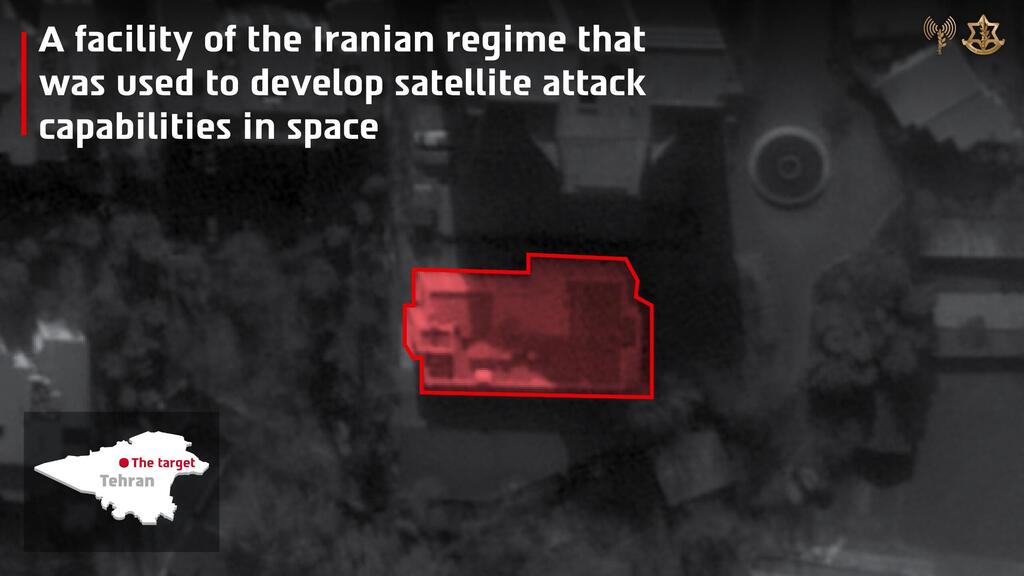
It should be emphasized that these targets remain highly significant in the broader campaign and are intended to help Israel achieve the war’s objectives. One example was the destruction of an Iranian center used to develop satellite attack capabilities in space, which the IDF said “posed a threat to Israel’s satellites and to the space assets of other countries.”
The United States, for its part, has increased the pace of its strikes against the Iranian navy and is now focused on preventing Iran from blocking the Strait of Hormuz. The understanding in Washington is that if Tehran succeeds in halting the war through such a move, it would gain a bargaining chip that could be used for years against the global economy.
Yet none of these efforts are directly tied to the war’s central objectives, which Prime Minister Benjamin Netanyahu defined as “damaging the ballistic missile program and the nuclear capabilities.”
For now, Iran’s most significant nuclear capability — about 450 kilograms (nearly 1,000 pounds) of uranium enriched to 60 percent, which can quickly be enriched to weapons-grade levels — remains intact. The containers holding the material are still buried at a site in Isfahan that the United States bombed during Operation Rising Lion. Iran’s ballistic missile capabilities have been degraded, but Tehran has already shown it can restore its production capacity, even though its launch rate is currently lower than during the previous operation.

Strikes in Isfahan
As a result, the nature of the targets struck in recent days suggests that the main objective of the current campaign — at least from Israel’s perspective — may be to undermine the regime itself, rather than to focus primarily on facilities with strategic value.
So far, those efforts have not met with significant success, though the dynamics of coups and regime collapse are inherently unpredictable. It is also possible that the war is continuing while both sides prepare for a much larger operation — for example, seizing the enriched uranium buried in Isfahan, or carrying out a long-term effort to damage Iran’s ability to threaten the global economy. Another possibility is that forces are waiting for an operational opportunity to strike a “golden target.”
'It's much less important where the bombs land'
“The term ‘target bank’ is somewhat misleading,” Brig. Gen. (res.) Eran Ortal, head of the military studies program at the Begin-Sadat Center for Strategic Studies at Bar-Ilan University and a visiting research fellow at the American Foreign Policy Council, told ynet.
“Before a war, you collect as many targets as possible. Some are meant, for example, to reduce the surface-to-surface missile array; others are nuclear, industrial or production-related targets. But the more operationally efficient you are, the more that ‘target bank’ begins to run out.”
Strike in Tehran during Iran’s Jerusalem Day celebrations


Ortal, who previously commanded the Dado Center for Interdisciplinary Military Studies in the IDF Operations Directorate, explained that adjustments are made to that “target bank” during combat.
“Things happen during the fighting,” he said. “You don’t start with a warehouse of munitions and targets and simply see both run out over time. In combat, the enemy tries to adapt and change — and you have to adapt in response. You also learn things you didn’t know before, and you need to act accordingly.”
In this war, Ortal stressed, “it is completely clear that the effort to create conditions for the fall of the regime is not directly related to how many targets you strike. In other words, there is no list of 100 percent of targets that, if you hit them all, the regime will fall.”
He added that the goal of the strikes — even more than destroying the targets on the ground — is “to damage the cohesion of the regime’s frameworks and the determination of its commanders, while boosting the confidence of citizens watching from the sidelines.”
 Brig. Gen. (res.) Eran Ortal Photo: Courtesy
 To achieve that, he said, “it matters far less where the bombs land — what matters more is that people see them landing.”
“This is not the logic of a ‘target bank’ at all. Whether the mechanism of damaging cohesion, weakening commanders’ determination and strengthening citizens’ confidence will work — we don’t know. At some point there will be a situational assessment and a decision whether to continue.”
Ortal added that “to create the kind of domino effect that would significantly undermine the regime’s stability, there is no target bank. For that purpose, almost any object on Iranian soil can become a target. As long as that is the objective, there are virtually endless relevant targets in Iran.”
As for the “target bank” that does exist and is updated during the fighting, he explained that after all the warehouses, sites and launch trucks known in advance to the IDF were struck, “the enemy found new storage points for what survived and is positioning itself in different locations. So now the effort is to find those points and strike them.”
“New targets emerge during a war. For example, if the Basij militia positions itself in schools, that wasn’t in the bank before the war. Targets are also created based on what we learn about the enemy’s logistics chain.”
Regarding U.S. efforts related to the potential closure of the Strait of Hormuz, Ortal said that “the United States has a problem there, because it cannot find all the drones, coastal missiles and Iranian capabilities in that area.”
“On the other hand, Iran is essentially draining its own ammunition reserves. So it may be that the American idea right now is to allow the Iranians to launch everything already in their launchers, but to block the supply chain that has adapted itself to wartime conditions. In other words, American analysts are now sitting with satellite images and drones in the air, trying to determine how to disrupt the supply chain feeding the blockade of the Strait of Hormuz. That involves an entire set of air operations — and at the far end of it, strikes on targets that did not exist before.”
US strike near the Strait of Hormuz
(Video: X)
Regarding Iran’s nuclear program, where about 450 kilograms of enriched uranium are stored, Ortal said that in this respect the material will likely remain where it is.
“Even if by some miracle we were to take it, the wounded beast that is Iran would always have the option of obtaining nuclear weapons somewhere else. That’s why I think Israel will try to exhaust and maximize the chances that this regime collapses — especially as long as the Americans are with us. That is the only thing that will guarantee the nuclear threat does not return.”
In conclusion, he said, “the description of a ‘target bank’ is somewhat misleading, because there is no final tally here. Even hitting 100 percent of that bank — which is constantly being replenished — does not necessarily achieve the war’s goals. Therefore, when it comes to the regime itself, we will continue striking as long as we believe there is a chance this could happen.”