

A report by the international research and policy institute IMPACT-se examining the content of Syrian school textbooks has attracted extensive coverage in Syria and across the Arab world in recent days, raising questions about growing religious extremism in a country that will mark two years since the fall of Bashar Assad's regime next month.
The report gained traction on social media largely thanks to an exiled Syrian journalist named Mohamed Al Salloum, who shared the institute's findings as though they were his own before eventually acknowledging that he had not produced the original research. Amid the widespread debate, Syria's Education Ministry issued a response to the report, authored by three Israeli researchers, and the controversy reached parliament in Damascus.
Gallery
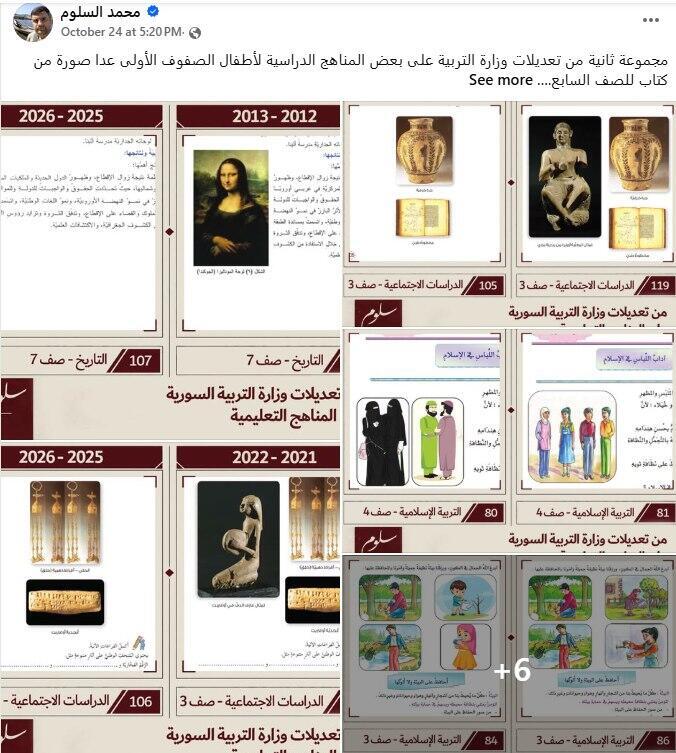
Examples of changes to Syrian textbooks reflecting growing religious extremism
(Photo: IMPACT-se)
IMPACT-se, which researches and analyzes school textbooks worldwide according to UNESCO standards, published the report on October 19 under the title "The New Syria: Education Under al-Sharaa, Review of Syria’s National School Curriculum, 2025–2026."
The 241-page report, authored by three Israelis — Dr. Yonatan Negev, Matan Perchikov and Itam Shalev — examined 130 textbooks from Syria's national curriculum for the 2025-2026 academic year, the first under Syrian President Ahmed al-Sharaa.
The textbooks, covering grades 1 through 12 across a range of subjects, were compared with earlier editions used under the Assad regime. According to the researchers, the changes offer insight into the new Syrian government's intentions and priorities in shaping the national curriculum.
Among its findings, the report states: "The findings reveal a broad ideological transformation of the Syrian curriculum. Assad-era Ba’athist, pan-Arabist, and Syrian-national content and narratives have been substantially replaced by concepts of Islamist political ideology, Sunni Muslim exceptionalism, and pan-Islamist nationhood. Across subjects and grades, the curriculum redefines Syrian identity, historical memory, and regional relations through a framework grounded in Sunni-Muslim Arab identity that marginalizes religious and ethnic minorities, rejects gender equality and restricts women’s roles in society, normalizes violent conflict against the Other rather than seeking peaceful resolution, and limits exposure to pluralism and coexistence."
The report also says Jews are depicted "in demonizing terms, denied collective history and often portrayed through antisemitic tropes in their conflicts with the Prophet Muhammad and the early Muslims."
According to the researchers, "History textbook includes a passage that seeks to undermine Jewish peoplehood and the Jewish historical connection to the land. It characterizes Jews as “a mixture of peoples, not a single nation'"
The report further finds that Israel's very existence is denied, the country is described as an enemy and Palestinian violence against Israel is consistently justified and glorified.
"Historical peace agreements with Israel are presented in a negative light. Interest in the Golan Heights as a Syrian national issue has declined and it is now framed as one of many occupied Muslim lands," the report states.
The researchers also emphasize that jihad and shahada (martyrdom) are presented as core elements of identity and as legitimate, sometimes even desirable, ideals. Whereas these concepts were previously framed in the context of defending the homeland, they are now presented as sacrifice "for the sake of Allah."
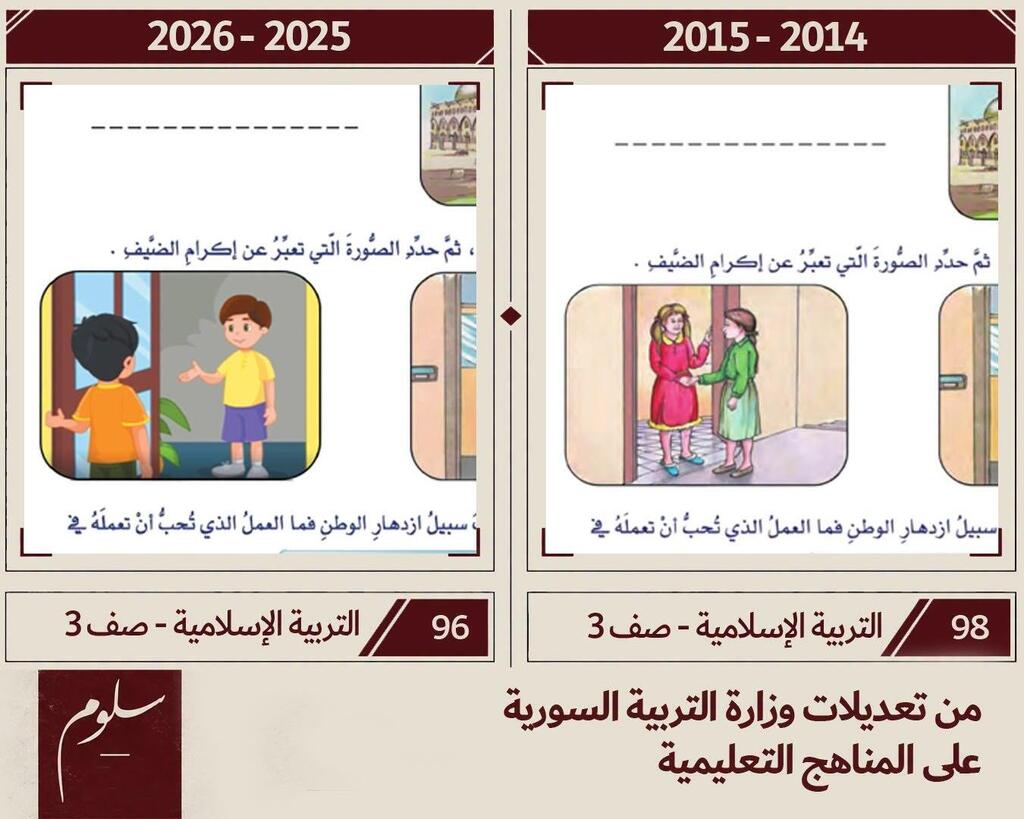
A broad ideological transformation of the Syrian curriculum
(Photo: IMPACT-se)
Among those who came across the report was Syrian journalist Mohamed Al Salloum, who, according to social media accounts, currently lives in Lyon, France.
On October 24, he wrote on Facebook: "The Syrian Education Ministry has published a textbook intended for sixth-grade students. The book is not new. In fact, it is a reprint of an older edition originally published for the 2012-2013 academic year.
"The earlier version underwent several changes: Content related to the former regime was removed, as were lessons dealing with local government, political life, citizenship, the media and democratic participation. The ministry even went so far as to alter the images appearing in the book."
Al Salloum attached images showing how Syria's Education Ministry had removed depictions of women and added hijabs, or Islamic head coverings, to female figures. Later that day, he published another collection of images highlighting additional changes made by the ministry, without identifying the source of the images or the original findings.
On October 25, Al Salloum published another post clarifying his position.
"The images I published on my account regarding changes to the Syrian curriculum include complete and accurate documentation, including page numbers from both editions, the publication dates as printed on their covers and the names of the subjects," he wrote.
"Therefore, it is best to refrain from claiming these are old books or previous editions. We are not playing games here. As for images that have been edited, cropped or generated using artificial intelligence, I have nothing to do with them and bear no responsibility for them. Let me emphasize once again: I am responsible only for what I publish on my personal account, nothing more and nothing less."
He subsequently published a third collection of images.

Bashar Assad and Ahmed al-Sharaa. Growing religious extremism
(Photo: Alexander Zemlianichenko / POOL / AFP)
The exiled journalist's posts gained widespread attention across Arab social media, including in Syria.
One Syrian website reported: "Journalist Mohammed Al Salloum raised questions about changes made to some textbooks approved for use in Syrian schools. He published observations about alterations to images, illustrations and educational content."
The report continued: "Through his personal Facebook page, Al Salloum reviewed a series of changes that, according to him, included the removal of images of women, the addition of hijabs to female figures and the removal of images of statues and works of art, some of which were replaced with other illustrations. These changes raise questions about the standards adopted in reviewing textbooks."
Amid the growing debate, Syrian television quoted a source at the Education Ministry on Oct. 25 who defended the curriculum.
"Since liberation [the fall of Assad], we have made only one minor adjustment to the Syrian curriculum," the source said.
"The Syrian curriculum is diverse. It reflects the diversity of society and takes into account its various cultures and communities. Contrary to what is being circulated on social media, the Syrian curriculum does not adopt any particular character or ideological direction.
"The ministry will begin developing new curricula once the Supreme Council for Education approves the new standards prepared by the ministry. These new curricula will contribute to advancing education and improving educational outcomes."
'I initially planned to avoid mentioning the report'
Several hours later, Al Salloum acknowledged on Facebook that his comparisons were based on research conducted by others.
"The comparisons I have presented, and will continue to present, regarding the Syrian curricula are not my own invention," he wrote.
"At the beginning of this project, I relied on a comprehensive research report published recently that examines changes made to the Syrian curriculum. In this post, I will discuss that report.
"I initially planned to avoid mentioning the report until I had finished publishing my comparisons, out of concern that the discussion would shift away from the changes themselves, as they appear in the textbooks, toward the organization that authored the report and its underlying motives.
"What did I actually do, given that the report already exists? I examined the old and new versions of the textbooks and independently verified the changes."
Al Salloum added: "Every image I shared was taken directly from the original textbooks, not from the report. During my research and comparisons, I discovered many additional changes that were not mentioned in the report. I have already shared some of them, and more will follow.
"I also identified errors in the way some comparisons were documented in the report, mainly concerning page numbers and sometimes even the identification of the textbook itself. This required additional research to locate the original texts.
"Furthermore, parents and teachers contacted me privately and shared additional examples, which I found very moving. The changes themselves exist in the Education Ministry's textbooks, and anyone can examine them to verify the facts."
Responding to the Syrian Education Ministry's statements, Al Salloum wrote on Facebook on Oct. 26: "What I have already shared, and what I intend to share in the future, provides conclusive evidence that the ministry's response is pathetic. These revisions do not in any way reflect the diversity of Syrian society or strengthen the representation of its various communities and cultures."
The controversy subsequently drew responses from Syrian lawmakers.
Four members of parliament — Ali Dawoud, Yasser Shehadeh, Ibrahim al-Abdullah and Lina Aizouki — said that, as part of their responsibility to voice citizens' concerns and convey them to the relevant authorities, they had held consultations on the issue.
They said the curriculum adopted for the coming academic year would undergo revisions, with sections found to lack a sound scientific or educational basis to be corrected.
The lawmakers called on citizens to exercise restraint and engage in responsible dialogue. They also stressed that schools should be places that foster critical thinking, promote civic values and respect diversity.
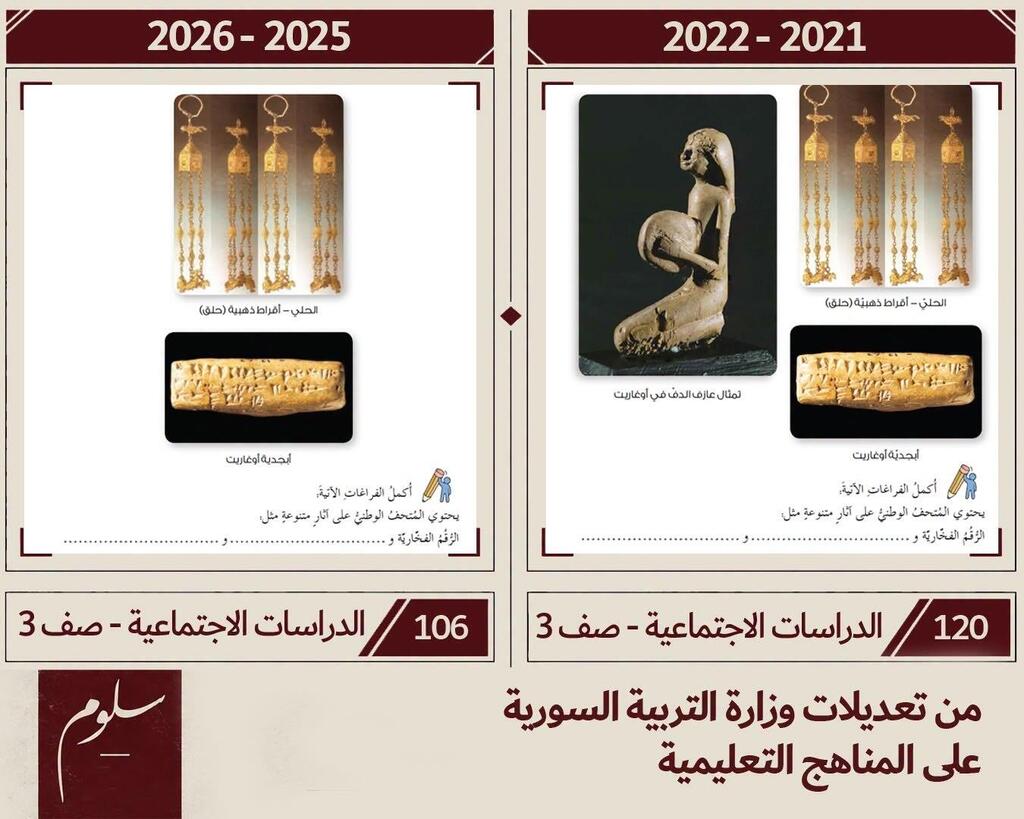
Sacrifice 'for the sake of Allah'
(Photo: IMPACT-se)
Arik Agassi, deputy director and head of international partnerships at IMPACT-se, told ynet that the international research institute maintains an office in Israel.
Discussing the extensive coverage of the report in the Arab world, Agassi said the Syrian journalist had not contacted the institute.
"We saw significant reactions in terms of the attention it generated," Agassi said. "Very quickly, it reached the [Syrian] parliament, and the Education Ministry issued a response.
"This is not the first time the Education Ministry in Damascus has responded to our reports. Even during the Assad era, they addressed our findings. But the amount of follow-up coverage in the Arab media was certainly more unusual."
Regarding Al Salloum's claims of inaccuracies, Agassi said the allegations were unfounded and invited the exiled journalist to specify the errors he believed he had found.
According to Agassi, Al Salloum had simply "copied and pasted" material from the report without adding any original findings of his own, contrary to what he claimed in his Facebook posts.
"The uproar in Syria following our research demonstrates just how crucial education is in shaping the future of nations," Agassi said.
"As an international research and policy institute, IMPACT-se works with governments and education ministries across the Middle East to advance curriculum reforms, recognizing that textbooks do not merely reflect reality — they shape the next generation.
"The same books that can perpetuate hatred and conflict can also lay the foundations for peace, build mutual trust and shape a generation that believes in tolerance and coexistence. This is true for Syria, and it is true for every country in the region."
Marcus Sheff, CEO of the international research and policy institute IMPACT-se, also welcomed the response to the report within Syria.
"It is particularly encouraging to see educators, civil society organizations and members of parliament in Syria itself expressing concerns similar to those raised in our research," Sheff said.
"The future of the new Syria will also be determined in its classrooms. A Syria that wants to build a future of stability and peace needs education free of antisemitism and incitement, education that guarantees equality for women, respects all religions and communities and makes room for science, critical thinking and a shared Syrian identity.
"One exclusionary ideology must not be replaced with another."