

For Opher Dubrovsky, the ordeal aboard the Flydubai flight did not end when passengers subdued the co-pilot accused of trying to crash the plane.
Dubrovsky, who was returning to Israel after a trip to Kathmandu, was seated in 8C near the front of the aircraft. He fell asleep after takeoff and woke to shouting as the crisis unfolded.
Opher Dubrovsky


In an interview with the YouTube channel Captain Steve, he described the struggle inside the cockpit, the unexpectedly smooth emergency landing in Saudi Arabia, his wife’s efforts to calm panicked passengers and how he later bought SIM cards for Israelis who were unable to contact their families.
“Everything was normal until that moment,” Dubrovsky recalled.
“Luckily, the woman sitting in front of me went to the bathroom at the front of the plane, heard shouting and said to the flight attendant, ‘What’s going on? We have to check.’ They opened the cockpit door and saw blood everywhere. She started screaming. That got everyone moving, especially her husband, who ran toward her. People around me rushed forward, and I joined them to help. We immediately understood that the co-pilot had stabbed the captain.”
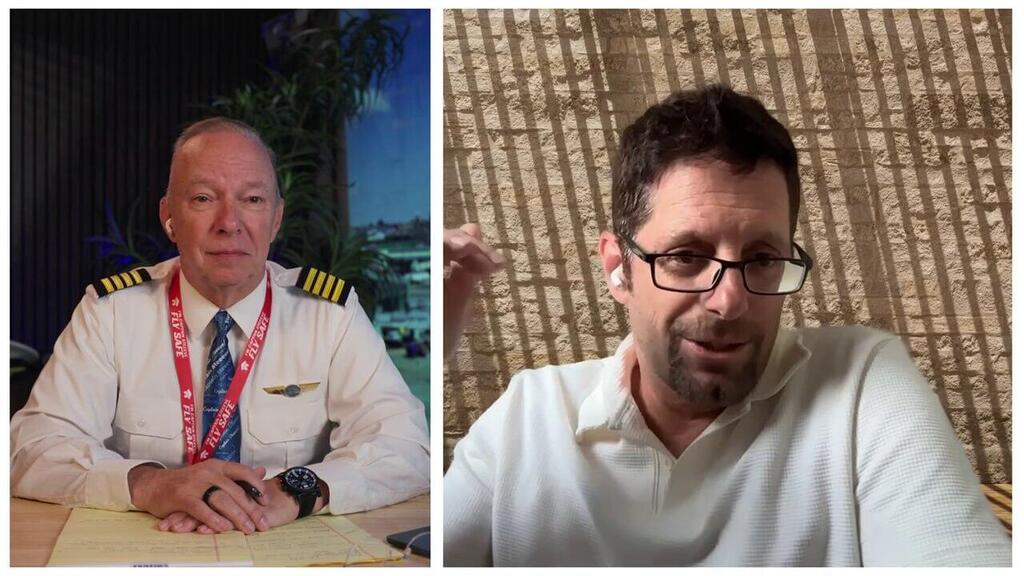
Captain Steve Scheibner, a former U.S. Navy and American Airlines pilot who hosts the YouTube channel, said Boeing cockpit doors are relatively easy to open from inside but considerably harder, though not impossible, to open from the passenger cabin.
Dubrovsky said passengers pulled the wounded captain out of the cockpit and overpowered the co-pilot.
“He was a big guy. Three people managed to subdue him,” he said. “At first, someone tied his hands with headphones, and then the cabin crew brought plastic restraints and tied him up. About 30 seconds later, the plane started diving.”
Flight data showed the aircraft descending roughly 5,500 meters, or about 18,000 feet, in around 30 seconds.
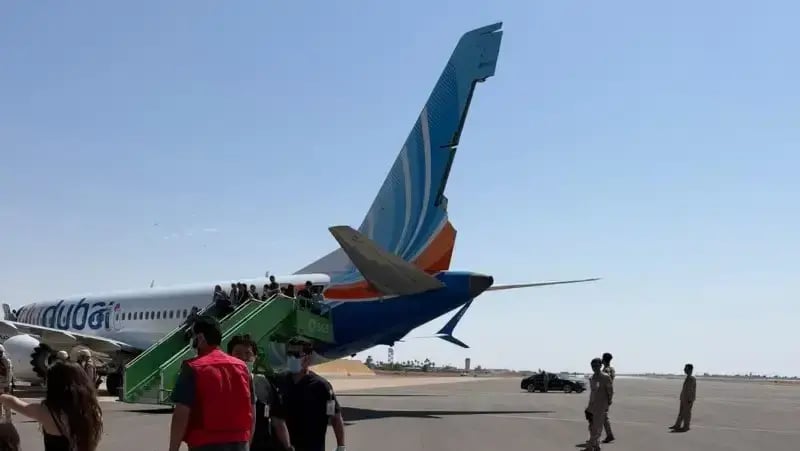
The aircraft’s tail was damaged during the rapid descent
(Photo: Rotter.net)
Scheibner said it was possible, though not yet known for certain, that the co-pilot had damaged or manipulated the flight controls in a way that disengaged the autopilot and triggered the dive.
According to Scheibner, Israeli fighter jets were scrambled after a hijacking alert code was transmitted from the aircraft. He said the replacement pilots aboard the flight were apparently not permitted to land in Israel and, after what appeared to be communication with the Israeli jets, diverted toward Saudi Arabia.
Dubrovsky said that even after control of the aircraft had been restored, passengers remained deeply uneasy.
“The story wasn’t over after the struggle and after the plane was stabilized,” he said. “We still had about another hour of flying, and we were worried that someone from the cabin crew might be cooperating with the co-pilot.”
“We, the passengers, secured the cockpit and placed guards on the flight attendants,” he continued. “Someone accompanied them wherever they went. It wasn’t based on any concrete suspicion, but better to apologize than regret it.”
Some passengers were struggling to remain calm.
“Some of the passengers panicked,” Dubrovsky said. “My wife is a psychiatrist, and she went over to them together with several other people and calmed them down. So until we landed in Saudi Arabia, everyone was tense, but calm.”
Dubrovsky said he pressed his phone against the window and used GPS data to determine that the aircraft was heading toward Saudi Arabia.
“I wondered why it was taking us so long to land,” he said. “The captain was seriously injured, but we circled several times. At the time, we didn’t understand that the rear of the aircraft had been damaged.”
The landing itself, he said, was surprisingly smooth.
“I complimented the replacement pilot afterward,” Dubrovsky recalled. “He told me, ‘Thank Boeing for that. The nose wheel did the job it was supposed to do.’”
When the aircraft landed, emergency services were waiting.
“At the airport there were ambulances, fire engines and soldiers, because apparently the place is also used by the military,” Dubrovsky said. “They put us in an isolated area and took care of us. They brought us food and water. Everyone was really nice.”
But the unexpected landing created another problem: many of the Israeli passengers could not connect their phones and tell relatives back home that they were safe.
“I spoke to someone and asked him to open a hotspot so I could order a SIM card,” Dubrovsky said. “I ordered one for myself and bought SIM cards for another 20 people so they could speak to their loved ones.”
The uncertainty continued when Flydubai sent a replacement crew to Saudi Arabia.
According to Dubrovsky, the crew had been instructed to fly there without being told what had happened aboard the original flight.
“They landed and asked us to get on the plane, which looked exactly like the previous plane, and they asked us to sit in the same seats,” he said. “People were very stressed by that.”
Dubrovsky said he spoke directly with the new pilots and explained what had happened.
“I think for them it was no less stressful, thinking that a colleague could have stabbed them,” he said. “They were very patient with the passengers. They spoke with them and asked them to board, but they didn’t pressure anyone.”
He ultimately tried to reassure fellow passengers that the replacement crew could be trusted.
“I spoke to people and told them the crew was great,” Dubrovsky said. “What’s amazing about this whole story is that everyone on that plane contributed something in that situation.”