


Ministers Israel Katz and Bezalel Smotrich are advancing a series of dramatic cabinet-approved decisions aimed at deepening Israel’s de facto annexation of parts of the West Bank, according to a report on Sunday.
The measures, approved by the cabinet, are expected to bring far-reaching changes to land registration and property acquisition procedures in the West Bank, enabling the state to demolish Palestinian-owned buildings in Area A.
Gallery

Finance Minister Bezalel Smotrich and Defense Minister Israel Katz
(Photo: Ariel Hermoni, Defense Ministry)
As Prime Minister Benjamin Netanyahu prepares for a visit to the United States, amid concerns that President Donald Trump may be retreating from earlier red lines on negotiations with Iran, it remains unclear whether the Americans were coordinated with the cabinet decisions. In practice, the moves mark another step in the sovereignty push settlement leaders are seeking to complete ahead of elections expected in October.
The decisions are considered legally complex to reverse and are expected to significantly expand Jewish settlement across the West Bank. One of the key steps concerns land ownership: the cabinet approved lifting the long-standing confidentiality of West Bank land registries. The move will make records public, allowing potential buyers to identify landowners and approach them directly. Until now, land registration in the West Bank had been classified.
The decisions run counter to the principles of the 1997 Hebron Protocol, signed as an interim step in the Israeli-Palestinian peace process. Hebron is the only city from which Israeli forces did not withdraw during the first phase of redeployments following the Oslo II accord. The measures were approved by the cabinet rather than the full government, with ministers determined to advance the application of sovereignty in the West Bank before the elections.

The Cave of the Patriarchs in Hebron, the removal of restrictions is expected to lead to an increase in the city’s Jewish population
( Photo: Ilan Rosenberg/ Reuters)
The cabinet also canceled a law banning land sales to foreigners and abolished the requirement for a transaction permit. Until now, land sales to those defined as ‘non-Arabs’ were prohibited, meaning Jews could purchase land only through locally registered companies rather than as private individuals. Under the new decisions, most barriers to land purchases have been removed.
In addition, the cabinet scrapped legislation requiring a special permit for real estate transactions. Purchases in the West Bank will no longer require oversight by professional authorities in the Civil Administration, instead needing only to meet basic professional registration criteria. This change is expected to allow Jews to acquire property with minimal bureaucracy.
Another major decision concerns the Jewish settlement in Hebron. Under the new measures, planning and building authority for the Jewish settlement, including at the Cave of the Patriarchs, will be transferred from the Hebron municipality, which is under the Palestinian Authority, to Israeli authorities. Until now, any construction changes required approval from both the municipality and the Civil Administration. Going forward, approvals will come solely from the security establishment.
Once authority is transferred, significant obstacles are expected to be removed, paving the way for substantial expansion of the Jewish presence in the city. The move effectively undermines the 1997 agreement between Israel and the Palestinian Authority.
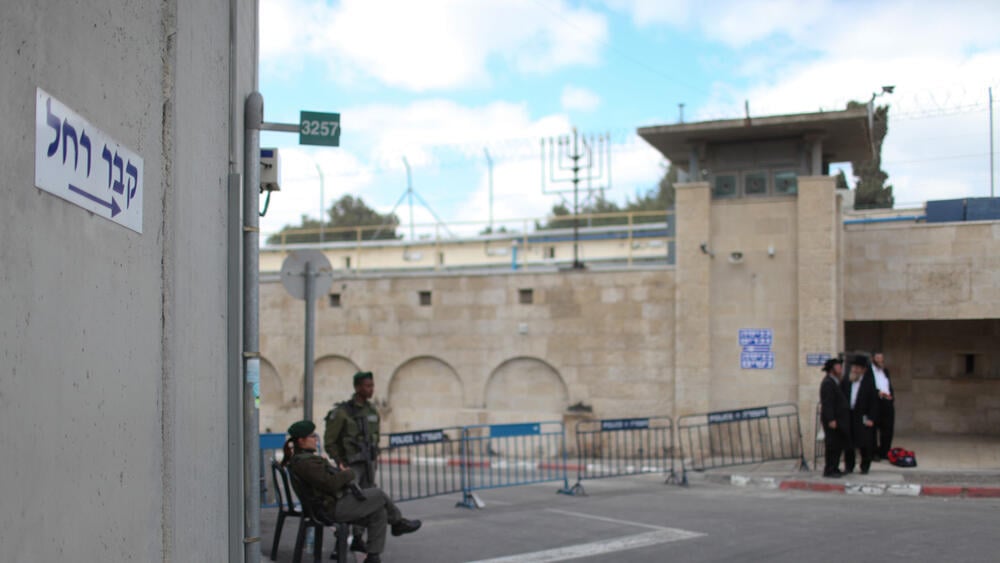
Rachel’s Tomb will also be transferred from the Bethlehem municipality to Israeli control
(Photo: Ohad Zwigenberg)
The new authorities will also apply to the Cave of the Patriarchs, a site considered highly sensitive both nationally and religiously. In effect, the decisions sever the Jewish settlement from the Hebron municipality, creating an independent municipal entity. Similar steps were approved regarding Rachel’s Tomb, located within the municipal boundaries of Bethlehem, which does not provide services to the site.
The cabinet approved the establishment of a dedicated municipal administration to manage local affairs at the tomb compound and the adjacent yeshiva, effectively annexing additional territory. It also authorized enforcement bodies to act against illegal Palestinian construction in Area A, citing damage to heritage and archaeological sites.
Until now, enforcement against illegal Palestinian construction was limited to Area B and only in specific locations. The new policy would allow Israel to expropriate land in Area A and demolish structures deemed to harm or sit atop heritage sites.
Security officials support most of the decisions, with the exception of those concerning Hebron, and have requested that implementation be delayed until after Ramadan.
Security officials warned that unilateral changes could lead to escalation. In a statement, they said that the Cave of the Patriarchs is one of Islam’s holy sites and that Ramadan is a particularly sensitive and volatile period. They cautioned that unilateral changes could trigger widespread condemnation, diplomatic pressure and heightened security tensions.
The Defense Ministry confirmed that the cabinet approved what it described as dramatic decisions advanced by Smotrich and Katz that fundamentally alter the legal and civilian reality in the West Bank. According to the ministry, the measures are intended to remove decades-old barriers, repeal discriminatory Jordanian-era laws and accelerate settlement development.
Defense Minister Katz said the decisions reflect a clear policy of strengthening Israel’s hold on the West Bank and securing the future of settlement there. Smotrich said the moves mark a normalization of life in the West Bank and vowed to continue blocking the idea of a Palestinian state.