

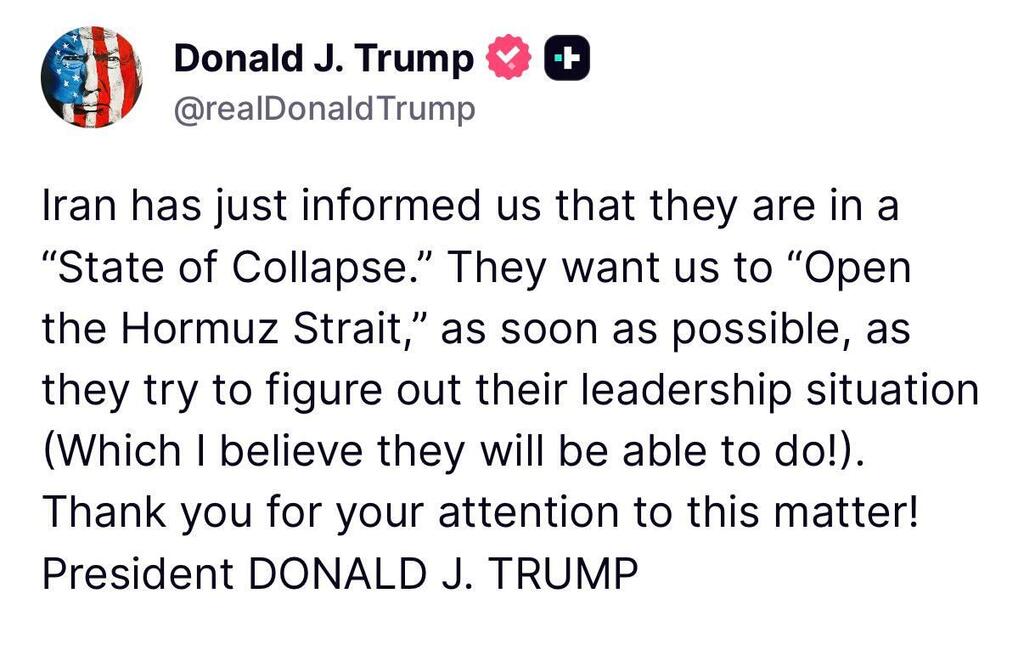
U.S. President Donald Trump said Tuesday that Iran had informed Washington it was in a “state of collapse” and wanted the United States to reopen the Strait of Hormuz as it works through what he described as a leadership crisis.
“Iran has just informed us that they are in a ‘State of Collapse,’” Trump wrote in a post on his Truth Social platform. “They want us to ‘Open the Hormuz Strait,’ as soon as possible, as they try to figure out their leadership situation (Which I believe they will be able to do!).”
Trump did not explicitly reject Iran’s latest proposal, under which Tehran is reportedly calling first for the reopening of the Strait of Hormuz, alongside the lifting of the U.S. blockade, while delaying negotiations on core issues, including its nuclear program, to a later stage. According to the reports, Iran is also seeking guarantees that the war will permanently end.
In his post, Trump also returned to a claim he has made repeatedly in recent days: that Iran’s leadership is divided and lacks a unified position. From Trump’s perspective, that argument has justified extending the ceasefire, without setting a new deadline, until Washington can supposedly receive an orderly response from Tehran.
Iran denies claims of a leadership split, though assessments suggest decision-making is now being led by hard-line Revolutionary Guard generals.
According to reports, Iran submitted an updated proposal over the weekend offering to resolve the Hormuz crisis first, allowing the strategic strait to reopen in parallel with the lifting of the U.S. blockade on its ports. Only afterward, Tehran proposed, would the sides discuss the main unresolved issues, including the nuclear file.
The Wall Street Journal described the proposal as a three-stage plan. First, Iran would demand guarantees that the war will end. Next, the sides would negotiate the terms for reopening Hormuz, with Iran insisting that the strait be reopened under its control and that it be allowed to collect fees from tankers passing through it — a position the United States has rejected outright. Only in the final stage would negotiations be held on Iran’s nuclear program and other issues, including Tehran’s support for militias and terrorist organizations across the Middle East.
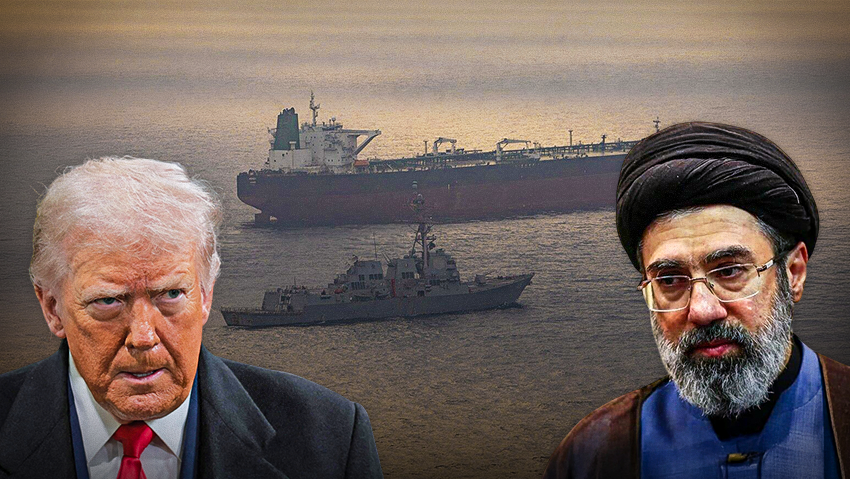
(Photo: Anna Moneymaker / AFP, CENTCOM)
Although Trump did not explicitly dismiss the Iranian offer in his post, reports said he voiced reservations about it overnight during a security meeting with senior members of his administration.
“Opening the strait without resolving the question of Iran’s uranium enrichment would remove a large part of American leverage in the talks,” U.S. officials told CNN. Still, the report said it remains unclear what steps Trump will take next.
The New York Times also reported that Trump expressed dissatisfaction with the Iranian proposal, given his demand that any agreement prevent Iran from ever obtaining a nuclear weapon. One U.S. official told the newspaper that accepting the Iranian proposal could be seen as denying Trump a victory.
In recent days, Trump has sounded skeptical about resuming strikes on Iran. U.S. officials told The New York Times that some in the administration believe maintaining the naval blockade for another two months could cause long-term damage to Iran’s energy industry, particularly as the country runs out of storage capacity for oil being pumped from underground reserves.
Those officials argued that oil wells cannot simply be turned on and off, and that a forced shutdown would exact a heavy price from Iran, giving Tehran an incentive to reach an agreement to avoid long-term damage.
Rubio: We won't allow Iran to normalize control of Hormuz
(Video: FOX NEWS )


Other administration officials, however, have argued that assessment is flawed, pointing to Iran’s hardening position in the negotiations. Tehran has repeatedly rejected U.S. proposals to halt its nuclear program and hand over its stockpile of enriched uranium.
People briefed on Trump’s discussions said the Iranian proposal sparked a fierce internal debate over which side has more leverage in the negotiations and which country is better positioned to withstand the economic consequences.
The Times reported that some Trump administration officials doubt Iran will agree to meaningful compromises on its nuclear program, particularly because Washington believes the Iranian leadership has not authorized its negotiators to make such concessions. As a result, those officials argue that the best path forward may be a narrower agreement focused on reopening Hormuz.
Ibrahim Rezaei, spokesman for the Iranian parliament’s National Security and Foreign Policy Committee, reiterated Tehran’s uncompromising position on the nuclear issue Tuesday.
“We will not compromise on the nuclear issue, and we have many surprises,” he said.
Iranian military spokesman Mohammad Akrami Nia said Iran is preparing for a possible resumption of attacks.
“We do not see the war as over,” he said. “The conditions are still considered wartime conditions, and accordingly, the target bank and the forces’ equipment have been updated.”