

A pro-Iranian Iraqi militia has released footage that appears to show an FPV drone striking a U.S. base near Baghdad’s international airport.
The group, Kataib Hezbollah, published what it described as documentation of the attack, which allegedly hit the American base. If confirmed, it would mark the first time the organization has successfully struck a U.S. target using an FPV drone.
Iraqi drone attack on the US Victoria base near Baghdad airport


The footage, broadcast on the pro-Iranian Iraqi channel Naya, appears to show the drone flying for several minutes before hitting its target.
The report came against the backdrop of ongoing attacks by Iran and its allied militias in Iraq against U.S. positions in the region. According to the report, “U.S. Central Command (CENTCOM) always claims the attacks are successfully intercepted, but the footage appears to show the U.S. air defense system failing to intercept.”
A drone that the operator sees through
Experts at Israel’s Institute for National Security Studies (INSS) explained that FPV drones, reportedly used in the attack, can operate at ranges of up to about 20 kilometers and are equipped with cameras that allow operators to guide them with high precision toward a target.
The drones can maneuver around obstacles and adjust their flight path in real time according to terrain conditions. Their maneuverability allows them to operate in hard-to-reach areas, and they are considered relatively resilient even against electronic warfare.
Dr. Yehoshua Kalisky, a senior researcher at INSS, explained that an FPV drone, short for “first-person view,” is equipped with a camera that transmits live video directly to special goggles worn by the operator.
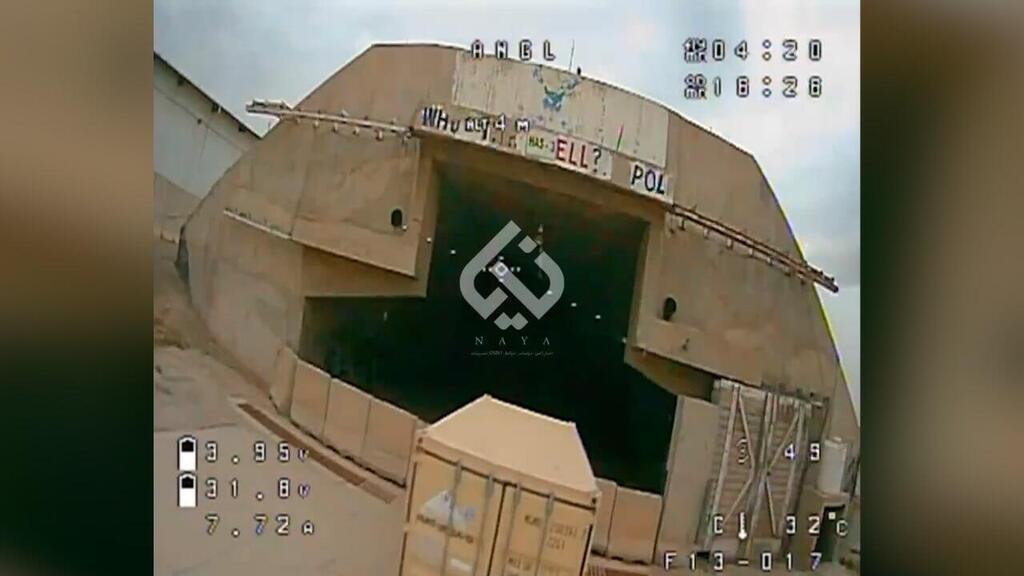
'Capable of penetrating hiding places and with a low radar signature': Footage from the FPV drone
“He sees exactly what the drone sees, as if he is riding on top of the drone,” Kalisky said.
According to him, such drones excel in speed, maneuverability and operator control, since the pilot navigates toward the target while viewing the drone’s perspective through the goggles.
Small, fast and difficult to intercept
Kalisky added that the drones are also small in size and have a low radar signature.
“These characteristics — high speed, strong maneuverability, the ability to penetrate hiding places and a low radar signature — combined with their relatively low cost, make them an effective attack tool and pose significant challenges for interception,” he said.
Unlike typical drones, which are often guided via GPS and do not transmit live video back to the operator, FPV drones rely on real-time visual control.
As for ways to counter them, Kalisky said the drones can sometimes be neutralized through electronic warfare that disrupts communication with the operator.
“If that is not possible,” he added, “they can also be targeted with systems that emit high-power microwave waves in order to burn out critical components in the drone.”