


Slovenia has taken an unusual step in European diplomacy, blocking a joint statement by all 27 European Union member states criticizing Israeli construction plans in the E1 area east of Jerusalem, in a move that could signal a significant shift in relations between Ljubljana and Israel.
The government of Prime Minister Janez Janša vetoed the proposed statement in recent days. The Czech Republic also opposed the measure, as it has done with previous EU initiatives critical of Israel.
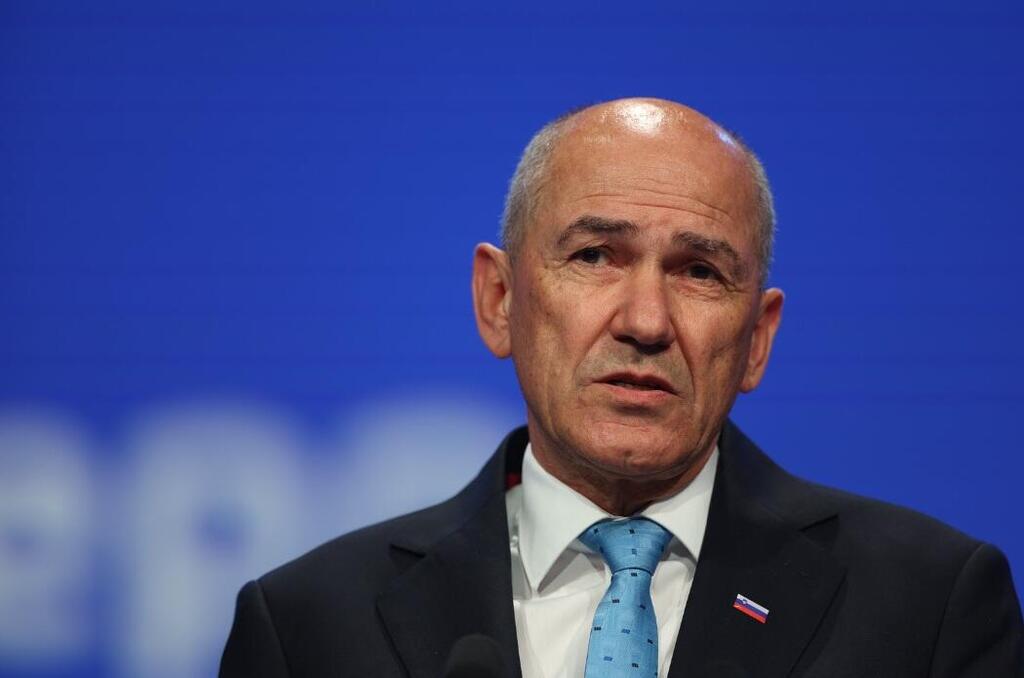
Slovenian Prime Minister Janez Janša
(Photo: European People's Party)
The objections did not prevent the EU from criticizing the Israeli plans, but they stopped the criticism from being issued as a formal statement backed by all 27 member states. With the bloc unable to reach the required consensus, EU foreign policy chief Kaja Kallas issued a statement Aug. 23 in her own name and on behalf of the European External Action Service.
The dispute centered on E1, a strategically sensitive area of the West Bank between East Jerusalem and the settlement of Ma’ale Adumim. Israeli construction plans there have long drawn international opposition, with critics arguing that development could impede the territorial continuity of a future Palestinian state.
The Slovenian and Czech objections followed a series of telephone conversations between Foreign Minister Gideon Sa'ar and his counterparts in Slovenia, the Czech Republic and other countries.
According to diplomatic officials, pressure from Slovenia and the Czech Republic also resulted in the statement including a reference to Israeli efforts to prosecute settlers involved in violence, language that was not part of the EU’s original collective draft.
A new Hungary? Not necessarily
The Slovenian move draws inevitable comparisons with Hungary under former prime minister Viktor Orbán.
For years, Budapest has been the EU member state most closely associated with blocking measures critical of Israel. On issues requiring unanimous agreement among EU members, Hungary’s veto has repeatedly provided Israel with an important diplomatic shield.
Slovenia, by contrast, has not historically been associated with frequent use of its veto to protect Israel, making the latest decision particularly notable.
It also represents a sharp departure from the position of Slovenia’s previous government, which regularly supported statements critical of Israel, including over E1. As recently as May 22, 2026, the previous government backed such criticism.
Janša’s new government took office in June, and the change in policy underscores how rapidly Slovenia’s approach to Israel has shifted following the political transition in Ljubljana.
Still, describing Slovenia as a “new Hungary” would overstate the change.
The country has not become an automatic supporter of Israel on every issue, and its latest veto did not eliminate European criticism of Israeli policy. Rather, the significance lies in the new Slovenian government’s willingness to break with an emerging EU consensus when Israel is involved.
That shift is especially striking because it has come within weeks of the new government taking office.
Another significant change is also underway in bilateral relations: Israel is expected to open its first embassy in Slovenia in mid-September.
Sa'ar is expected to travel to Ljubljana for the opening. Israeli officials are also considering adding visits to the Czech Republic, Hungary and Slovakia to the trip, although the final itinerary has not yet been determined.
Political divisions remain in Slovenia
The warming ties between Israel and Janša’s government do not erase Slovenia’s internal political divisions over Israel.
President Nataša Pirc Musar has been a sharp critic of Israel and holds views markedly different from those of the government. That divide was also apparent when Israel’s new ambassador, Ruth Cohen-Dar, presented her credentials to the president.
The emerging question for Israeli diplomacy, therefore, is less whether Slovenia has become “pro-Israel” than whether Jerusalem has gained another potential ally capable of blocking measures against it inside the EU.
For years, Orbán’s Hungary was prepared to stand alone against the broader European position on Israel. Slovenia’s latest move raises the possibility that Ljubljana could, at least on some issues, play a similar role.
Slovenia’s Foreign Ministry said its underlying policy had not changed.
“Slovenia did not support the proposal presented following consultations,” the ministry said in a statement. “Our position has not changed: Slovenia supports international law and an agreed two-state solution that takes into account the interests of both sides.”
The ministry added that another declaration on the issue would add little because a European Council statement from June already addressed the matter.