

Yashar! Chairman Gadi Eisenkot is expected to receive the mandate to form a government from President Isaac Herzog on Sunday. On Friday, he got a preview of what the coming weeks are likely to look like, and they are expected to be especially challenging.
During the 28 days he will be given, plus a possible 14-day extension, Eisenkot could encounter difficulties from his partners in the bloc. The four party leaders did keep their preelection commitment to present the president with a single candidate, unanimously recommending Eisenkot, but they have struggled to conceal the differences between them. Coalition negotiations began over the past week, even before the mandate was formally granted, and the bloc’s leaders also held a joint meeting.

Lieberman’s pent-up frustration
While the Yashar! leader has made no secret of his intention to continue pursuing plans for a minority government, after receiving the backing of 67 lawmakers, including the Arab parties, compared with just 46 for Prime Minister Benjamin Netanyahu, Yisrael Beytenu Chairman Avigdor Lieberman has repeatedly ruled out that option, effectively tying Eisenkot’s hands.
Lieberman also made no effort to hide his anger with Eisenkot at a news conference this week, arguing that the election results, which he called a “stinging failure” for the bloc, were the product of “Gadi’s campaign.”
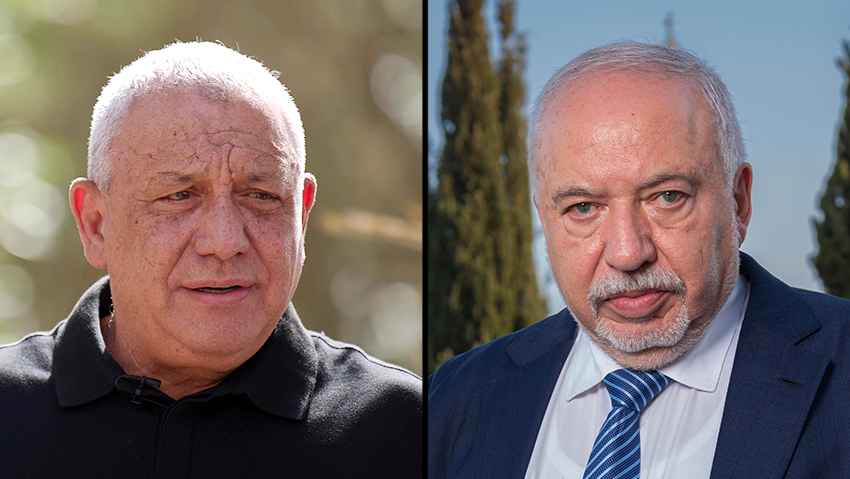
Public clash; Eisenkot and Lieberman
(Photo: Yuval Chen, AP Photo/Ariel Schalit)
In a lengthy post Friday, Lieberman again expressed opposition to a minority government. At the same time, he lifted his boycott of the ultra-Orthodox parties and said he would be prepared to make “compromises on conscription as well,” drawing anger over what critics described as a breach of his commitment to advance a universal service framework.
After Lieberman’s remarks, Eisenkot published a post of his own, continuing their public confrontation.
“Israel is in a real, tangible and dangerous state of emergency,” Eisenkot wrote, calling for the establishment of a “national emergency government” while avoiding the words “minority government.”
Eisenkot said his goal was to move toward swearing in such a government “as quickly as possible.”
“The government will be formed on the basis of the four Zionist parties of change and reform, with the addition of any party and any Knesset member who agrees to my four basic principles, immediately or gradually,” he wrote.
He said “this is the need of the hour,” while sending an implicit message to Lieberman: “Anyone who tries to drag out or torpedo the formation of the government for personal rather than substantive reasons will be remembered by history as someone who failed to rise to the occasion and failed to act to save Israel in a time of emergency. That will not be forgiven.”
Bennett’s silence
While Eisenkot and Lieberman have made no effort to conceal their dispute, one party leader in the bloc has chosen to remain largely silent.
Since the election, Beyachad Chairman Naftali Bennett has avoided forceful or dramatic declarations. After the bloc leaders met this week, the former prime minister said, “We don’t have time. We need to act with great urgency.”
He said the first step should therefore be to “take control” of the Knesset, meaning replacing Amir Ohana with a new Knesset speaker.

Bennett remains silent as Netanyahu allies take aim at Yonatan Shalev
(Photo: Itay Shaked)
Over the past two days, Yashar!, Beyachad, the Joint List, the Democrats, Ra’am and Yisrael Beytenu have appealed to Ohana, demanding that he be replaced when the new Knesset is sworn in Tuesday.
“The faster we take control of the Knesset, receive the mandate to form a government and act as quickly as possible to establish a Zionist reform government, the faster we can launch the revolution of those who serve and begin repairing the country,” Bennett said.
But criticism of Bennett has intensified over the past day following Lieberman’s declaration that he would sit with the ultra-Orthodox parties and compromise on the conscription issue, because Bennett’s campaign focused heavily on what he called the “alliance of those who serve.”
One person singled out by Netanyahu’s bloc is Yonatan Shalev, who is expected to become the youngest member of the 26th Knesset and entered Bennett’s slate as a representative of military reservists.
On Friday, Topaz Luk, a senior adviser to the prime minister, mocked the 24-year-old Shalev on X.
“Anyone with information about the whereabouts of Yonatan Shalev, last seen promising lies alongside Bennett, is asked to provide an update,” he wrote.
Amid the controversy Friday, Bruria Naim Arman, the party’s director-general and an incoming Knesset member on the Beyachad slate, circulated a message in groups saying Bennett “continues to support Eisenkot in the difficult and complicated task of forming a government.”
In an apparent reference to Lieberman, she wrote: “To achieve significant results, one must act responsibly and quietly. Silence should not be interpreted as agreement. Patience is required, along with trust in Bennett to lead us toward the establishment of a Zionist reform government that will implement the revolution of those who serve.”
Golan ‘optimistic’
There is also one leader in the bloc who, in his own words, is “optimistic.”
Democrats Chairman Yair Golan wrote on X that he was more optimistic about forming a government than he had been the day after the election.
“There is progress. There is willingness. And serious work is taking place every day to turn the election results into a government of change,” he wrote. “There are difficulties, and I have no intention of hiding them. But there is also real progress.”
Golan warned against a unity government and did not mention any opposition to sitting with the ultra-Orthodox parties.

Yair Golan
(Photo: Moti Kimchi)
“The negotiating teams of the Democrats and Yashar!, which is leading the talks to form the government, have already met several times this week. We are working seriously, responsibly and determinedly to advance the formation of a government as quickly as possible,” he wrote.
“And this is not the only track on which we are operating. We are also increasing public and political pressure on Netanyahu and his partners, making clear on every platform that there is a majority for replacing the government, working with our partners in the change bloc to accelerate the process and preparing to take control of the Knesset as early as Tuesday.”
Golan added that he was aware of the obstacles, but said he also “knows our partners, the responsibility they feel and their genuine desire to bring about change.”
“The public gave us a major opportunity. Now our responsibility is to turn it into reality,” he wrote. “It will not be simple. But it is possible. And I am determined to do everything necessary for us to succeed. We are on it. We have a majority. We have an opportunity. And we have a historic responsibility not to miss it.”