

Spanish Prime Minister Pedro Sánchez called a snap general election for Nov. 29 on Monday, taking a major political gamble after parliamentary setbacks and scandals weakened his government and left his Socialist Party trailing in opinion polls.
Sánchez has emerged as one of Europe’s most outspoken progressive leaders, taking strong positions on issues including Palestinian statehood, multilateral institutions and regulation of powerful technology companies. His government has also taken a sharply critical line toward Israel.
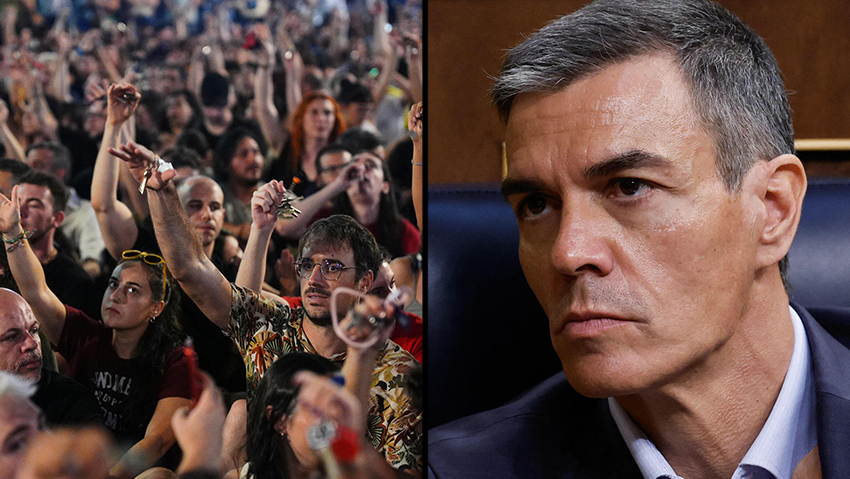
Spanish Prime Minister Pedro Sánchez
(Photo: Oscar DEL POZO / AFP, AP Photo/Manu Fernandez)
At home, however, a series of political setbacks and corruption allegations involving senior members of his Socialist Party have steadily eroded his position.
The immediate trigger for the election came after right-wing lawmakers on Friday defeated government proposals aimed at addressing Spain’s worsening housing crisis. The measures had been well received by parts of the public, and further protests over housing were planned.
Calling an election now is a significant risk. Sánchez’s Socialist Party is behind in most opinion polls, while surveys point to strong support for the conservative People’s Party, or PP, and the far-right Vox party.
A defeat would bring an end to one of Europe’s few remaining left-leaning governments at a time when far-right parties are making major gains across the continent.
Polls suggest a PP-led coalition supported by Vox is one possible outcome, which could bring a far-right party into Spain’s central government for the first time since the country returned to democracy following the death of dictator Francisco Franco.
Sánchez, however, has repeatedly defied predictions that his political career was nearing its end.
Despite never winning enough seats to govern with an outright majority, he has assembled a succession of fragile parliamentary alliances stretching from the far left to Catalan separatists, allowing him to remain in power for three successive terms spanning eight years.
Growing divisions among those partners have made governing increasingly difficult during his latest term. His government has passed relatively little major legislation and has failed to approve a new national budget since 2023, even as Spain’s economy has remained among the strongest-performing in the developed world.
From Rajoy’s ouster to Sánchez’s own scandals
Sánchez first took office after leading a successful parliamentary effort to remove center-right Prime Minister Mariano Rajoy following major corruption scandals involving Rajoy’s People’s Party.
In the past year, however, senior figures in Sánchez’s own Socialist Party have faced allegations of corruption, further weighing on a party whose support has generally hovered between about 26% and 31% during his years in office.
Sánchez nevertheless secured another four-year term after the 2023 election despite heavy Socialist losses in regional and local contests.
He remained in power by negotiating support from a loose alliance of parties in parliament, including Catalan separatists.
The agreement was secured after Sánchez promised an amnesty for Catalan pro-independence leaders, a deeply controversial move that opponents portrayed as a betrayal of Spanish unity.
Earlier in his premiership, Sánchez won praise on the left for measures including the exhumation of Franco’s remains from a mausoleum outside Madrid and labor reforms that helped bring unemployment to its lowest level in nearly two decades.
He also established a liberal stance on immigration early in his tenure. In June 2018, Sánchez said Spain would accept the Aquarius migrant rescue ship and its 629 passengers after Italy and Malta refused to allow it to dock.
As other European governments tightened immigration policy, Sánchez continued to argue that migrants were essential to Spain’s economic growth, filling labor shortages in sectors including construction, agriculture and hospitality while contributing revenue to the country’s strained welfare system.
More recently, Sánchez has clashed with Washington over his refusal to meet U.S.-led demands for defense spending equivalent to 5% of GDP, while Spain’s growing engagement with China has also unsettled U.S. President Donald Trump and some European leaders concerned about increasing Chinese imports.
Housing crisis offers an electoral opening
The housing crisis gave Sánchez a rare opportunity to shift the political debate away from damaging issues including corruption scandals and the migrant crisis in Ceuta.
Lorenzo Bernaldo de Quirós, an economist and president of consultancy Freemarket Corporate Intelligence, said the government’s housing proposals offered Sánchez an opening to present himself once again as the leader of a mobilized left.
“This is a window of opportunity,” de Quirós said. “If he does not call elections fast, [those topics] will return to center stage.”
Sánchez has now chosen to take that chance, setting up a Nov. 29 election that could determine whether his unusual coalition-building strategy can keep Spain’s left in power or whether eight years of Socialist-led government are coming to an end.