


“When the number of people leaving and entering does not exceed 40 a day, it is impossible to truly speak of reopening the crossing. This is simply a continuation of the blockade,” an editorial in Al Resalah, a Hamas-affiliated daily in Gaza, ruled this week, capturing the frustration felt by many residents following the reopening of the Rafah crossing on Monday.
“The majority are barred from leaving. Anyone who fails to present a convincing reason to the Israelis is refused. Sick patients are sent back to their homes, and those who return are interrogated for many hours,” the paper added. That sentiment stands in contrast to remarks made this week by Ali Shaat, head of the technocratic government, who said the reopening “symbolizes a gateway to hope and a new path for Gaza’s residents.”
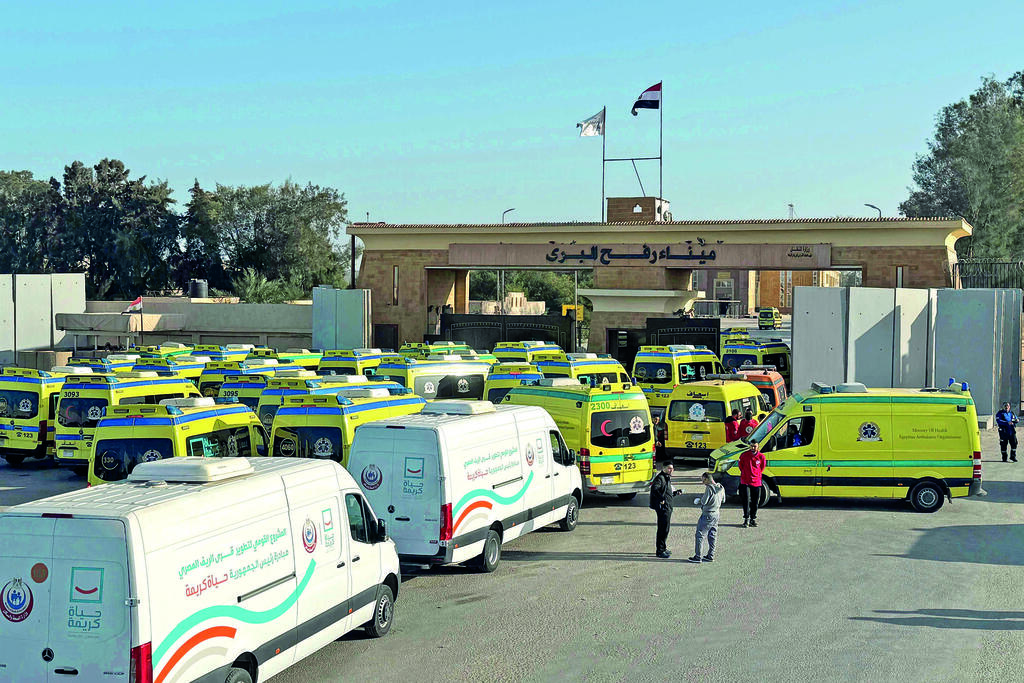
Numerically, the reopening, the first since May 2024, when the Israeli army took control of the crossing, has barely been felt on the ground. Since Monday, about 60 people have exited Gaza, roughly 20 of them patients or wounded individuals and the rest companions. About 75 people have returned to the enclave. Under the arrangement, 150 people are supposed to leave daily, while 50 are allowed to enter.
Most of those moving through the crossing are women, children and elderly people. Returnees face strict limitations: one suitcase, one mobile phone, 600 dollars, and a ban on bringing in electrical devices or metal items. Movement was allowed during the first two days, but on Wednesday, without explanation, the departure of patients from Gaza was halted.
These figures fall far short of the needs. About 22,000 Palestinians, the vast majority wounded, are seeking permission to leave Gaza for medical treatment abroad. Tens of thousands of the roughly 130,000 people who left Gaza during the war wish to return. “Many are not rushing back or will come only for family visits, but a large portion of those who left do want to return,” explained Prof. Mkhaimar Abusada, a political science lecturer at Al-Aqsa University in Gaza who left for Egypt with his family during the war. “So far, 20,000 applications from Gaza residents wishing to return have been submitted to the Palestinian Embassy in Cairo.”
On the delay in the arrival of the technocratic government in Gaza, a senior Palestinian official told me, “Its members may arrive as early as next week,” though doubt was evident in his tone. It was exactly what he told me last week as well
Testimonies published in Palestinian media underscore the gap between expectations and what many in Gaza perceive as the beginning of a new chapter. “Five hours of waiting on the Egyptian side, followed by lengthy inspections by Palestinian and European teams who carried out strict searches of luggage and body,” said Sabah al-Rakab, who returned to Gaza from Egypt this week. Gaza journalist Rasha Farahat said, “There is ostensibly Egyptian coordination, a European team is operating, and a Palestinian force claims to be managing the crossing, but in practice it has no real authority. This is a gate under international supervision that is effectively controlled by Israel.” Adding to the frustration are reports of involvement by members of the Abu Shabab militia from Rafah, which is backed by Israel, in interrogating and detaining those returning to Gaza. Palestinian media, particularly Hamas outlets, highlighted the account of Rutanah al-Rakab, who returned from Egypt this week.
“After the inspections on the Palestinian side ended, militiamen arrived, declared that they were our brothers and that they were fighting Hamas,” she said. “They grabbed me and tried to hand me over to Israeli forces, but foreign officials operating at the crossing, apparently European monitors, prevented it.” Others reported being taken for interrogation while handcuffed and blindfolded, and said members of the militia stole their belongings. “The fate of these militias will be the dustbin of history. We have no connection to them and will continue to thwart Israel’s plans to operate through clans,” said Sheikh Husni al-Moughani, head of the Association of Tribes and Clans in Gaza.
Hostility toward the Abu Shabab militia has intensified following another incident that has stirred Gaza. The militia captured Adham al-Aqar, commander of the Jenina neighborhood company in Rafah and a member of Hamas’ military wing. The gaunt militant, who had spent weeks in a tunnel, was filmed in a video that spread widely online, partially naked and beaten by Rassan Dehini, the militia’s leader, who was seen casually smoking a cigarette. Even Palestinians who are not affiliated with Hamas, or are openly hostile to it, condemned what they described as a disgraceful collaboration with Israel. The episode underscored the growing gap between Israel’s hope that clans could serve as an alternative to Hamas and the reality on the ground in Gaza.
As is often the case, Israeli discourse this week focused on peripheral issues, notably the emblem of the national committee for managing Gaza, the technocratic government, which features the eagle symbol used by the Palestinian Authority rather than the phoenix associated with Gaza City. The issue was accompanied by a sharply worded statement from the Prime Minister’s Office asserting that Israel would not allow the Palestinian Authority any foothold in Gaza. This stance persisted despite the fact that dozens of Palestinians staffing the Rafah crossing operate on behalf of the committee and, even without a formal definition, are clearly closely linked to the authority.
Another Israeli fantasy revived this week was the notion that Gaza would be emptied of Palestinians in line with former President Donald Trump’s vision, a plan he himself abandoned long ago, once Palestinians were allowed to leave the enclave. This, as usual, ignores the reality that the number of people exiting is minimal, that no country is willing to absorb large numbers of Gaza residents, including Somaliland and Puntland, and that among Palestinians there is growing resistance to anything perceived as a scheme of displacement. Anyone seen as cooperating with such plans is branded a traitor.
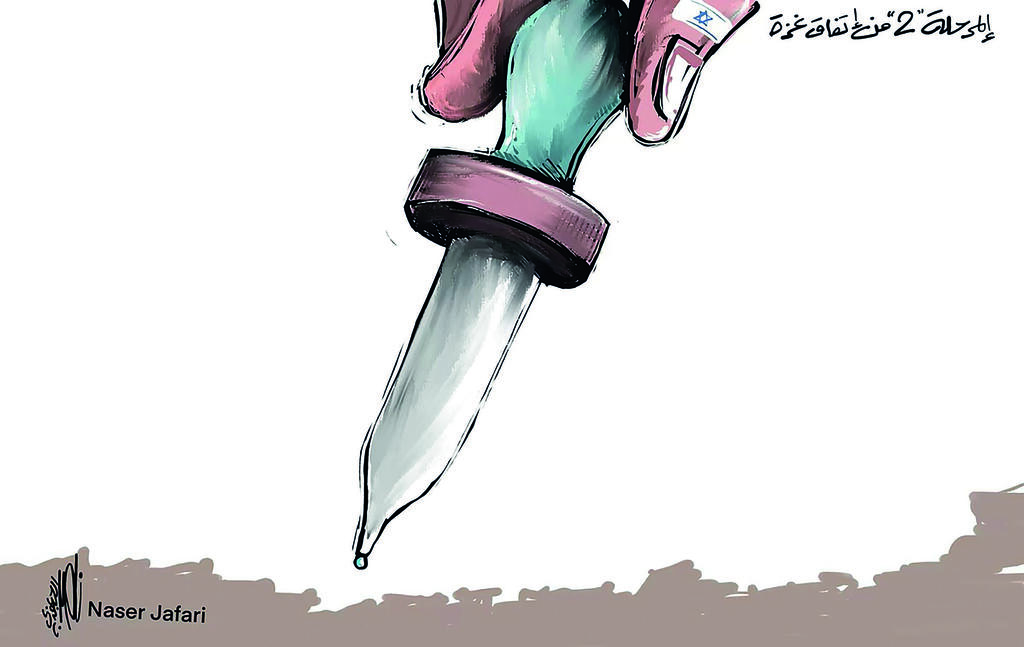
Phase two as a drop in the ocean. Cartoon from Al-Quds
(Illustration: Naser Jafari)
Palestinian media this week were filled with statements emphasizing return and steadfastness. “Better the hell of Gaza than paradise outside it. We have returned and will not leave again,” said Lamia Rabie upon her return to the enclave. Hamas has also claimed that Palestinians who returned were detained by Israel and enticed not to go back through promises of assistance in resettling elsewhere.
Another idea that collapsed this week was the claim that the United Arab Emirates would take responsibility for governing Gaza. The notion was categorically denied by UAE Minister of State for International Cooperation Reem Al Hashimy. Hamas, for its part, continues to signal eagerness to advance to the second phase, repeatedly declaring that it is ready to hand over full civilian authority to the technocratic government. It argues that the government’s failure to enter Gaza is due to deliberate Israeli obstruction aimed at sabotaging an agreement to end the war.
Against this backdrop, Kan 11 correspondent Elior Levy revealed a secret document this week confirming what many already assumed: Hamas intends to adopt the Hezbollah model in Gaza. Under this approach, the technocratic government would function as a cosmetic cover, managing civilian needs, while Hamas retains dominant military and civilian power.
Hamas operatives slated to integrate into the future administration were instructed to play along, publicly displaying obedience to the technocratic government and refraining from criticizing it, while maintaining loyalty to the organization.
Meanwhile, the delay in the government’s arrival is fueling growing concern among Gaza residents. “It may happen as early as next week. That is what committee members were told,” said a Palestinian official involved in the technocratic government’s work, though his tone betrayed doubt. “That is exactly what he told me last week as well.” “It is clear to everyone in Gaza that the committee’s activity depends primarily on Israel, and there is hope that the Americans will pressure Netanyahu to move to the second phase and allow the committee to arrive,” Abusada said.
On the ground, Israel appears intent on continuing phase one as if phase two does not exist, maintaining offensive operations even, or especially, as it seeks to establish a new reality in Gaza. This was evident last Saturday, on the eve of the crossing’s reopening, when Hamas police facilities were struck in response to violations by the organization, killing about 30 Palestinians. The pattern continued after the crossing reopened. More than 20 Palestinians were killed in strikes on Tuesday and Wednesday. The attacks drew sharp criticism from mediators, particularly Egypt and Qatar, which argued that Israel was working to undermine the establishment of the technocratic government. Daily friction also continues along the so-called yellow line. In one incident this week, a reserve officer was seriously wounded. In recent strikes, Israeli forces killed, among others, the commander of Islamic Jihad’s northern Gaza brigade and the terrorist responsible for the murder of surveillance soldier Noa Marciano, who was abducted from her base on October 7.
In Israel, meaningful debate remains elusive, as every issue is immediately absorbed into political arguments over whether one supports or opposes Netanyahu. Some rushed to dismiss the reopening of Rafah as meaningless or even a government achievement, while others labeled it a severe failure. As usual, a sober and balanced view is preferable. The US administration, focused on the crisis with Iran, has yet to respond to developments in Gaza, though it may ultimately criticize what is seen as stalling Trump’s plan. Palestinian and Arab frustration could translate into increased pressure on Washington to act vis-a-vis Netanyahu.
A hint of potential Arab pressure on Trump, and through him on Israel regarding Gaza, appeared this week in an editorial in the London-based Qatari-funded daily Al-Quds Al-Arabi. Under the headline, “Is Israel afraid of eagles and children’s toys,” the paper expressed hope that Steve Witkoff would discuss with Netanyahu the need to advance the second phase during his visit to Israel. Similar hopes are voiced inside Gaza. “Moving to the second phase can be considered the beginning of the erosion of the Israeli plan, but not its end,” said Gaza researcher Dr. Bassam al-Qassem. “The second phase is expected to become a battleground over who makes the decisions. Israel seeks to preserve hegemony in Gaza but constantly fears that Trump will promote moves that serve his own interests, even at the expense of the Israeli vision.”
Israel may soon discover that Rafah is only the beginning of a series of changes Trump hopes to advance as part of shaping a new reality in Gaza, while in Jerusalem there remains a belief in staying indefinitely along the yellow line and even returning to full-scale fighting and occupation of the enclave. This underscores the widening gap between how reality and expectations are perceived in Israel and in much of the rest of the world.