

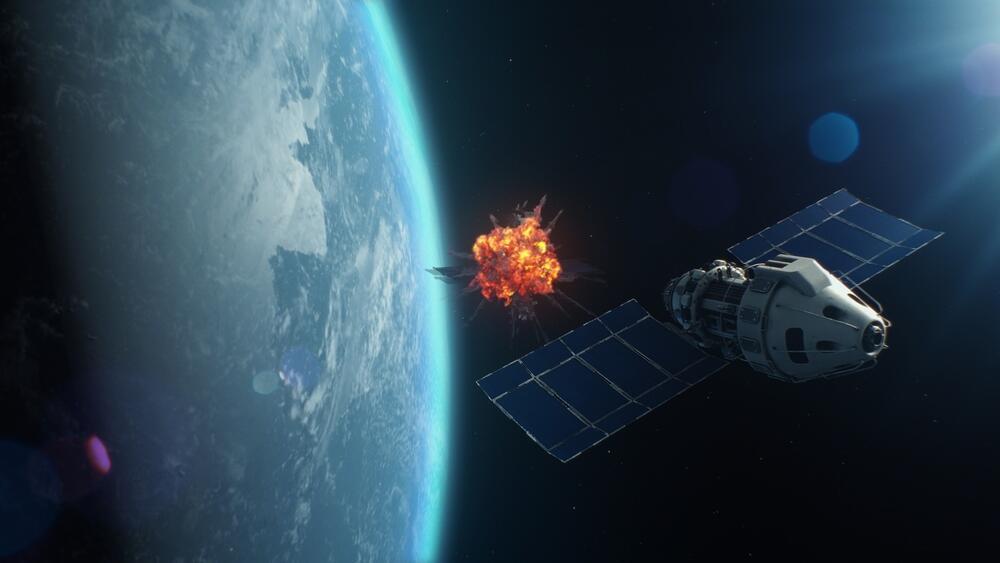
The United States has disclosed for the first time that it has deployed weapons in space. The revelation came Monday from U.S. Air Force Secretary Troy Meink, who said the U.S. military’s Space Force has placed “space control weapons” in orbit around Earth, but declined to elaborate on the nature of the weapons or even say exactly when they were launched.
Meink, speaking at an air, space and cyber conference in Maryland, made clear that the purpose of the disclosure was to deter U.S. rivals amid a growing race with Russia and China to weaponize space. Both countries are believed to be developing offensive satellites capable of disabling other critical satellites in the event of a direct confrontation between the powers.
“Today, we continue to ensure we remain ready to meet the challenge of evolving threats — wherever they exist,” Meink said in his opening remarks at the conference. “This is why the Space Force now has on-orbit space control weapons capable of defending the joint force against hostile adversary action.”
Later, in an interview at the conference, he said the announcement had been carefully considered, adding that maintaining U.S. superiority “not just in the air but also in space” is critical. “That is why we had to take steps aimed at ensuring that if we are under threat, we can deal with it,” he explained.
Meink declined to detail the capabilities of the new weapon deployed in space, including whether it is kinetic or non-kinetic. He said that, while the disclosure was intended to create deterrence, revealing the specific capabilities could undermine that goal.
“We’re not going to talk about the specifics of what we’re doing, what we’ve tested, what we haven’t tested, or anything else. I would just say that the space environment is critical for military and economic security, and we need to make sure that the U.S. can operate freely there,” he said.

US Air Force Secretary Troy Meink
(Photo: Matt Rourke, Pool, AP)
A U.S. Space Force spokesman said the term “space control,” which Meink used to describe the new orbital weapon, “includes the mission areas necessary to compete and control in the space domain — using kinetic and non-kinetic means to affect an adversary’s capabilities through disruption, degradation and even destruction, if required. These capabilities can be employed for offensive and defensive purposes, in accordance with command guidance.”
The U.S. disclosure comes amid an intensifying race in recent years among the major powers to develop offensive capabilities in space, with particular focus on the ability to disable satellites in a future conflict. Such disruption could damage critical enemy capabilities, including communications, navigation and intelligence gathering.
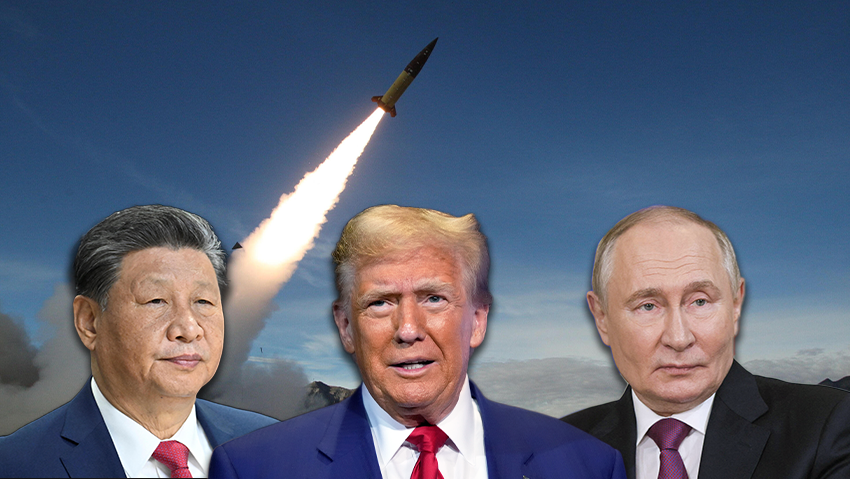
Xi Jinping, Trump, Putin
(Photos: Alex Brandon/AP, Alexander Nemenov/Pool via Reuters, Sputnik/ Alexander Scherbak/Pool via Reuters /Reuters, AFP / John Hamilton/US D)
The 1967 Outer Space Treaty prohibits the placement of nuclear weapons or other weapons of mass destruction in orbit around Earth, but does not ban other types of weapons. The United States, Russia, China and India all have demonstrated the ability to shoot down satellites using missiles launched from the ground. In recent years, however, concern has grown in Washington that both China and Russia are developing offensive satellites capable, among other things, of attacking an adversary’s satellite systems.
Satellites can be disrupted kinetically — for example, by one satellite launching a weapon at another that explodes or collides with it and causes physical damage. But this method is considered particularly dangerous because it creates large amounts of debris in orbit that can pose a serious threat to other satellites and spacecraft as well.
Disruption also can be carried out through non-kinetic methods, such as electronic jamming of the kind now widely used on the ground to bring down drones. According to the BBC, it emerged in February that two Russian satellites had apparently succeeded in intercepting communications from at least a dozen European satellites since the outbreak of the war in Ukraine in 2022. The British broadcaster noted that the ability to intercept satellite transmissions could allow Russian intelligence services not only to obtain sensitive information but, in theory, to take control of the satellites themselves.
Against this backdrop, President Donald Trump ordered the creation of a new military branch, the U.S. Space Force, in 2019. Its mission initially was defined as protecting U.S. assets in space, including the hundreds of satellites used by Washington and its forces for communications and intelligence.
After returning to the White House last year, however, Trump signed an order defining the Space Force’s mission as not only defensive but offensive as well. Trump also is currently advancing development of the “Golden Dome” missile defense system, which is intended to intercept threats from space as well, including through interceptors stationed in orbit around Earth.
At Monday’s conference, Meink also addressed the development of Golden Dome, saying that in just one year the program had advanced from initial contracts to “hardware ready.” He said the program, which now includes several companies competing to deploy interception capabilities in space, could yield an initial operational capability beginning in 2028.
China and Russia both reacted angrily Tuesday to the U.S. disclosure and called on Washington to avoid an arms race in space, although both countries have themselves been accused of developing offensive capabilities in orbit.
“We call on the U.S. side to stop expanding its military capabilities and preparing for war in space,” China’s Foreign Ministry said, while Kremlin spokesman Dmitry Peskov argued that “we believe space must remain free of any type of weapon.”
The spokesman for President Vladimir Putin added: “We expect broad international support for continued efforts toward the complete demilitarization of space.”
In this context, it is worth recalling that, according to U.S. officials, Russia launched a satellite in 2022 that tested components related to an anti-satellite weapon — a kind of “prototype” for a satellite that has not yet been launched and which Washington fears could use a nuclear weapon to disable satellite constellations such as SpaceX’s Starlink.