

U.S. President Donald Trump hosted Syrian President Ahmed al-Sharaa at the White House on Monday, a visit that capped a stunning year for the rebel-turned-ruler who toppled a longtime autocratic leader and has since sought to end Syria's decades of international isolation.
Trump met with Sharaa in the first-ever visit by a Syrian president to Washington, six months after their first meeting in Saudi Arabia, where the U.S. leader announced plans to lift sanctions, and just days after the U.S. said the former al Qaeda commander was no longer a "Specially Designated Global Terrorist."
Trump hosts Syria's al-Sharaa at the White House


Sharaa arrived at the White House without the fanfare often given to visiting foreign leaders. He entered through a side entrance unseen by reporters instead of through the West Wing's main door where cameras are positioned. Sharaa, 43, took power last year after his Islamist fighters launched a lightning offensive from their enclave in Syria's northwest and overthrew longtime Syrian President Bashar al-Assad just days later on December 8.
Syria's regional realignment has since moved at a dizzying pace, away from Assad's key allies Iran and Russia and toward Turkey, the Gulf - and Washington.
Security was expected to be a top focus of Sharaa's meeting with Trump, who in a major U.S. policy shift has sought to help Syria's fragile transition.
The U.S. is brokering talks on a possible security pact between Syria and Israel, which remains wary of Sharaa's former militant ties. Reuters reported last week that the U.S. is planning to establish a military presence at a Damascus airbase.
Syria is also set to join a U.S.-led coalition to fight Islamic State, which could be formally announced at Monday's White House meeting.
Just hours before the landmark talks, word emerged of two separate Islamic State plots to assassinate Sharaa that had been foiled over the last few months, according to a senior Syrian security official and a senior Middle Eastern official.
The sources said the plots underlined the direct threat Sharaa faces as he tries to consolidate power in a country ruined by 14 years of civil war.
Over the weekend, the Syrian interior ministry launched a nationwide campaign targeting Islamic State cells across the country, arresting more than 70 suspects, government media said.
Days before the meeting, Trump told reporters at the White House that "a lot of progress has been made" on Syria.
"I think he's (Sharaa's) doing a very good job. It's a tough neighborhood, and he's a tough guy, but I got along with him very well," Trump said.
After Sharaa and Trump met in Riyadh in May, Trump announced he would lift all sanctions on Syria.
But the toughest measures, known as the Caesar Sanctions Act, require a repeal from Congress. The White House and State Department have publicly backed lifting them before 2025 ends, but experts say the government shutdown may affect that time frame.
Sharaa is expected to strongly advocate for a repeal, which will help spur global investment in a country ravaged by 14 years of war and which the World Bank estimates will take more than $200 billion to rebuild.
Several influential members of Congress have called for the lifting of the 2019 Caesar sanctions, passed in response to human rights abuses under Assad. A few of Trump’s fellow Republicans want the sanctions to stay in place, but that could change if Trump applies pressure.
Syria's social fabric has been more recently tested. New bouts of sectarian violence left more than 2,500 dead since Assad's fall, deepening civil war wounds and putting into question the new rulers' ability to govern for all Syrians.
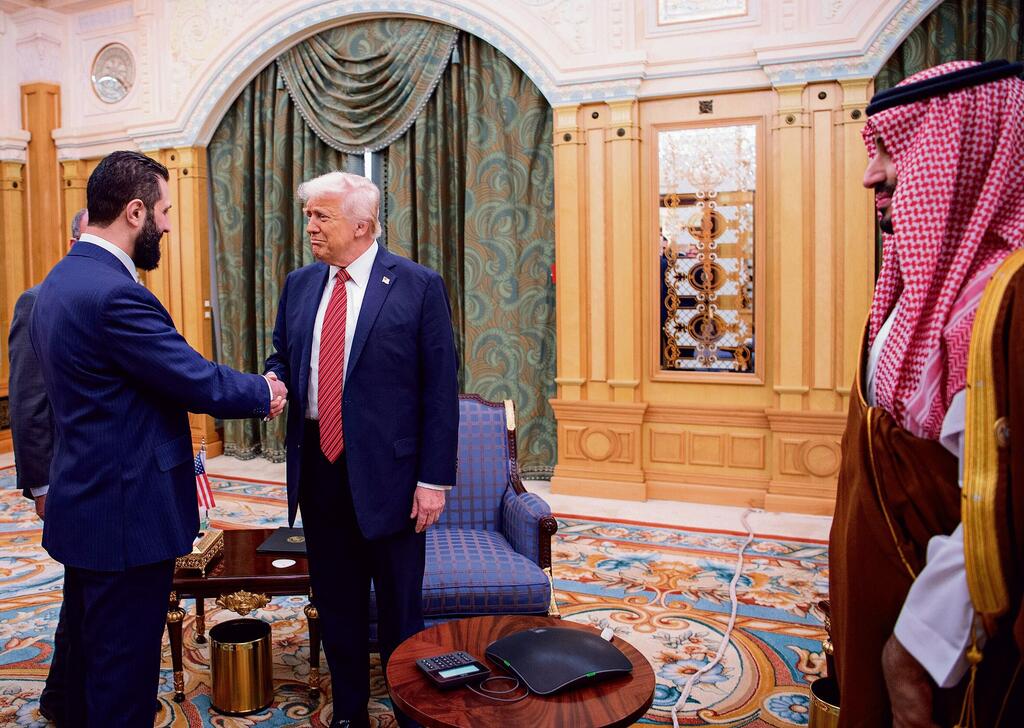
(Photo: Bandar Aljaloud/Saudi Royal Palace, AP)
Trump's focus on Syria comes as his administration seeks to keep intact a U.S.-brokered Gaza ceasefire deal between Israel and Hamas militants and push forward on his 20-point plan for an end to the two-year-old war in the Palestinian enclave. Some of the toughest issues remain unresolved.
Sharaa's own turnaround is no less impressive than his country's. He joined al Qaeda in Iraq around the time of the 2003 U.S.-led invasion and spent years in U.S. prison there, before returning to Syria to join the insurgency against Assad.
In 2013, the U.S. designated Sharaa, then known as Abu Mohammad al-Golani, as a terrorist for his ties to al Qaeda. He broke ties with the group in 2016 and consolidated his influence in Syria's northwest.
The U.S. removed a $10 million bounty on Sharaa's head in December, and just last week, the United Nations Security Council lifted terror-related sanctions designations on him and his Interior Minister Anas Khattab.
Following the U.N. move, Britain and the U.S. lifted sanctions on the pair. In Washington, that included removing "Specially Designated Global Terrorist" designations on them.
"Sharaa's visit to Washington is emblematic of the dramatic shift underway, where Syria went from being an Iranian satrapy to joining the American-led camp, and Sharaa himself transformed from a wanted terrorist to a partner in the war on terror," said Firas Maksad, managing director for Middle East and North Africa at the New York-based Eurasia Group.
"Much can still go wrong in this nascent experiment, and there remain grave concerns about minority and individual rights," Maksad said, "but the first ever visit by a Syrian president to Washington is a moment of hope that Syria is on the right track."