

The New York Times reported Sunday that President Donald Trump has told his advisers he is inclined to support an initial, limited strike against Iran in the coming days, aimed at persuading the Islamic Republic to abandon its ability to develop nuclear weapons as part of an agreement with the United States.
According to the report, potential targets for such a limited attack range from headquarters of Iran’s Revolutionary Guard to nuclear facilities and sites linked to its ballistic missile program.
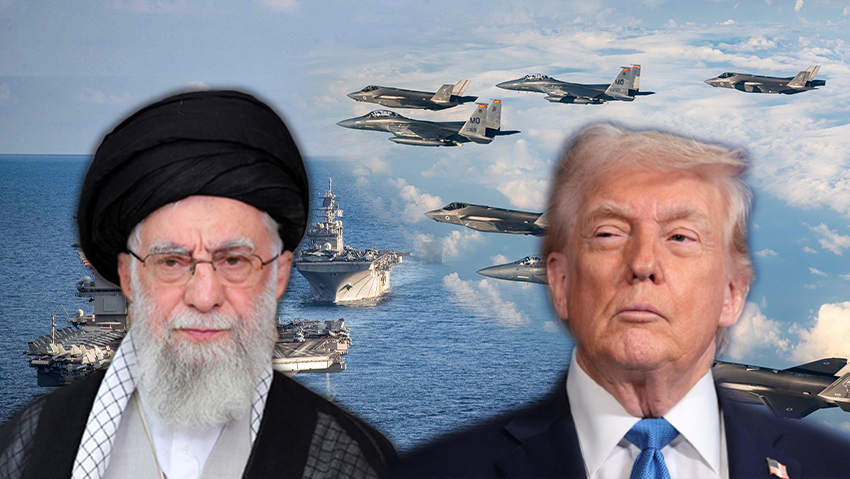
(Photo: REUTERS/Jonathan Ernst, Office of the Iranian Supreme Leader/WANA (West Asia News Agency)/Handout via REUTERS)
Trump has also told advisers that if diplomatic contacts with Iran or limited US strikes fail to compel Tehran to give up its nuclear program, he would consider a much broader attack in the “coming months,” the newspaper said. Such a campaign would aim to topple the ruling clerical regime, although the report noted there is no certainty within the US administration that such a goal is achievable.
The Times, citing American and Western security officials, reported that troubling signs have been detected that Iran could direct its proxies to carry out terrorist attacks against US targets in Europe and the Middle East if Trump orders large-scale strikes. Officials said no specific plots have been identified at this stage, but there has been increased “chatter” among militant groups, indicating a degree of planning and coordination.
The newspaper emphasized that no decision has yet been made. A third round of US-Iran talks is scheduled for Thursday in Geneva and is seen as a last opportunity to prevent an American strike, which Iranian officials have warned could ignite a regional war.
According to the report, a “last-minute proposal” is now on the table aimed at allowing both sides to step back. Under the proposal, a nuclear agreement would permit Iran to continue enriching uranium, but at a very limited level and solely for medical research purposes.
Iran has firmly refused to relinquish what it calls its right to uranium enrichment, while the US administration insists that any deal must result in “zero enrichment.” Officials familiar with the details told the Times that one compromise proposal under consideration in Washington and Tehran was raised by International Atomic Energy Agency chief Rafael Grossi, under which Iran would be allowed to enrich uranium only in very small quantities for medical needs.
The report noted that Iran produces isotopes used in medical research at a nuclear research reactor near Tehran, a roughly 60-year-old facility originally supplied by the United States. The reactor, Iran’s oldest, began operating in 1967 under Shah Mohammad Reza Pahlavi, who was ousted in the 1979 Islamic Revolution. It was built as part of the US “Atoms for Peace” program, which assisted developing countries in establishing civilian nuclear programs in exchange for commitments to use the technology solely for peaceful purposes.
If adopted, the proposal would allow Iran to claim it continues enriching uranium, while Trump could argue that Tehran is shutting down the main facilities that provide a pathway to a future bomb. However, the Times said it remains unclear whether Iran’s leadership would agree to such a compromise or whether Trump himself would accept it, given his stated demand for zero enrichment.
The report did not mention Israel’s demand that any agreement also impose limits on Iran’s ballistic missile program or its support for militias and militant organizations in the Middle East, amid concerns in Israel that the US might settle for a deal focused solely on the nuclear issue.
Israeli officials were surprised Sunday by the Trump administration’s decision to hold another round of indirect talks with Iran. In Israel, officials said Trump appeared to have accepted the recommendation of his envoy, Steve Witkoff, to give diplomacy another chance, even though Witkoff himself has acknowledged that Iran is not prepared to “surrender,” despite the significant US military buildup in the Middle East.
According to Israeli officials, Witkoff’s approach is troubling and signals weakness and compromise, which they argue will not lead Iran to back down. An Israeli diplomat said there is disappointment in diplomatic circles over Witkoff’s conduct, which is seen as allowing Iran to buy time. That delay, officials in Jerusalem believe, could further postpone a US decision on whether to pursue a military strike, at least until next week.
At the same time, Israeli officials noted the close coordination between Israel and the United States and cautioned that the possibility of American deception cannot be ruled out, as occurred before Operation Rising Lion. At that time, talks were scheduled between Iranian Foreign Minister Abbas Araghchi and Witkoff, but Israel carried out its strike before the planned meeting.
According to the Times, US officials expect Iran to present its updated proposal in the talks as early as Monday or Tuesday. Araghchi said in an interview with CBS on Sunday that “a diplomatic solution is still achievable.” He said prospects remain good and that Tehran continues to work on elements of a potential agreement with Washington. If the US seeks a solution to Iran’s nuclear program, he said, diplomacy is the only path. “We have proven that in the past, and I believe there is still a good chance. There is no need for a military buildup, and it cannot help. It cannot pressure us,” he said.
The Times also detailed internal US deliberations over possible military action, noting that due to the complexity of a commando raid against Iranian facilities — an option examined among a range of possibilities presented to Trump — the idea has for now been set aside. Such raids were considered to destroy enrichment or production facilities buried deep underground that could not be eliminated through airstrikes, but they would require special forces to remain on the ground for extended periods and would be extremely risky.
Officials familiar with the matter described parts of a meeting Trump held Wednesday with his top national security advisers. They said Trump pressed Chairman of the Joint Chiefs of Staff Gen. Dan Caine and CIA Director John Ratcliffe to outline the broader strategy toward Iran. According to those officials, Caine and Ratcliffe refrained from endorsing any specific policy: Caine discussed how the military could operate from an operational standpoint, while Ratcliffe addressed conditions on the ground and the potential implications of the various options.
Gen. Caine, who in discussions preceding last month’s operation to capture Venezuelan President Nicolás Maduro reportedly told Trump there were high chances of success, could not provide a similar assessment regarding action against Iran, the Times said. During Wednesday’s meeting, Vice President JD Vance, identified with the more isolationist camp in the administration, did not oppose a strike but posed pointed questions to Caine and Ratcliffe, urging them to clarify their positions on the options and to provide more information about the risks and complexities of a strike on Iran.