

Israel's first election exit polls point to a narrow lead for the bloc seeking to replace Prime Minister Benjamin Netanyahu, but neither side is projected to win the 61 seats needed for a parliamentary majority. While Netanyahu's Likud emerges as the country's largest party, Arab parties are projected to make substantial gains, potentially complicating efforts to form the next government.
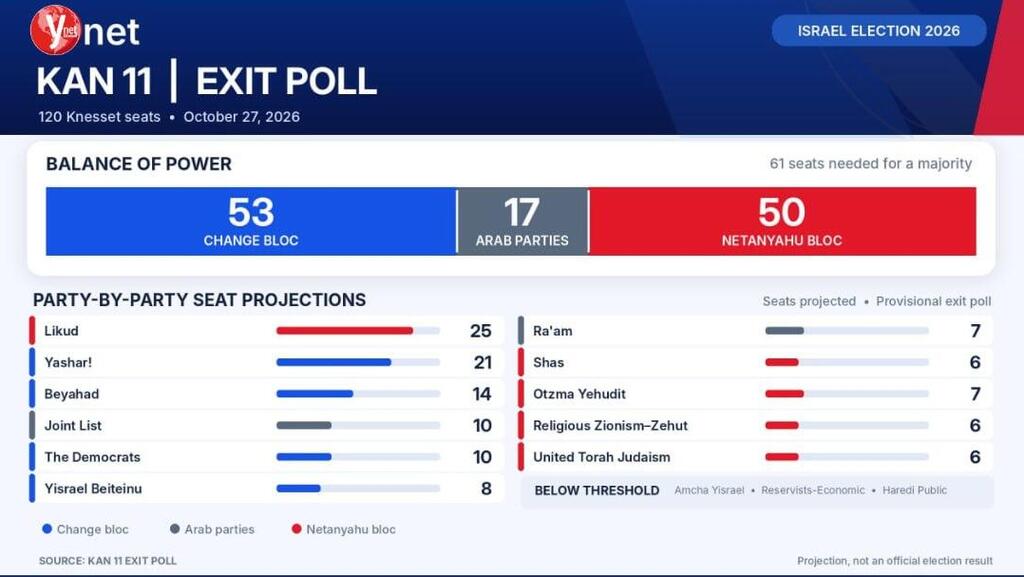
According to Channel 12's exit poll, the bloc seeking political change wins 52 seats, compared with 50 for Netanyahu's bloc. The two Arab parties secure a combined 18 seats, leaving neither main bloc with an outright majority in the 120-seat Knesset.
Gallery
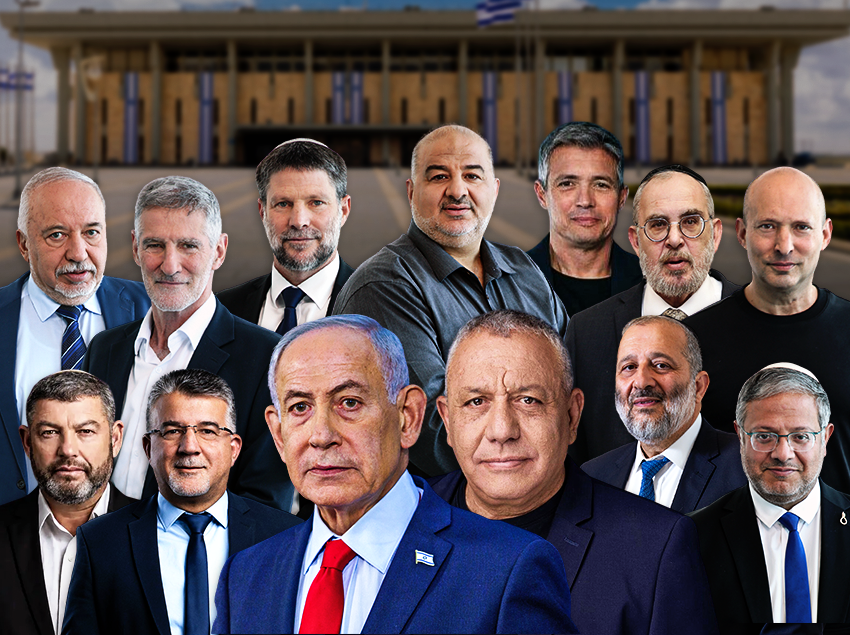
Israel election exit polls: Opposition edges Netanyahu, but no bloc wins majority
(Photo: Shutterstock, Shalev Shalom, Elad Malka, Joint List Spokesperson's Office, Ryan Preuss)
Channel 13 projects a slightly larger advantage for the change bloc, giving it 53 seats against 50 for Netanyahu's allies. The Arab parties receive 17 seats in that projection.
The results represent a significant shift from the final pre-election opinion polls, which had consistently placed Gadi Eisenkot's Yashar! party ahead of Likud. Both exit polls instead put Netanyahu's party in first place, although the broader political balance remains narrowly tilted toward his opponents.
The projections are based on surveys of voters and do not constitute official results. The allocation of seats could change as ballots are counted, particularly for parties close to the electoral threshold.
Channel 12: Likud leads with 24 seats, Yashar! follows with 22
Channel 12's exit poll projects Likud as the largest party in the 26th Knesset with 24 seats, followed closely by Eisenkot's Yashar! with 22.
Naftali Bennett's Beyahad party is projected to win 12 seats, while the Joint List, an alliance of Arab political parties, reaches 11.
The Democrats, led by Yair Golan, and Avigdor Lieberman's Yisrael Beiteinu each receive nine seats. The Islamist Ra'am party and the ultra-Orthodox United Torah Judaism party are projected to win seven seats apiece.
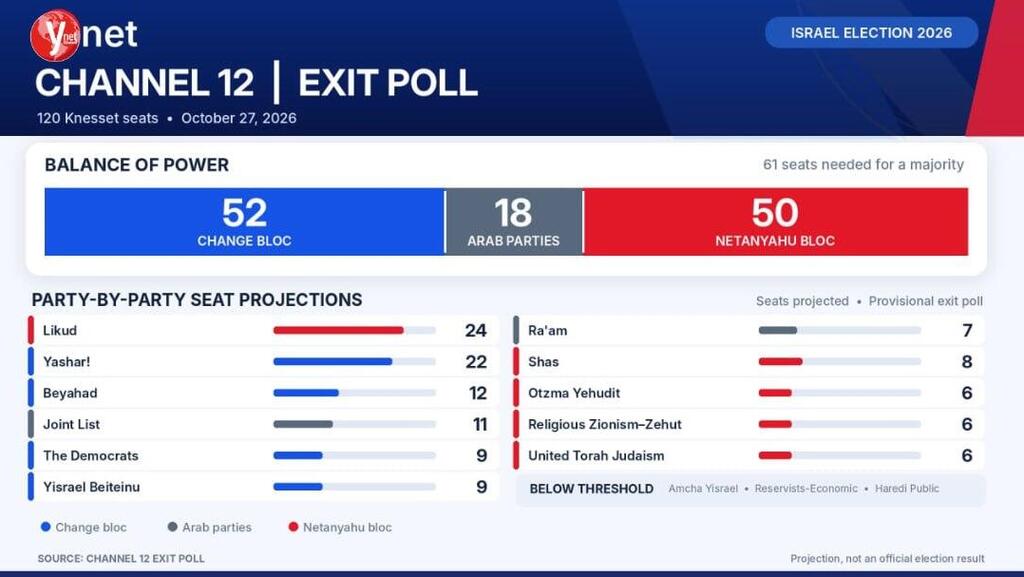
Shas and the Religious Zionism-Zehut alliance each receive six seats.
Together, the four main parties seeking to replace Netanyahu hold 52 seats, compared with 50 for the prime minister's political allies. The Joint List and Ra'am account for the remaining 18 seats.
Channel 13: Opposition bloc grows to 53 seats
Channel 13's exit poll presents a similar picture, although several parties receive different projections.
Likud leads with 25 seats, followed by Yashar! with 23. Bennett's Beyahad party wins 14, while the Joint List receives 10 and the Democrats nine.
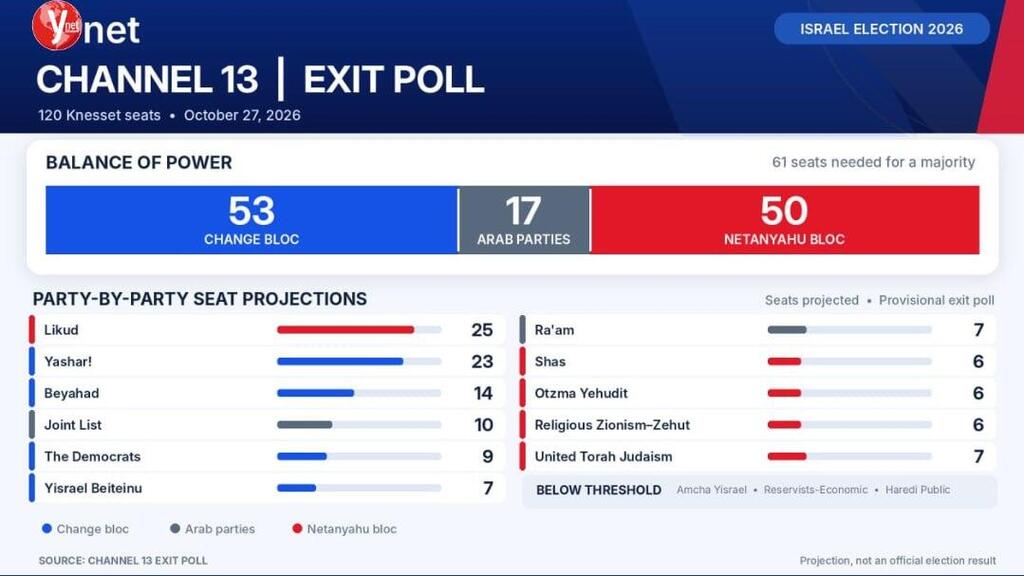
Yisrael Beiteinu is projected to win seven seats, alongside Ra'am and United Torah Judaism, which also receive seven each. Shas and Religious Zionism-Zehut are allocated six seats apiece.
The overall distribution leaves the change bloc with 53 seats, Netanyahu's bloc with 50 and the Arab parties with 17.
Despite the differences between the two surveys, both point to the same central political challenge: neither main bloc has enough parliamentary seats to form a government independently.
Arab parties emerge with 17 to 18 seats
One of the most striking developments in the exit polls is the increased representation projected for Israel's Arab parties.
Channel 12 gives the Joint List 11 seats and Ra'am seven, for a combined total of 18. Channel 13 projects 10 seats for the Joint List and seven for Ra'am, bringing their combined representation to 17.
That marks an increase from the final pre-election surveys, which projected 14 seats for the Arab parties on Channel 12 and 16 on Channel 13.
The gains could have significant implications for the parliamentary balance. With the two main political blocs separated by just two or three seats, the Arab parties' positions may become an important factor in the political negotiations that follow.
However, neither exit poll indicates an outright majority for the bloc seeking to replace Netanyahu, even as it holds a narrow advantage over his allies.
Three parties fail to cross the electoral threshold
Both exit polls also project that several smaller parties will fail to enter the Knesset.
Ofer Winter's Amcha Yisrael party remains below the 3.25% electoral threshold, as does the Reservists-Economic Party led by former minister Yoaz Hendel and economist Yaron Zelekha.
The Haredi Public party, which has attempted to attract ultra-Orthodox voters dissatisfied with the established religious parties, is also projected to fall short.
Under Israel's electoral system, parties that fail to secure at least 3.25% of valid votes receive no parliamentary seats. Their votes are excluded from the allocation of seats among qualifying parties, potentially affecting the balance between competing political blocs.
With record voter turnout, the absolute number of votes required to cross the threshold is higher than in previous elections. Final results could therefore change if parties finish particularly close to that mark.
Record turnout, but the final result could take days
The exit polls follow a day of historic voter participation. According to the Central Elections Committee, turnout had reached 74.3% by 8 p.m., the highest rate recorded at that hour since 1988.
A total of 5,449,277 Israelis had voted by that point, out of 7,331,981 eligible voters. At the same hour in the November 2022 election, turnout stood at 66.3%.
The final distribution of seats may remain uncertain for several days because of the large number of special double-envelope ballots, including votes cast by soldiers, diplomats, hospital patients and voters away from their registered polling stations.
More than 650,000 such ballots are expected to require separate verification and counting. Central Elections Committee officials have warned that the process could continue until Friday morning.
For parties hovering around the electoral threshold, those votes could be decisive, potentially changing not only their parliamentary representation but also the overall balance between political blocs.
Even once the final results become available, Israel's next government will not necessarily be determined. President Isaac Herzog must consult the elected parliamentary factions before assigning a lawmaker the task of forming a coalition.
With both exit polls showing a divided Knesset and no immediate majority for either main bloc, the central political question remains unresolved: which combination of parties, if any, can secure enough parliamentary support to form Israel's next government?