

Iran has arrested two organizers of a weekend marathon on a Persian Gulf island where many women were filmed running without a head covering. The event, held despite opposition from authorities and Iran’s sports federation, has become the latest example of women challenging the strict modesty laws enforced by the ayatollahs, even under threat of arrest for showing their hair in public.
Footage from the Friday morning race on Kish Island — a major tourist destination sometimes called “Iran’s Ibiza” — showed many of the roughly 2,000 female runners participating without a hijab. Another 3,000 men ran separately, as mandated by gender segregation rules. Clad in red T-shirts, numerous women appeared with uncovered hair, though many others kept it concealed.
Thousands of women run a marathon without hijab


The race went ahead despite the sports federation’s warnings of potential violations of Iran’s “legal and religious requirements.” On Saturday, the judicial authority announced the arrest of two organizers: a local government official on Kish and an employee of the private company behind the event. The marathon, it said, was held “despite previous warnings” to obey state laws and religious, social and professional norms, and the way it unfolded amounted to a breach of “public decency.”
Calls for punishment
The arrests followed angry demands from ultraconservative figures for an investigation. Tasnim, a hardline news agency, accused the marathon of promoting “public debauchery” and urged immediate punishment for those responsible. In an opinion column, a writer mocked officials he said had acted irresponsibly, calling the race a “disco marathon” and asking, “Is this the Islamic Republic or the Republic of Las Vegas? Who supported this foolish act?”
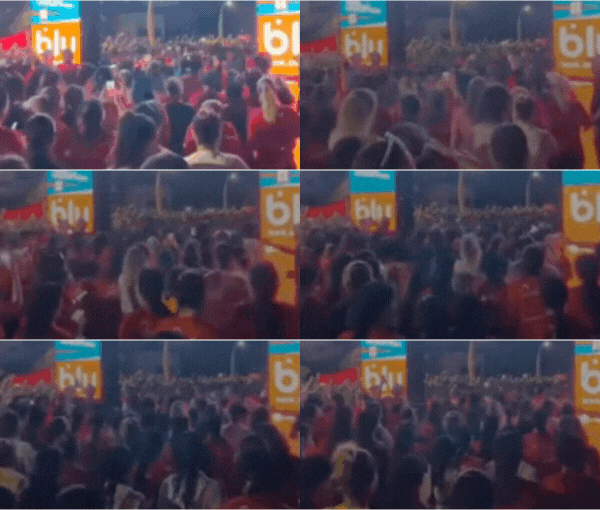
Masih Alinejad, an exiled Iranian journalist and opposition figure who survived a regime-backed assassination attempt in New York, said the arrests underscored what she called Iran’s “gender apartheid.” She wrote, “The regime in Iran just arrested two marathon organizers. Why? Because women ran without a hijab. Yes, in 2025. The Islamic Republic treats women’s hair and running as ‘national security threats’. Total madness.”
She shared images and videos of smiling runners and quoted one participant: “They won’t silence us. We won’t obey a ridiculous rule.” Women in Iran, she said, are breaking those restrictions “step by step.”

Kish Island
Echoes of the 2022 hijab protests
Under Iran’s strict interpretation of Sharia, women have been required to cover their hair in public since the 1979 Islamic Revolution. Until a few years ago, a mass event where women appeared with uncovered hair would have been rare. But in recent years, especially in major cities, more women have openly challenged the rules — a trend that intensified after the 2022 “hijab protests” sparked by the death of Mahsa Amini, who was detained by morality police for allegedly wearing her hijab improperly. That nationwide uprising posed the most serious challenge in years to the regime’s stability and was brutally suppressed, leaving hundreds dead and thousands arrested.
A reformist president with limited power
President Masoud Pezeshkian, a reformist considered more moderate on internal civil issues, has said he opposes excessively harsh enforcement of dress codes. Last year he announced he would not implement a parliamentary law aimed at significantly increasing penalties for hijab violations. “Human beings have the right to choose,” he said in a recent interview with NBC.
But in Iran’s theocratic system, the president does not have the final say on core issues. Hardline conservatives have sharply criticized Pezeshkian’s leniency. “The hijab is the first fortress of Islamic identity for Iranian women. If this fortress falls, all cultural and traditional foundations will collapse one after another,” wrote the ultraconservative daily Khayan, which is close to Supreme Leader Ayatollah Ali Khamenei.
Last month, Iran’s judiciary chief, Gholam-Hossein Mohseni-Ejei, said intelligence services had been instructed to “identify and report” what he described as “organized trends promoting immorality and the removal of coverings.” Mohseni-Ejei, who answers directly to the supreme leader and is not subordinate to the president, called for tougher enforcement of modesty laws to counter what he labeled “social anomalies,” claiming they were being pushed as part of “enemy efforts.”