

The Sea of Azov, the northeastern extension of the Black Sea, is a strategic maritime artery for Russia. Reuters reported Monday that ship traffic there remains restricted for “security reasons.” A source familiar with the matter said commercial vessels can move within the Sea of Azov, but cannot enter or leave through the Kerch Strait, which connects it to the Black Sea, or through the Azov-Don Canal, a strategic route linking the sea to Russia’s Don River and, from there, to the Caspian Sea.
'Russian soldier’ opens fire with machine gun, spins out of control and is thrown into the air


Ukrainian military footage shows drone strikes on Russian tankers and ships in the Sea of Azov
(Video: Ukrainian military)
The Guardian described Ukraine’s campaign in the Sea of Azov as an attempt to impose a limited maritime siege on Russia along a key trade route. Former Ukrainian defense minister Andriy Zagorodnyuk said the Kremlin had lost control of a critical maritime artery, especially because the route helps connect the Caspian Sea to global export channels through the Azov-Don Canal and the Don River. He said the strikes also disrupt Moscow’s ability to export grain allegedly taken from occupied Ukrainian territory through the ports of Mariupol and Berdyansk.
Gallery
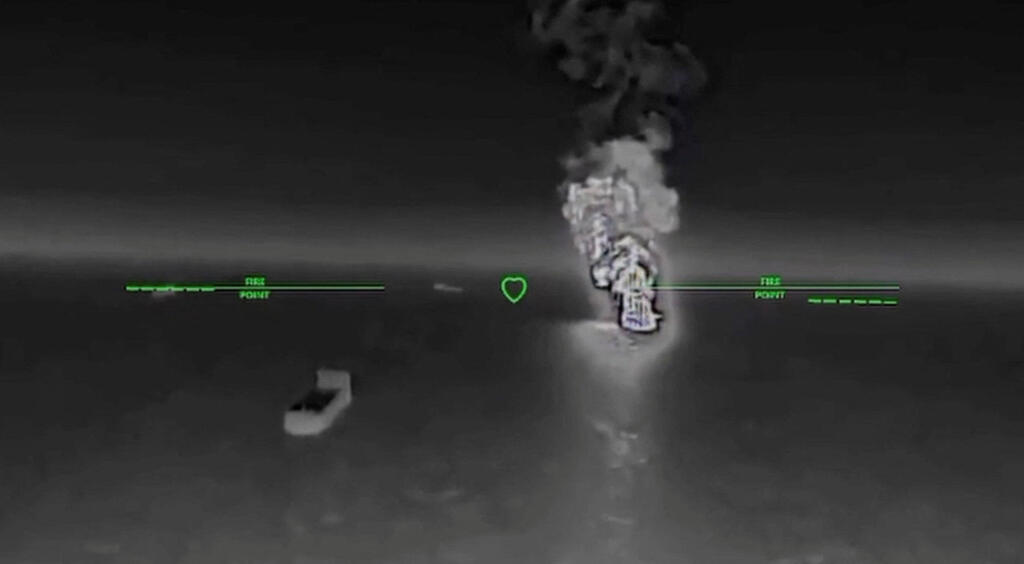
A Russian tanker burns after a Ukrainian attack in the Sea of Azov
(Photo: Commander of Unmanned Aerial Systems Force/Handout via REUTERS )
Ukraine’s unmanned systems commander Robert Brovdi, known as Magyar, said his forces hit another 15 Russian vessels overnight, including tankers, dry cargo ships, a ferry and tugboats. He said the number of Russian vessels struck in the Sea of Azov had reached 105 in eight days. His unit, Magyar’s Birds, released footage showing hits on Russian ships and oil tankers, including one explosion that sent a large cloud of smoke from a vessel’s deck. The unit said the attacks targeted Russia’s “shadow fleet,” used by Moscow to keep trading despite Western sanctions.
Russia has tried to protect some ships with cages and ropes, according to The Guardian, but the measures have not stopped the drone strikes. In several cases, crews reportedly abandoned damaged vessels that caught fire and were left drifting at sea. The Sea of Azov campaign is part of a wider Ukrainian drone offensive against Russian refineries, oil depots and fuel infrastructure, which has caused shortages in several regions and forced Moscow to restrict diesel exports and import refined fuel. The shortages are especially severe in Crimea, where Russian authorities declared a state of emergency and limited civilian fuel purchases.
Ukraine also continued striking deep inside Russia, with Moscow region authorities reporting three people killed and three wounded in a drone strike in Pionersky, while 81 drones were reportedly intercepted overnight.
The FSB claimed it foiled a Ukrainian plan to launch drones from inside Russia against the Shagol and Ukrainka air bases, in an alleged operation resembling Ukraine’s “Spiderweb” strike last year, when drones launched from trucks destroyed about 10 Russian warplanes. Kyiv says the purpose of the drone campaign, which President Volodymyr Zelensky has called “long-term sanctions,” is to disrupt Russian logistics, cut war funding from oil revenues and make Russian civilians feel the consequences of the war.
Operation Spiderweb last June: Drones exploded on Russian aircraft
(צילום: רויטרס)
The viral video circulating online appeared to highlight Russia’s military strain and improvisation. The footage, which has not been officially verified, appears to show a Russian soldier firing a machine gun during an air-defense drill before losing control from the recoil. As the gun fires, the soldier spins, loses his grip and is thrown into the air, while the weapon continues firing on its rotating mount and another soldier nearby ducks to avoid the line of fire.
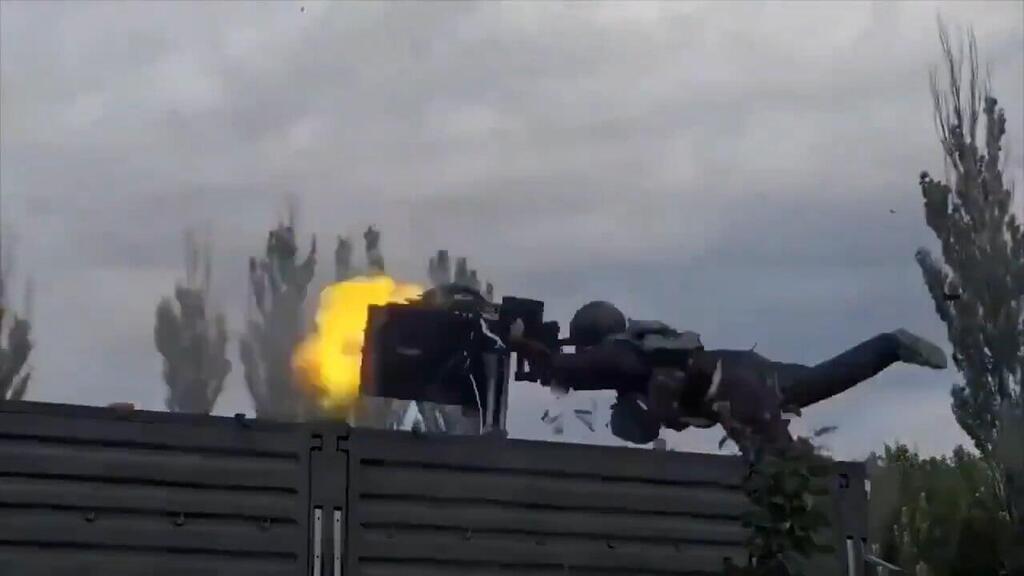
The soldier spins and is thrown into the air moments before losing control

It is unclear where or when the video was filmed, though reports said it first appeared on a Russian Telegram channel. ynet commentator Yair Navot noted that the weapon appears to be a YaKB-12.7 machine gun, originally designed for Russian Mi-24 attack helicopters, mounted on a makeshift rotating platform to counter Ukrainian drones. Its rate of fire, about 4,000 rounds per minute, likely produced the massive recoil that sent the soldier flying. The clip quickly went viral, drawing ridicule online over Russia’s improvised anti-drone defenses.