

It took us a little more than half an hour to cover a route that should have taken no more than two minutes.
Moments after leaving the center of the Palestinian village of Qusra and beginning the climb up the road leading to the besieged home of Louay Abu Rida, we stopped in front of a roadblock manned by Border Police troops. We counted three white Toyota Hilux pickup trucks and two brown jeeps blocking the road. One of the officers approached our vehicle and asked what we were doing there.
The violent attack in Qusra last Saturday


Qusra is a Palestinian village in Area B, southeast of Nablus, just before the descent toward the Jordan Valley. In recent weeks, it has made headlines not only in Israel but around the world.
One might ask what happened in Qusra that has not happened elsewhere in the West Bank. After all, relentless violent raids, attacks and what Palestinians describe as daily terror by extremist hilltop settlers against Palestinian communities and villages accelerated immediately after the war began on October 7, 2023, and have continued ever since.
The specific case is not new either. The method of setting up an outpost in or near the yard of a Palestinian family’s home, then subjecting the residents to harassment and attacks around the clock in an effort to break them and force them to leave so settlers can take control of the property, has been used successfully elsewhere.
It happened not far from here, in the village of Jalud, where the Tubasi family was driven from its home by the same method. Reporters and television crews from around the world did not descend on that village.
Perhaps the reason Qusra has attracted so much attention has to do with the homeowner at the center of the affair.
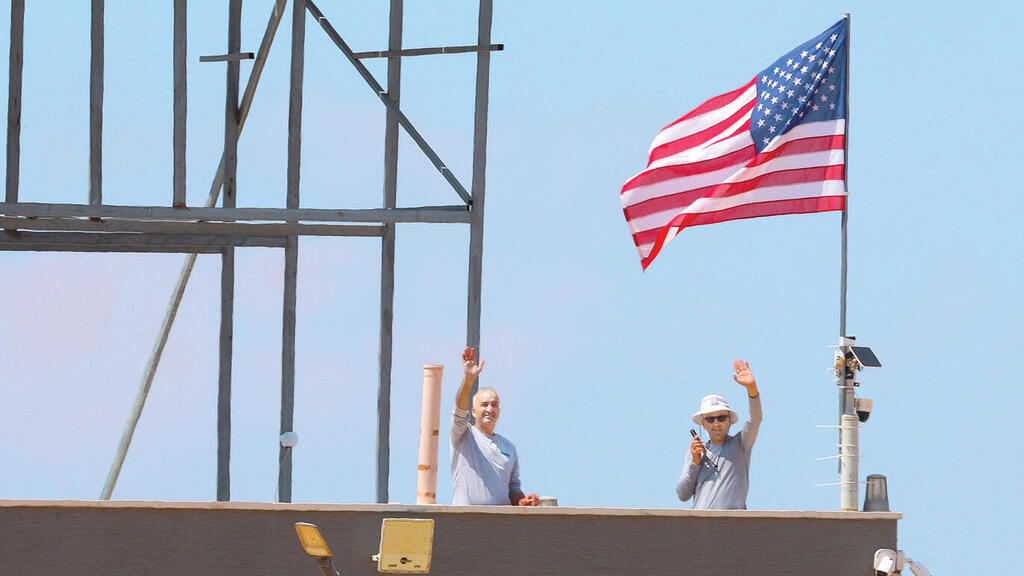
Abu Rida is an American citizen who speaks fluent English, making him an effective spokesman before the international media. When settlers began laying siege to his home more than three weeks ago, he was at his home in Ohio. Several days later, with assistance from the U.S. Embassy, he arrived in the village and quickly hung an American flag from the roof.
A Palestinian home under attack and siege by settlers, with the Stars and Stripes flying from its roof, was something new.
‘Go up, it’s your responsibility’
The roadblock lasted about half an hour.
The first officer who approached us wanted to know who we were. After a series of questions and answers, he warned us that the area was extremely volatile and that if violence suddenly erupted, we would find ourselves alone.
“We won’t be there to get you out,” he warned, then asked again: “Are you sure you want to go up there alone?”
About 15 minutes later, we underwent another round of questioning, this time by a man in civilian clothes who showed us a police ID. He was part of the Border Police force, though only later would we learn what the unit was doing in the area.
They took our identification cards, checked over the radio, waited for a response and eventually said there was no problem.
“You can go up,” they told us, “but it’s your responsibility.”
As noted, what is happening in Qusra is not unusual.
At the beginning of 2026, an outpost called Tel Talpiot was established on the mountain above the village center. Like it, dozens of other outposts have been established and continue to spring up across the West Bank.
The mountain, Jabal Ein Eina, is the highest in the area and among the highest points in the West Bank. Settlers attach great importance to it because of the commanding view it offers over the surrounding area.
Shortly after the outpost was established, residents of nearby villages — Jalud, Talfit and Qusra — began reporting daily attacks by settlers, often masked.
Most of the attacks were documented in real time on cellphones and security cameras, and in many cases the Palestinians who said they had been attacked also filed police complaints.
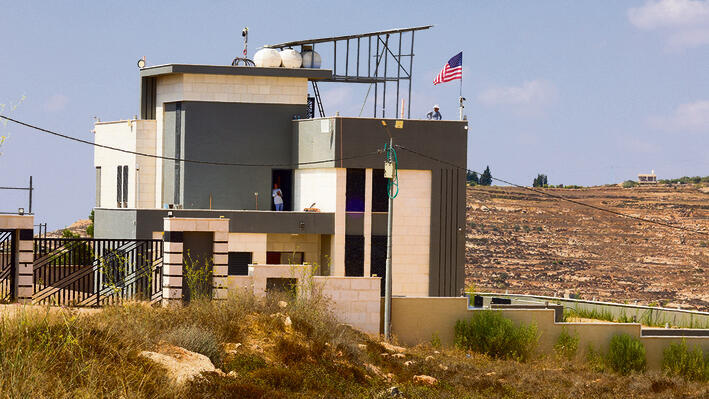
The besieged house
(Photo: Shaul Golan)
Oded Fafurish, an activist with a group that provides a protective presence for Palestinians in the West Bank, said that in mid-February, as attacks by settlers from the outpost on Qusra residents intensified, villagers asked his group for help.
“They asked us to come and provide a protective presence because even then the attacks were already very intense and had caused one family in the village to leave its home,” he recalled.
“I got there on Friday, Feb. 27, the day before the big war with Iran began. It was me, Yael Levkovitz and Adi Cohen Harari. We went to show solidarity with a family whose home settlers had entered and ransacked.
“One of the residents asked us to come with him to see damage done to a house he was building on the road up the mountain. When we got there, I went inside with two village residents while Yael and Adi stayed outside.
“Within minutes, four masked settlers arrived on an ATV. They had wooden clubs and began beating both women. Adi was struck very hard in the head and collapsed.
“When I heard the screams, I came out of the house and the attackers began chasing me. They caught me, knocked me to the ground and beat me with clubs. I suffered four comminuted fractures in my right hand, broken ribs and a deep cut in my eyebrow above the eye.
“Adi was critically injured. She lost consciousness and there was serious concern for her life. If Yael had not insisted with Magen David Adom and the police that they come evacuate her — really insisted, shouting at them — she would not have survived.”
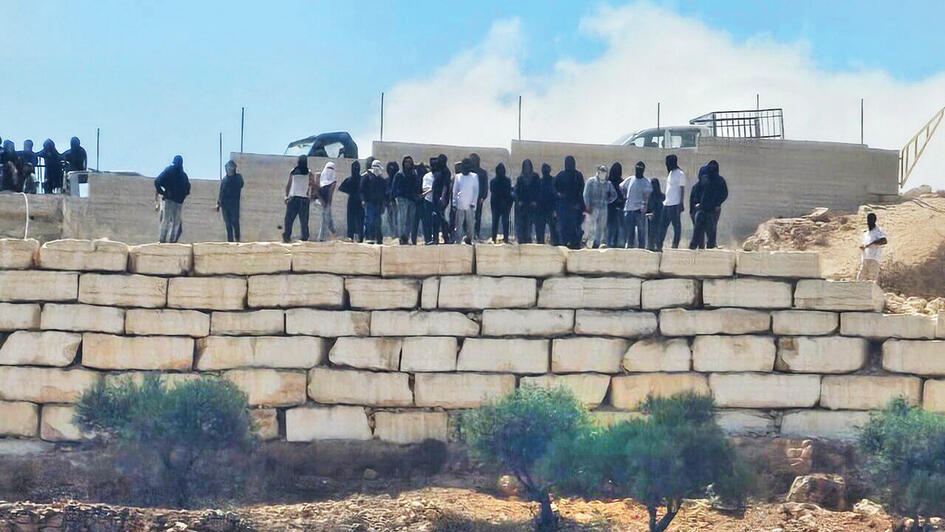
Masked settlers in Qusra; Maj. Gen. Bluth’s order has not deterred them
Two weeks later, settlers again raided homes in the village.
It happened during the war with Iran, when warnings of ballistic missile attacks were sending large parts of Israel into bomb shelters several times a day.
During the violent raid on March 14, several residents tried to confront the settlers and push them out of the village. In response, several armed settlers opened fire, killing 28-year-old Amir Odeh and wounding his father, Muatasem, who was left disabled.
Qusra residents say the army and police have evacuated the outpost several times.
“But every time, after an hour or two, the settlers go back and rebuild their tent and shed and bring a few goats and sheep, and this situation continues nonstop, day after day,” said village council head Wadi Abd al-Azim.
“We are deep inside Area B. This is territory under Palestinian civilian responsibility. Anyone who builds here receives approval from Palestinian authorities. Israel is responsible only for security — including our security, as Palestinians — but construction is our responsibility.
“This area on Jabal Ein Eina belongs to Qusra. The settlers have no business being there. They come and cut water pipes and electricity cables, they took control of a spring, they attack people’s homes so they will flee. They are making our lives hell.
“We have repeatedly contacted the Palestinian District Coordination Office so it can approach the Israeli DCO. We contacted the army, the Civil Administration, the Israeli police — we have appealed to everyone in the world.
“Since January we have approached everyone we possibly could, but it does not help. The settlers do whatever they want and the army works with them and does not stop them from harming us.
“We have 40 young men from the village in prison since the settlers began attacking us, and not one of the settlers attacking us has been arrested.”
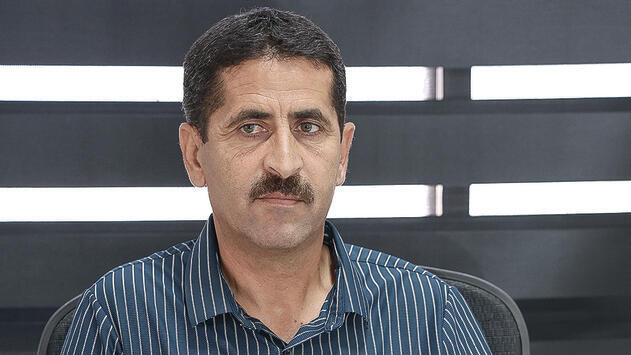
Al-Azim
(Photo: Shaul Golan)
The hilltop activists have a strategist who lays out policy and identifies targets. His name is Elisha Yered, and he is highly active on social media.
After efforts to take control of areas in Area C and drive Bedouin communities from them, Yered identified a new objective: settlement in Areas B and A.
On the night of Aug. 9, several settlers descended from the outpost at the top of the mountain and erected a makeshift shelter in front of the Abu Rida family home.
The house stands on the outskirts of Qusra, not quite at the summit but close to it. Two other homes belonging to the Hassan family are nearby.
From that moment, residents said they could not so much as stick their heads outside without being met by a barrage of stones.
The IDF arrived but, according to the residents, made little effort to remove the settlers. A siege was imposed on the house, and the videos filmed by Louay’s brothers, Wafiq and Qusai, made no difference.
The army declared the area around the besieged homes a closed military zone, barring anyone from entering.
During the first days after the army arrived, settlers remained in the area, while Israeli activists who wanted to visit the besieged family and bring them food were barred from entering.
As international attention grew and the U.S. administration began condemning the situation and demanding answers about what was happening on the mountain above Qusra, the settlers were also moved away — though only from the immediate vicinity of the house, not from the mountain as a whole.
Attackers and victims
We were now in the home of Saddam Odeh, below which stood the Border Police vehicles that had blocked us from driving up the mountain.
Odeh’s house sits at the beginning of the road leading to Abu Rida’s besieged home and is covered by security cameras providing a 360-degree view.
Last Saturday, Louay Beiruti, another village resident, asked Odeh to accompany him to the shell of a house he is building farther up the mountain.
It was at Beiruti’s house that Fafurish, Cohen Harari and Levkovitz had been attacked about six months earlier.
“Beiruti wanted to put metal grilles over the windows and doors because settlers enter his house and destroy the equipment and building materials there,” Odeh said.
“There were seven workers with Beiruti, and a few minutes after we arrived, three settlers came on an ATV. They saw that we were working and it drove them crazy.
“They filmed us and went up to a four-story building that is also under construction, above Beiruti’s house. They waited there for their friends to come.
“I’m telling you, within 15 minutes maybe 70 settlers came down from the mountain. They came on foot and in pickup trucks and started throwing rocks at us inside the house.
“They were accompanied by settler-soldiers” — a reference to local defense troops — “who fired two tear-gas grenades into the house. We started choking and went up to the roof, where the air was open and we could breathe.”
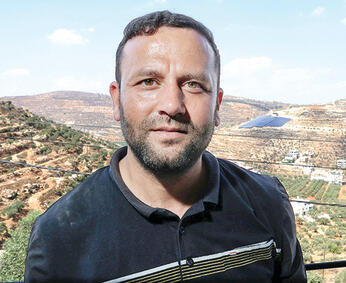
Saddam Odeh
(Photo: Shaul Golan)
The entire incident was documented on cellphones by residents watching from a distance and on security cameras mounted on homes.
After footage of pickup trucks filled with masked settlers circulated around the world, settlers said they had been attacked first and that the large group had merely arrived as reinforcements to rescue settlers who had been ambushed with stones by Palestinians.
Such defenses by settlers are familiar, Odeh said.
“They are always the victim,” he said. “Even the police say the settlers are lying.”
How do you know that is what the police say?
“They took testimony from me about what happened. And just before you arrived, Border Police officers were here at my house. They came in a large force to take the DVR from the cameras.
“I told them, ‘You could have sent one person and I would have gladly given it to him. We want you to see what the cameras recorded.’
“The thing is, now it is Tuesday and the incident was Saturday. Look how long it took them to come get the footage. If it were the other way around, if Palestinians had gone into a settlement, they would have come to collect it in less than an hour.”
At least, as far as you are concerned, Saturday’s incident ended safely.
Odeh frowned. “We were hit by rocks and one of us could not breathe on the roof. Eventually soldiers arrived and we said to one another, ‘Finally, the regular army is here. They’ll get us out of here alive.’
“Not two minutes passed before soldiers came up to the roof, tied our hands behind our backs with plastic restraints and blindfolded us.
“The man who had trouble breathing begged them not to restrain him, and they didn’t.
“They threw us into a military vehicle and we had no idea where it was going. Inside the village, you can drive maybe 200 meters. But they took us to the entrance to Duma, a village about a 10-minute drive from here, and dumped us on the road.
“Before they left, they told the man who had trouble breathing to count to 60 and then release us.”
The IDF said the Palestinians were detained because of stone-throwing.
“After the Israeli rioters fled the area, the forces handcuffed several Palestinians,” the military said. “According to the force at the scene, one of them resisted, leading to proportionate force being used against him. The suspects were taken for questioning and released a short time later.”
Council head Abd al-Azim added: “The attacks intensified from the beginning of the year with the new settlement. Altogether, we have been surrounded by 16 new settlements” — farms and outposts.
“A settlement like that can consist of just one tent. It is enough to have three or four men there with a few goats or sheep, and that’s it. The most serious attacks come from places like these.
“In our village, four homes were completely burned. Seven homes were partially burned and badly damaged, and 18 vehicles were burned and declared total losses.
“They also burned two mosques and three businesses. The biggest property damage was in the chicken-coop area at the southern edge of the village.
“We have 11 large chicken coops there, and four were burned. Three of them contained a total of 30,000 chickens. They all burned to death. The structures themselves and the water and electricity systems were badly damaged.
“Out of fear, nobody in the village goes near that area anymore. And we don’t have insurance, so nobody here received a single shekel in compensation for the damage caused by the settlers.
“A dunam of land here was worth 6,000 dinars in 2011, and by 2023 it had climbed to 40,000 dinars. Now nobody would take a dunam here even for free. For free.”
He pointed toward the mountain.
“They want to eliminate us.”
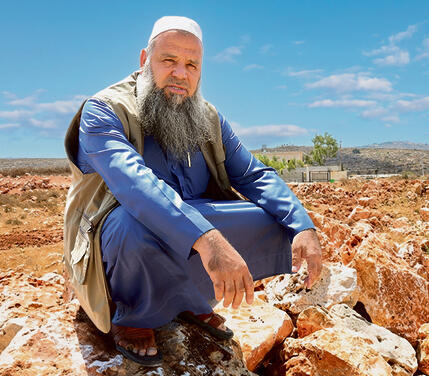
Sheikh Odeh
(Photo: Shaul Golan)
We sat in the village council office. Sheikh Ziad Odeh, imam of one of the village mosques and a fluent Hebrew speaker from the days when he worked in Israel, joined the conversation.
“I am sounding a warning to normal Israelis, and I know they are the majority in Israel,” he said.
“They need to know what is happening here. They will not be able to say, ‘We didn’t know,’ because these things are already known around the world.
“What is happening in Qusra is not happening only in Qusra. It is happening in all the villages in the area.
“Every day that passes pushes people closer to the edge. There is a limit to how much suffering people can endure.
“People have no work, and the settlers have taken our agricultural land or do not allow us to go out and work it. We have lost 70% of Qusra’s agricultural land. The settlers have taken control of it.
“Wherever you go, there are problems. So patience has an end.
“The settlers hurt people, and the government is with them, the army is with them, the police are with them.
“Everyone saw what happened in the village of Tell when settlers went in there. Sheikh Farouk” — Farouk Ramadan, who seized the weapon of Binyahu Malt, deputy security coordinator of Havat Gilad, and used it to kill Malt and Maj. Yuval Ezra — “couldn’t take it anymore.
“It will happen in other places. I am sure it will happen. It will happen because people have nothing left to lose.
“They are in a corner, on the edge. We in Qusra are already at the edge. We have nothing left to lose.
“We are heading toward a very serious escalation. Once someone enters your home, what are you left to do? You have to defend yourself.”
American procedure
After warning us against going up the mountain, the Border Police officers got into their vehicles with the DVR taken from Odeh’s home and left.
We drove slowly uphill and passed Beiruti’s house, which dozens of masked settlers had attacked Saturday.
None of them was detained at the scene. Only yesterday, nearly a week later, was the first suspect arrested.
Maj. Gen. Avi Bluth, head of the IDF Central Command, signed a military order a year ago prohibiting people from covering their faces in public areas of the West Bank.
The order applies to all civilians, Jews and Palestinians, and is intended to address the difficulty of identifying rioters involved in disturbances and nationalist crimes.
Violating the order is punishable by up to six months in prison, but it has not deterred hilltop extremists. They continue to move through and attack Palestinian villages while masked.
What reason would they have to obey the order when the soldiers themselves do not enforce it on the ground?
The army had set up a shade canopy about 50 meters from Abu Rida’s house. When we arrived there at midday Tuesday, two female reservists were stationed beneath it.
They did not allow us to approach the house, saying that a closed military zone order applied from the canopy to the house compound.
That is the situation now: It is no longer the settlers imposing a siege on the house at the top of the mountain in Qusra, but the army.
“Is that you over there in the white car?” Louay Abu Rida asked us by phone, waving his hand.
We said yes and waved back. He did not sound well.
“Look at the absurd situation we are living in,” he said. “I am locked inside my own home, under siege, unable to leave or have people come to me. It is a nightmare.
“Today is the 25th day of the siege on the house. The military checkpoint prevents us from leaving and returning to the house freely.
“The siege is total. Today, after three or four days of coordination, we managed to bring up a pickup truck with food and medicine.
“I’m telling you, we coordinated this delivery with the Palestinian side, the Civil Administration, the Israeli DCO, the Israeli army, everyone we needed to.
“In the end, when the truck arrived, they allowed it to drive up, but the female soldiers at the checkpoint before the house stopped it.
“They said nobody had coordinated with them. They did not know a delivery was supposed to arrive.
“So they agreed to let three of us leave the house and carry the boxes of food and medicine ourselves.
“We did it in several trips in the heavy heat — me, my brother Wafiq and the neighbor’s father.”
You appealed to Israel’s Supreme Court and you are in contact with the U.S. Embassy. Can you estimate when this nightmare will end?
“We filed a petition asking the Israeli court to order the army to prevent settlers from approaching our homes.
“The court asked the state to respond and explain what it intends to do to allow us to return to normal life.
“Unfortunately, nobody from the embassy has come to see what is happening here.
“I am an American citizen. My mother has a green card. We are entitled to American protection, but aside from condemnations, I have heard nothing from the administration.
“I very much hope your court will help, that the world will intervene, that America will exert pressure, that something will happen and we can get out of this situation.
“Wait, wait. The embassy is calling me. I have to answer.”
It was Millie from the embassy in Jerusalem.
We could not hear the entire conversation, except for a reference to a digital form he needed to fill out.
We called him again afterward and he sounded disappointed.
“It was about some procedural matter,” he said, “nothing that will help us get out of this terrible situation.”
In response to the report, the IDF said:
“Over the past month, reinforced IDF and Border Police forces have been deployed in the area of Qusra village in the Samaria Brigade in order to prevent friction and the entry of Israeli rioters into the area and to respond to every report of a disturbance.
“A closed military zone order was imposed in the area in order to protect the families and to enforce the law and prevent lawbreakers from reaching it.
“Accordingly, and for their protection, it is not possible to enter or move through the area of the homes without coordination.
“The family is in contact with IDF representatives, and eight entries have been coordinated over the past two weeks.”