

Kyiv accuses Vladimir Putin of “hallucinations.” One of his closest allies warns that international relations have become a “madhouse.” And one thing is clear: the breakthrough Donald Trump had hoped for in talks to end the war in Ukraine is not coming anytime soon.
The clearest evidence came in what was widely seen as an especially threatening message from Russia to the West, after Moscow announced Friday that for only the second time it had used a long-range ballistic missile capable of striking all of Europe and theoretically carrying a nuclear warhead. The missile was launched in an attack on western Ukraine, very close to the Polish border. Poland is a member of NATO.
Gallery
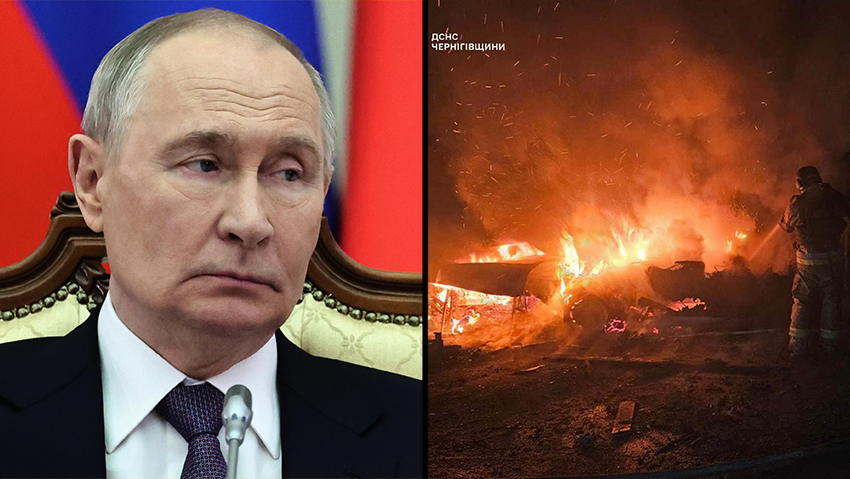
Vladimir Putin and fire after one of the repeated attacks on Ukrainian cities
(Photo: Handout / UKRAINIAN EMERGENCY SERVICE / AFP, Alexander Kazakov, Sputnik, Kremlin Pool Photo via AP)

A building hit in Kyiv in Thursday’s attack, which included the Oreshnik strike on Lviv, along with dozens of other missiles and 242 drones; four people were killed in the capital
(Photo: Sergei SUPINSKY / AFP)

Hundreds of thousands were left without electricity in Kyiv, as temperatures fell to minus 10 degrees Celsius
(Photo: Andrew Kravchenko / AFP)
The missile Russia used, the hypersonic ballistic Oreshnik, can reach a range of up to 5,000 kilometers, according to Moscow — meaning it could strike anywhere in Europe and theoretically even reach the eastern United States. In Thursday night’s attack, the missile reportedly hit near the city of Lviv, about 60 kilometers (37 miles) from the Polish border. On the other side of that border is a military base that has served throughout the war as a key hub for transferring advanced Western weapons to Ukraine, helping Kyiv repel invading Russian forces.
Ukrainian officials did not specify exactly what was struck, saying only that it was some form of infrastructure. They reported no casualties.
Alongside the Oreshnik launch, Ukrainian authorities said Russia fired 13 additional ballistic missiles, 22 cruise missiles and 242 drones. Four people were killed in Kyiv, and damage was also reported at Qatar’s embassy in the city. Later reports said about 500,000 households in the Ukrainian capital were left without electricity after energy infrastructure was hit, with temperatures around minus 10 degrees Celsius (14 degrees Fahrenheit).
Russia’s Defense Ministry confirmed it had launched an Oreshnik missile as part of the massive attack, without specifying the target. It claimed the strike was retaliation for an alleged Ukrainian drone attempt to hit Putin’s official residence in Novgorod late last year — a claim Kyiv has flatly denied. US President Donald Trump also said last week that such an attack did not take place.
The Oreshnik launch was seen as especially unusual because the missile can theoretically carry a nuclear warhead. This was only the second time Russia has used it. The first, in November 2024, was also widely viewed as a message to the West. At the time, Moscow struck an abandoned Ukrainian factory in the central city of Dnipro, calling it a “test.” That attack followed then-President Joe Biden’s approval for Ukraine to strike inside Russia with US-made HIMARS missiles.
Explosions in Dnipro during the first Russian attack using the Oreshnik missile, November 2024
(Reuters)


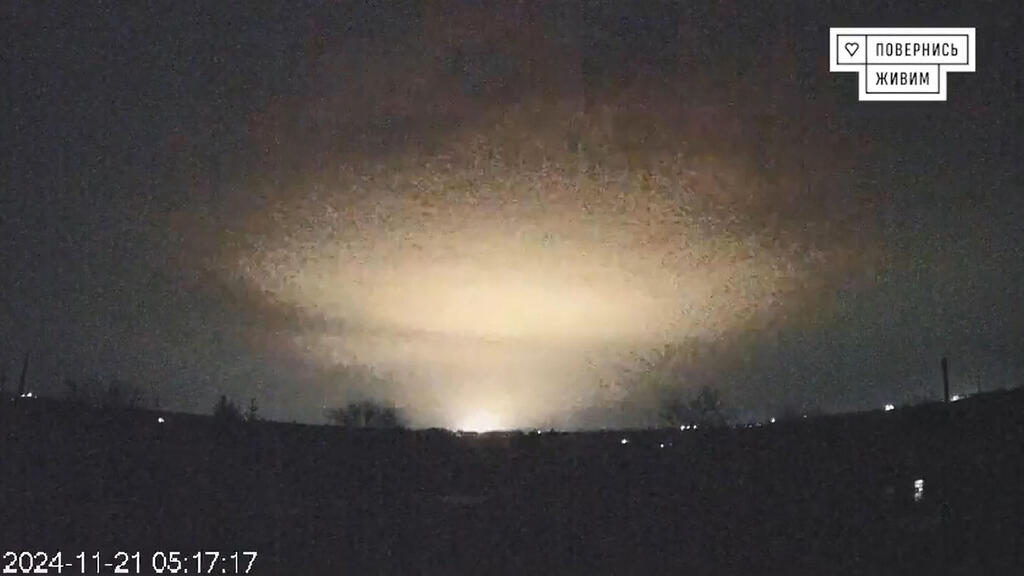
Footage from the previous Oreshnik attack in Dnipro
(Photo: COME BACK ALIVE / AFP)
Experts now assess that this was another Russian attempt to remind the West of its strategic nuclear capabilities, without explicitly using its nuclear arsenal. The backdrop includes European leaders’ insistence on sending troops to Ukraine in the event of a future ceasefire, as well as growing tensions with Trump following US action against Venezuela, a Russian ally, including the capture of its leader Nicolas Maduro and the seizure of an oil tanker that had flown a Russian flag in an apparent attempt to avoid takeover by the US Navy.
13,000 km/h and a ‘neutralized’ split warhead
Further evidence that the launch was meant as signaling rather than to inflict maximum damage came from a senior Ukrainian official, who told Reuters that the missile used in Thursday’s strike on what he described as a “state enterprise” near Lviv likely carried neutralized warheads or decoys. Similar reports followed the 2024 strike on Dnipro.
The Oreshnik missile, whose name means “hazel tree” in Russian, was unknown before the 2024 attack. It is classified as an intermediate-range ballistic missile, a category capable of carrying nuclear warheads and ranging from 500 to 5,500 kilometers. Washington and Moscow agreed during the Cold War to abandon such weapons, but that treaty collapsed in 2019. Russia says the Oreshnik’s range is close to 5,000 kilometers, just short of the threshold for an intercontinental ballistic missile. Recent reports say it has also been deployed in Belarus, a Russian ally.

Remnants of the Oreshnik missile that struck a facility in Lviv, in footage released by Ukraine
(Photo: AFP PHOTO / UKRAINIAN SECURITY SERVICE)

(Photo: AFP PHOTO / UKRAINIAN SECURITY SERVICE)
Putin has claimed the missile can travel at 10 times the speed of sound, “like a meteorite,” making it impossible to intercept with air defense systems. Ukraine’s military reported Friday that it reached a speed of 13,000 kilometers per hour — about Mach 10.5. The missile’s warhead can reportedly split into at least six separate warheads, each of which can then split again into six submunitions. Putin has previously said the missile is so powerful that a strike using only conventional warheads could be as destructive as a “strategic,” meaning nuclear, attack.
Multiple independently targetable reentry vehicles, or MIRVs, have been used for decades on intercontinental ballistic missiles. Such systems allow a single missile to strike multiple targets with separate warheads, each with its own guidance. The Oreshnik’s potential nuclear capability makes even its conventional use dangerous, because NATO countries would only know whether a warhead was nuclear or conventional after impact, increasing the risk of miscalculation. During the earlier Dnipro strike, the Pentagon said Russia had provided advance notice through nuclear risk-reduction channels. It remains unclear whether such notice was given this time.

Trump and Zelenskyy during their meeting last month
(Photo: AP Photo/Alex Brandon)
Kyiv and its allies issued a wave of sharp statements in response. “An attack this close to the EU and NATO border is a threat to the security of the European continent and a test for the transatlantic community,” Ukrainian Foreign Minister Andrii Sybiha said. Referring to Moscow’s justification for the strike, he called it a “response to Putin’s hallucinations.”
EU foreign policy chief Kaja Kallas said the launch was a threat to Europe and the United States. “Putin does not want peace. His response to diplomacy is more missiles and more destruction,” she said. “This deadly pattern of major Russian attacks will continue until we help Ukraine break it.”
‘Madhouse’
The strike came shortly after Britain and France announced plans to send “peace enforcement forces” to Ukraine if a ceasefire is reached — a move Moscow rejected outright, warning that any foreign troops on Ukrainian soil would be considered legitimate targets.
Gerhard Mangott, a Russia expert at the University of Innsbruck in Austria, said Moscow is frustrated by what it sees as its marginalization in talks among the United States, Ukraine and European countries. His comments came against the backdrop of Trump’s remarks last weekend that he is “not enthusiastic” about Putin at this point.
Trump has also recently signaled support for legislation in the US Senate that would tighten sanctions on Russia, particularly targeting countries that buy Russian oil, such as China and India. Britain’s Telegraph reported Friday that Trump is increasingly frustrated with Putin and views him as a greater obstacle to peace than Ukrainian President Volodymyr Zelenskyy.
A source close to Trump told the newspaper that the seizure of the “Russian” tanker from Venezuela and Trump’s support for the sanctions bill — promoted by his ally Sen. Lindsey Graham — were signals to Putin that his patience is wearing thin. “He works with the carrot and the stick,” the source said. “And I think he’s run out of carrots.”
According to Mangott, Russia is “especially angry” over Europe’s insistence on sending troops to Ukraine in a ceasefire scenario, a step European leaders see as necessary to deter Moscow from launching another invasion in the future. “The missile launch is a signal to the United States and the Europeans about the Russian military’s capabilities,” Mangott said. “Russia wants to be taken seriously because of its military arsenal, and wants Europe and Trump, at a minimum, to respect Russia’s position in negotiations.”
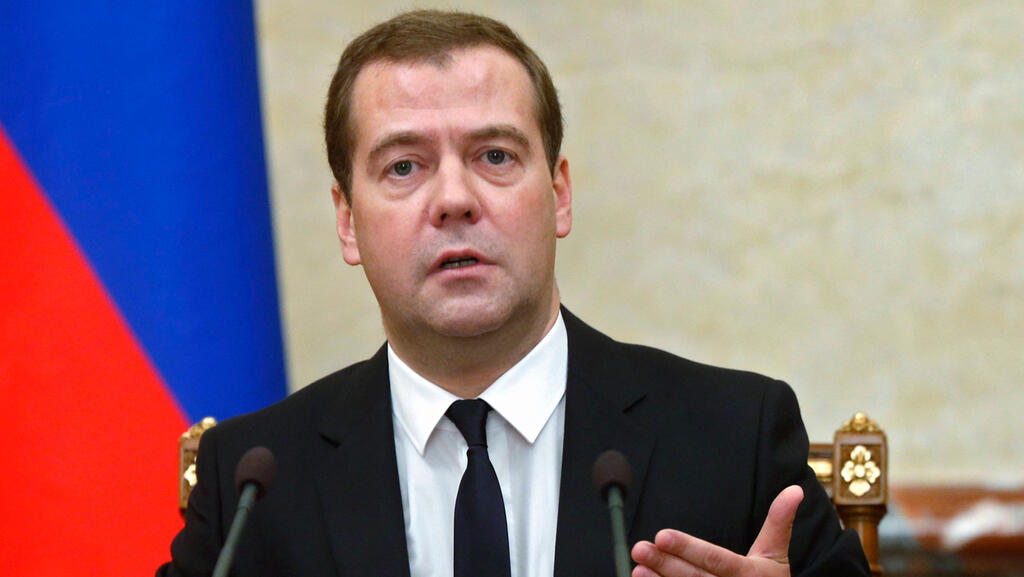
Dmitry Medvedev frustrated by a 'turbulent' start to 2026
(Photo: AP)
Former Russian President Dmitry Medvedev, now deputy head of Russia’s Security Council and a close Putin ally, hinted in a social media post that the missile launch was also linked to Maduro’s capture and the US takeover of the Venezuelan oil tanker that flew a Russian flag. He also mentioned the possibility of new US sanctions, calling it a “turbulent” start to the new year.
Medvedev, known for his hawkish rhetoric and past attacks on Trump, said international relations had descended into a kind of “madhouse.” He compared the Oreshnik launch to an “emergency injection of haloperidol,” an antipsychotic drug.