


Palestinian politician Sufian Abu Zaida, a senior figure in Fatah and the Palestine Liberation Organization and a former Palestinian Authority minister for prisoner affairs, said Thursday that he was the previously unidentified intermediary who relayed a warning in September 2023 that Hamas leader Yahya Sinwar was planning a major attack on Israel.
In a video posted on Facebook, Abu Zaida identified himself as the source referred to by the pseudonym “Coal Eyes” in a recent investigation by Israeli journalists Shlomi Eldar and Ruth Yuval. He said he would disclose more details “in the coming days” about the message he received from Sinwar and his role as an intermediary in contacts between Israel and Hamas.
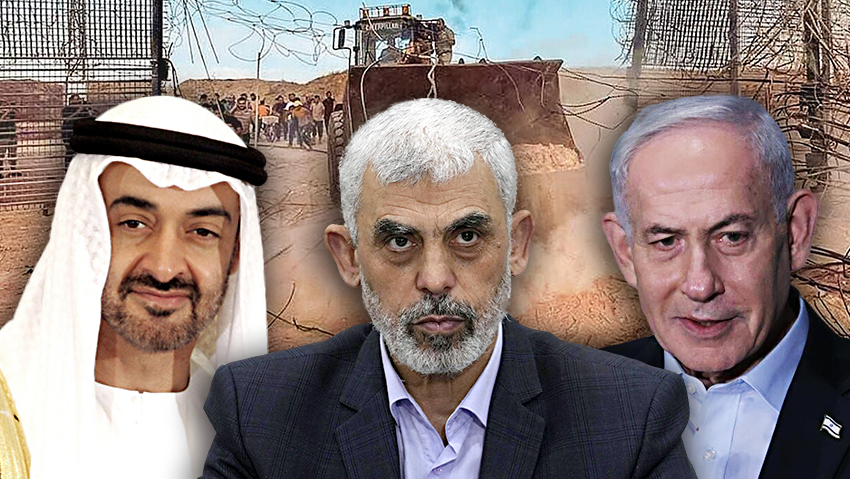
United Arab Emirates President Sheikh Mohammed bin Zayed Al Nahyan, Hamas leader Yahya Sinwar, Prime Minister Benjamin Netanyahu
(Photo: AP, Alex Kolomoisky)
The account was first detailed in a book by Eldar and Yuval, who initially withheld Abu Zaida’s identity because of concerns for his safety. Their reporting has drawn renewed scrutiny in Israel over what warnings Prime Minister Benjamin Netanyahu and Israeli security officials received before Hamas’ Oct. 7, 2023, attack. Netanyahu has strongly denied a central part of their account involving a purported warning from the president of the United Arab Emirates and has moved to sue the Haaretz newspaper over its publication of the allegations.
According to Eldar and Yuval, Abu Zaida was involved in indirect contacts between Israel and Hamas over the return of the bodies of Israeli soldiers Hadar Goldin and Oron Shaul and the release of two Israeli civilians, Hisham al-Sayed and Avera Mengistu, who were being held in Gaza at the time.
Eldar said the talks stalled in early September 2023, when Sinwar abruptly dropped out of contact. About a week later, according to Eldar, Sinwar summoned Abu Zaida and told him to warn the Israelis that if they did not make progress in the negotiations, he was preparing a “big surprise.”
Sinwar used the Arabic word “zilzal,” meaning “earthquake,” Eldar said. In a CNN interview this month, Eldar gave a similar account, saying Sinwar disappeared from the negotiations in early September and subsequently instructed the intermediary to tell Israel that he was preparing a major surprise.
According to the investigation, Abu Zaida was alarmed by the encounter and relayed Sinwar’s message to a Palestinian associate who now serves as an adviser to United Arab Emirates President Sheikh Mohammed bin Zayed Al Nahyan.
Sinwar later repeated the message to Abu Zaida and insisted that it be passed to Israel, again using the word “zilzal,” according to the journalists’ account. Other reporting on the investigation says Sinwar described what he was planning as an extraordinary and formidable operation and asked that his words be conveyed verbatim.
Eldar and Yuval reported that the warning eventually reached Ronen Bar, then head of the Shin Bet, Israel’s domestic security agency, on Sept. 15 and was passed to Netanyahu.
The journalists also reported that bin Zayed later sought to make certain Netanyahu had received the warning and spoke directly with the Israeli prime minister for about 45 minutes in late September, roughly 10 days before the Oct. 7 attack.
According to their account, Netanyahu sought to reassure the Emirati leader, saying Israel was prepared for developments in Gaza and assessing that any major trouble was more likely to occur in the West Bank.
The investigation alleges Netanyahu did not subsequently inform the military chief of staff at the time, Lt. Gen. Herzi Halevi, Bar or Mossad director David Barnea about the purported conversation with bin Zayed.
Netanyahu disputes that account. His office has said no conversation between Netanyahu and bin Zayed took place from the beginning of September through Oct. 7, 2023. It said the Prime Minister’s Office, National Security Council and military secretariat examined Netanyahu’s call records and found no record of such a conversation. Netanyahu has instructed his lawyers to pursue a defamation suit against Haaretz, Eldar and others over the report.
The UAE has not publicly confirmed the purported call. In a statement reported by CNN, it said it does not comment on media reports or speculation about conversations between government leaders.
Eldar has stood by the investigation, saying the journalists possess recordings, documentation and corroborating evidence supporting their account.
“People in the security establishment said — in the Shin Bet and the IDF — that if we had known about this conversation, it would have given us another assessment of the information that had already arrived on Sept. 15,” Eldar said.
The investigation also examined an Oct. 1, 2023, security discussion, six days before the Hamas attack, concerning unrest along the Gaza border and intelligence indicating Hamas intended to carry out an attack in the West Bank.
According to the journalists, Bar again recommended considering targeted killings of senior Hamas figures, including Sinwar, whom officials believed was displaying signs of increasing arrogance.
Netanyahu responded by asking security officials to prepare plans for his consideration, according to the investigation.
“He never said ‘no,’” one senior security official was quoted as saying. “That was always his way of postponing dealing with the problem.”
Another senior official who attended the meeting said Netanyahu instructed officials to continue developing the capability while focusing for the time being on calming the situation.
According to the investigation, Netanyahu did not mention during the meeting the warning that Eldar and Yuval say had been conveyed through Abu Zaida and the UAE.
A senior Shin Bet official quoted in the investigation said knowledge of the additional warnings might have caused the agency to give greater weight to the earlier message attributed to Sinwar.
“If we had known about the warnings, there is a chance it would have given much greater weight to the first message we received from Sinwar,” the official said. The information, he added, might have prompted officials to interpret Sinwar’s sudden withdrawal from the negotiations differently and “changed our entire assessment.”