


Violent conflict between groups within Israeli society and Iran obtaining a nuclear weapon are the two scenarios the Israeli public views as the country’s most serious threats, according to a new survey presented Monday at the ynet and Yedioth Ahronoth National Security Conference in partnership with the Institute for National Security Studies.
The study examined seven major threat scenarios facing Israel in 2026, along with three scenarios concerning the future of the Israeli-Palestinian conflict.
Live broadcast from the ynet-INSS conference


Its findings are based on two representative surveys conducted by INSS in February and July, measuring three factors: whether each scenario was identified as a major threat, how likely respondents believed it was to occur and how much damage they thought it could cause.
In the July survey, 39% of respondents selected violent conflict between social groups as one of the three main threats Israel could face over the next five years. The same percentage selected Iran obtaining nuclear weapons.
In February, internal conflict ranked first at 42%, while a nuclear Iran followed at 40%.
A large-scale missile attack on the home front ranked third in July, selected by 35% of respondents, down from 38% in February.
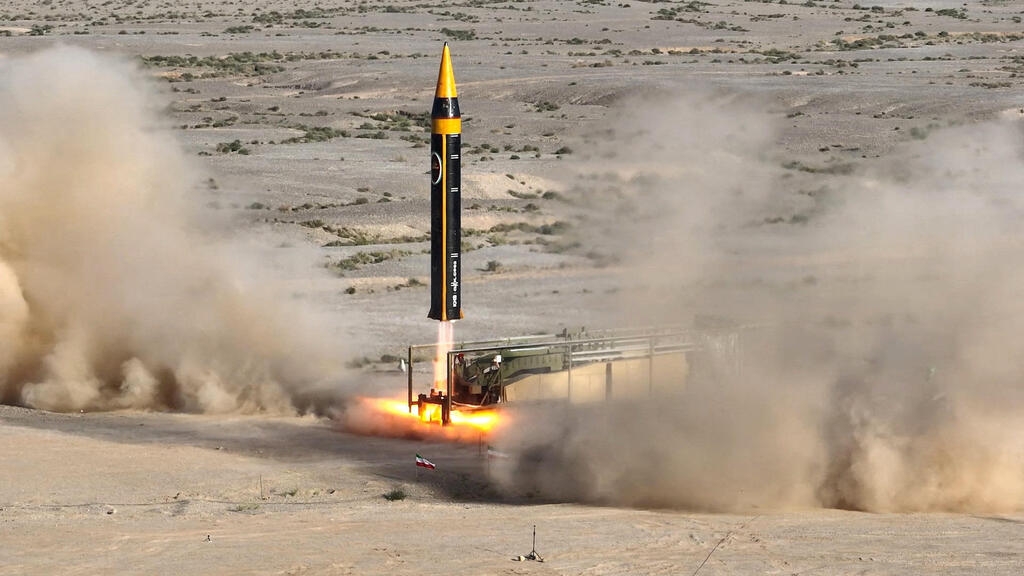
Concern over a nuclear Iran has grown in recent months
(Photo: Reuters)
The erosion of Israel’s democratic character followed at 31%, compared with 34% five months earlier.
A prolonged war on a single front was identified as a major threat by 27%, up from 23% in February.
The loss of U.S. support remained unchanged at 22% in both surveys.
At the bottom of the list was declining economic productivity due to demographic changes, although the share of respondents identifying it as a major threat rose from 4% in February to 12% in July.
The report noted that the wording of the economic scenario changed between the two surveys, making it impossible to determine what caused the increase.
Which threats are most likely?
When respondents were asked how likely each scenario was to occur, a large-scale missile attack on the home front ranked first.
In July, 61% said there was a high probability of such an attack, compared with 57% in February.
A prolonged war on a single front followed, rising sharply from 50% to 59%.
Another 54% said violent conflict between groups within Israeli society could occur, compared with 52% in the previous survey.
Concern over a nuclear Iran also increased. The proportion of respondents who considered the scenario highly likely rose from 36% to 43%.
By contrast, the perceived likelihood of democratic erosion declined slightly, from 40% to 37%.
One of the most striking shifts concerned the possible loss of American support.
In February, just 13% believed there was a high probability of that scenario. By July, the figure had doubled to 26%.
The share of respondents expecting a decline in economic productivity due to demographic changes also rose, from 13% to 24%.
Internal conflict seen as most destructive
The ranking by potential damage produced a somewhat different picture.
Violent conflict between social groups was viewed in July as the most damaging scenario, at 69%, up from 66% in February.
Another 64% said the state’s preparedness to deal with internal conflict was low or very low.
The erosion of Israel’s democratic character ranked second in damage potential at 68%, up slightly from 66%.
A nuclear Iran and the loss of American support followed, each at 67%.
For Iran, that figure was down from 73%, while concern over the loss of U.S. support declined from 71%.
The perceived damage from a prolonged war on one front rose from 55% to 57%.
By contrast, the damage attributed to a large missile attack fell from 66% in February to 56% in July, even though it was viewed as the most likely scenario.
The economic scenario also saw a major increase, with the share assigning it high damage potential rising from 28% to 44%.
Not only an external threat
The analysis accompanying the survey argues that the threats do not exist separately, but may reinforce one another.
Its central conclusion is that Israel’s main vulnerability does not stem only from external military threats, but from the interaction between internal processes, including the erosion of democracy, social cohesion and legitimacy, and declining support in the international arena.
The report describes a chain reaction in which domestic democratic erosion could weaken American support for Israel.
That, in turn, could erode Israel’s military and technological advantage and undermine deterrence against Iran.
According to the analysis, national resilience is the foundation on which Israel’s technological superiority and military power depend.
The United States is described as a central “force multiplier.”
The threat of a nuclear Iran increases Israel’s dependence on Washington, while also making the alliance more essential, more intensive and more fragile at the same time.
The report warns that losing U.S. support could create a “strategic vacuum.”
The Palestinian conflict and international legitimacy
The Israeli-Palestinian conflict was examined separately.
A total of 55% of respondents said it posed a significant or very significant threat to Israel.
Among three scenarios, 35% identified the establishment of a binational state in which Palestinians receive full citizenship as the most threatening.
Another 24% selected a two-state solution, while the same percentage chose full annexation without citizenship for Palestinians.
The analysis argues that the absence of a diplomatic horizon turns Israel from a “strategic asset” into a “burden,” making it more difficult to build international coalitions to contain Iran.
The conflict is therefore presented not only as a security issue, but also as a factor affecting Israel’s regional and international standing.
The home front, munitions and human capital
The report also highlights several additional vulnerabilities.
One is the economic gap between offensive and defensive systems.
Drones may cost between $20,000 and $50,000, while an interceptor can cost hundreds of thousands or even millions of dollars.
That disparity makes the depletion of interceptor stocks and dependence on supply chains a problem with direct implications for deterrence.
The home front is also defined as a permanent battlefield.
According to the study, about 2.6 million residents, or 28% of the population, lack standard protective shelter.
The gap is especially severe in peripheral regions and communities near Israel’s borders, worsening both anxiety and inequality.
Another vulnerability is human capital.
The high-tech sector accounts for about half of Israel’s economic growth, according to the report, but relies on only about 3% of the population.
The report warns that brain drain, including the fact that about 12% of doctoral students are abroad, could damage one of Israel’s main sources of technological and economic strength.
Taken together, the findings indicate that Israelis no longer see internal threats as separate from traditional military dangers.
Social conflict, democratic erosion and the weakening of American support now rank alongside a nuclear Iran, prolonged war and missile attack, and in some cases are viewed as potentially even more destructive.