

Luxury beachfront hotels, high-speed rail and AI-powered smart power grids are at the heart of an ambitious vision for a future Gaza drawn up by advisers to US President Donald Trump — special envoy Steve Witkoff and the president’s son-in-law, Jared Kushner. According to a report by The Wall Street Journal, the plan, dubbed “Project Sunrise,” envisions a long-term reconstruction of Gaza lasting at least 10 years, and possibly 20.
Under the plan, if Hamas disarms, the extensive rubble from Gaza’s devastated cities would be cleared and replaced with newly built urban centers, as part of Trump’s vision of a “Middle East Riviera,” which he outlined earlier this year, well before the war ended.
Gallery
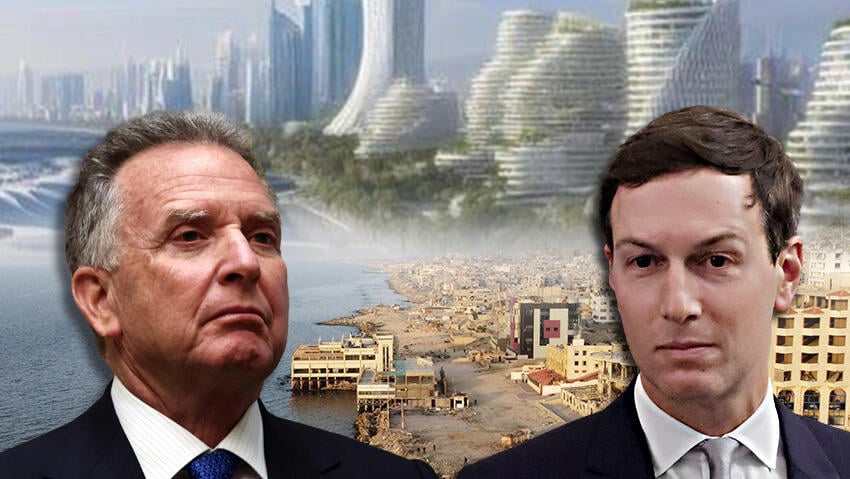
Jared Kushner and Steve Witkoff, alongside the current Gaza and the 'new Gaza' they envision in their 'Sunrise Project'
(Photo: REUTERS/Dawoud Abu Alkas, REUTERS/Evelyn Hockstein, AP Photo/Terry Renna)
The plan is detailed in a 32-slide PowerPoint presentation labeled “sensitive but unclassified.” It estimates the cost of reconstruction at at least $112 billion in the first decade. According to slides cited by the Journal, the United States would commit an “anchor” contribution of about 20% of the funding in the first 10 years. The plan’s feasibility remains unclear, with its main obstacle Hamas’ refusal to disarm and the fact that the last Israeli hostage believed to be deceased, Sgt. Ran Gvili, has not yet been returned.
Israel has said it will not move to the second phase of Trump’s peace plan — which includes reconstruction and the deployment of an international force to gradually replace Israeli troops — until Gvili’s body is returned.
US officials quoted by the Journal expressed “serious doubts” about the plan’s viability, citing Hamas’ refusal to disarm and concerns that donor countries will be unwilling to finance reconstruction as long as renewed fighting remains a risk. Steven Cook of the Council on Foreign Relations said the plan is unlikely to go anywhere, arguing that few in Israel expect the situation to change and that no progress is possible unless Hamas disarms, which he believes will not happen.

The presentation of the American program 'Building a New and Unified Gaza'
(Photo: From The Wall Street Journal)
Still, some Trump administration officials argue that presenting a detailed and optimistic vision for Gaza’s future, should Hamas lay down its arms, is preferable to assuming Gaza will remain a devastated territory plagued by a simmering humanitarian crisis and mass displacement. Officials said that if “security conditions” allow, implementation could begin within two months.
In response to the Journal report, the White House said the Trump administration is working closely with partners to maintain a durable ceasefire and support the groundwork for a peaceful, prosperous Gaza.
According to the report, Witkoff, Kushner and White House adviser Josh Gruenbaum finalized the plan over the past 45 days, consulting with Israeli officials and business leaders. The plan is described as flexible and would be updated every two years if adopted.
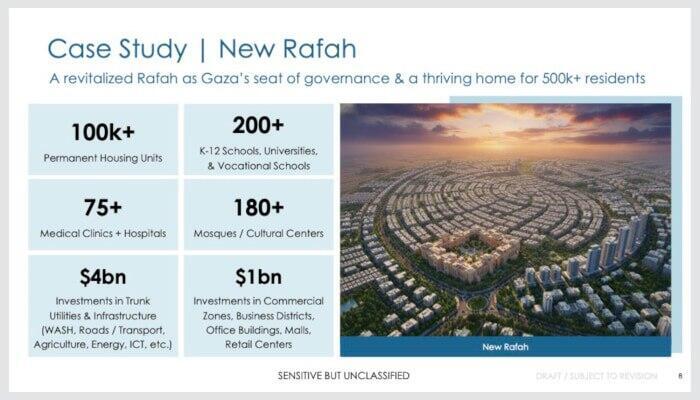
'New Rafah', which will be the capital of the Gaza Strip
(Photo: From The Wall Street Journal)
The presentation estimates total reconstruction costs at $112.1 billion over the first decade. In addition to the US, wealthy regional states are expected to fund the effort, though the presentation does not specify which countries. It also includes an especially ambitious projection that Gaza could eventually finance reconstruction and debt repayment through revenue generated by a revived local economy, including large-scale hotel development along the coast.
The plan has reportedly been presented to Gulf states, as well as Egypt and Turkey, which are deeply involved in efforts to advance the second phase of Trump’s plan. The report followed meetings Friday in Miami between Witkoff and Kushner and representatives from Egypt, Turkey and Qatar on Gaza and the proposed international force.
The presentation does not shy away from the central obstacle. Its opening executive summary includes a red-box warning stating that reconstruction depends on Hamas fully disarming and taking all weapons and tunnels out of use. Slides feature renderings of advanced cities, coastal towers and high-speed trains under the headline: “Building a New and Unified Gaza.”

Another slide from the presentation
(Photo: From The Wall Street Journal)
The plan outlines a more than 20-year roadmap, beginning with clearing massive war debris — a process that, as reported this month by ynet, the US wants Israel to carry out and finance. It also prioritizes removing unexploded ordnance, dismantling Hamas’ tunnel network and establishing temporary housing for residents, though it is unclear where they would live during construction.
Rebuilding would begin in Rafah, now under full Israeli control and largely destroyed in the war, and in Khan Younis in southern Gaza. Reconstruction would then move to central Gaza, with Gaza City rebuilt last. One slide proposes turning Rafah into the enclave’s new government seat under phase two of Trump’s plan. The city would house more than 500,000 residents in over 100,000 housing units, along with 200 schools, 75 medical facilities and 180 mosques and cultural centers.
In the second decade, Gaza would begin covering part of the costs itself. From year 10, the plan calls for turning 70% of Gaza’s coastline into a revenue-generating zone with luxury hotels. According to the presentation, the “Gaza Riviera” could yield more than $55 billion in long-term profits.
Marco Rubio says the goal is to ensure Hamas cannot threaten Israel, warning that there will be no peace if it can


The presentation does not detail which countries would provide funding, and it remains unclear whether donors would commit amid fears a future war could wipe out investments. Secretary of State Marco Rubio acknowledged those concerns Friday, saying “no one” would invest if they feared another war was imminent. Still, Rubio said he was confident donors could be secured for reconstruction and long-term humanitarian aid.
First published: 12:47, 12.20.25