

The United States is set to deploy the world’s largest aircraft carrier to Israel in the coming day, even as American, Iranian and Omani officials voiced optimism following the latest round of nuclear talks in Geneva.
The USS Gerald R. Ford, the newest aircraft carrier in the U.S. Navy, departed from Crete on Thursday, where it had been docked, and is expected to significantly bolster U.S. firepower in the region should President Donald Trump ultimately decide to launch a strike on Iran.
Negotiating teams enter talks in Geneva


The deployment comes after mediators from Oman, as well as U.S. and Iranian officials, described the latest round of indirect negotiations in Switzerland as constructive.
Before the talks concluded, Israeli officials had assessed that the likelihood of a U.S. strike on Iran in the near term was high. Following their conclusion, that timeline may have been pushed back. More than a week ago, Trump said he was giving Iran “10 to 15 days” to respond. If Washington waits for a follow-up round of talks expected next week, that deadline could shift.
A U.S. official described the discussions as “positive” and said another round is planned for early next week in Vienna. U.S. envoys Steve Witkoff and Jared Kushner, as well as Iranian Foreign Minister Abbas Araghchi, are not expected to attend the upcoming session. “We continue to work to produce an agreement,” the official said.
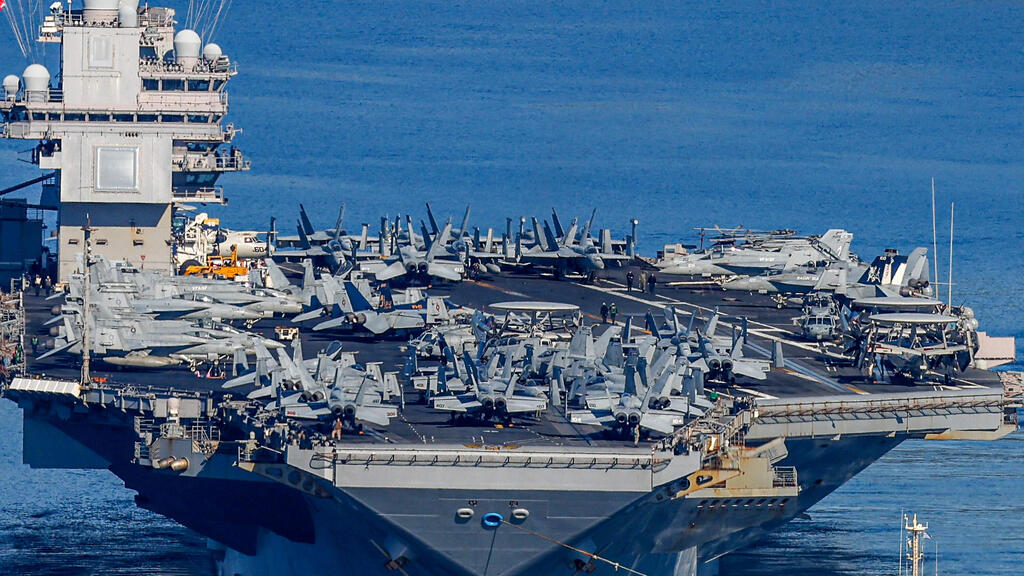
The massive war machine approaches Israel
(Photo: Costas METAXAKIS / AFP)
Araghchi struck an even more optimistic tone at the end of the talks in Switzerland. “We were able to achieve some positive things on sanctions and nuclear issues. This was the best and most serious round,” he said, adding that expert-level technical discussions would begin Monday. “This shows the seriousness of both sides regarding the diplomatic process.”
He said consultations would follow, leading to a fourth round of talks. “On certain issues we came very close to an understanding. There are other issues that remain in dispute,” Araghchi said. He added that “America must choose between dialogue or confrontation and tension. There is no military solution to the nuclear issue. The other side tried that in the past and failed.”
Omani Foreign Minister al-Busaidi, whose country is mediating the indirect talks, said earlier that “we concluded today after significant progress in the negotiations between the United States and Iran. We will resume soon after consultations.” He added that technical discussions would take place next week in Vienna and thanked participants, the International Atomic Energy Agency and Switzerland.
Despite the positive tone, major gaps remain. According to The New York Times, Trump still prefers a limited strike targeting Iran’s nuclear and missile sites rather than a broader campaign. The Wall Street Journal reported that despite the optimistic statements, the sides remain far apart on key issues.
U.S. envoys have said Iran must dismantle its three main nuclear facilities — Fordow, Natanz and Isfahan — and, according to officials, have demanded that Tehran transfer its remaining stockpile of enriched uranium to the United States. Washington has also insisted that any nuclear agreement be permanent.
Iranian media outlets and sources familiar with the talks said Tehran rejected the idea of transferring its uranium stockpile abroad and opposes halting uranium enrichment, dismantling nuclear facilities or accepting permanent restrictions on its nuclear program. The diplomatic developments come against the backdrop of a significant U.S. military buildup in the region, now culminating in the arrival of the Gerald R. Ford.
The carrier’s air wing includes 75 fighter jets, including F-35C, F-16 and F/A-18 aircraft. The ship is capable of launching up to 150 combat sorties per day, compared with about 120 on older carriers such as the USS Abraham Lincoln, which is already operating in the Gulf of Oman with a strike group that includes three guided-missile destroyers, a submarine and additional vessels.
Aircraft carrier Ford departs Crete
(Video: X)
In contrast, the Gerald R. Ford strike group includes six guided-missile destroyers. Named for the 38th U.S. president, the carrier has a displacement of about 100,000 tons and measures 337 meters (1,106 feet) in length and 78 meters (256 feet) across the flight deck. It can travel at speeds of up to 56 kph (35 mph). The ship was ordered to the region from the Caribbean roughly two weeks ago, where its aircraft had participated in an operation to capture Venezuelan President Nicolás Maduro.
Thousands of sailors serve aboard the carrier. Its defensive systems include anti-aircraft missile launchers, Rolling Airframe Missile systems, radar arrays and close-in weapon systems such as the Phalanx, 25 mm guns and four M2 Browning heavy machine guns.
Beyond its military capabilities, the carrier is equipped with a full hospital, four gyms, elevators connecting its decks, a chapel, a store, a supermarket and a cafeteria serving four meals a day, along with juice and salad bars. It also features lounges with shipwide Wi-Fi, billiards tables, gaming consoles and large television screens broadcasting channels and Hollywood films while at sea.