

U.S. President Donald Trump landed in Washington overnight Friday after his visit to China, with an escalation in the campaign against Iran still under consideration. Two Middle East officials who spoke with The New York Times said the United States and Israel are engaged in “intensive preparations”, the largest since the ceasefire took effect, for a possible resumption of strikes on Iran as early as next week.
According to the report, Trump’s senior advisers have drawn up plans for renewed military strikes if he decides to try to break the stalemate through additional bombing, though he has not yet made a decision on the next steps. Shortly before leaving Beijing on Friday, Trump said Iran’s latest peace proposal was unacceptable and dismissed it outright.
Trump's interview with Fox News
(Video: X)


Trump said he discussed Iran with Chinese President Xi Jinping, whose country is a strategic partner of Tehran and depends on oil and gas transported through the Strait of Hormuz. However, he said he did not ask Xi to pressure Iran, and the full details of their talks have not been disclosed.
Meanwhile, the Pentagon is preparing for the possibility that Operation Epic Fury could resume in the coming days. If Trump decides to renew the strikes, options include more aggressive bombing sorties against Iranian military targets and infrastructure, U.S. officials told the Times.
In an interview with Fox News, Trump said the sides had previously outlined terms for an agreement under which Iran would forgo nuclear weapons and hand over nuclear material sought by the United States. He accused Tehran of repeatedly backing away from understandings reached in negotiations and said Iran could not be allowed to obtain nuclear weapons.

Officials said another option under consideration is deploying special operations forces on the ground to target nuclear material buried deep underground. Several hundred special operations troops arrived in the Middle East in March as part of a deployment intended to give Trump that option, they said, including forces that could be used against highly enriched uranium in Isfahan. However, they stressed that such an operation would also require thousands of support troops, who could become drawn into fighting with Iranian forces. Military officials acknowledged to The New York Times that the option carries a “high risk of casualties.”
Iranian officials have also said they are preparing for renewed fighting. “Our armed forces are ready to deliver an appropriate response to any aggression. Wrong strategies and wrong decisions always lead to wrong results,” Iranian Parliament Speaker Mohammad Bagher Ghalibaf wrote on social media Monday. “The whole world already understands this. We are prepared for all possibilities. They will be surprised.”
In the US: 'Restraint does not mean lack of resolve'
Since the start of the ceasefire, Pentagon officials and military commanders have said the United States used the monthlong pause in bombing to rearm warships and strike aircraft in the region. Joint Chiefs Chairman Gen. Dan Caine told a Senate Armed Services subcommittee this week that military officials “continue to maintain a range of options for our civilian leadership.” He declined to detail what military actions Trump could order.
At a Pentagon briefing on May 5, Caine said more than 50,000 troops, two aircraft carriers, more than a dozen Navy destroyers and dozens of fighter jets “remain prepared to resume significant combat operations against Iran if authorized to do so. No adversary should mistake our current restraint for a lack of resolve.”
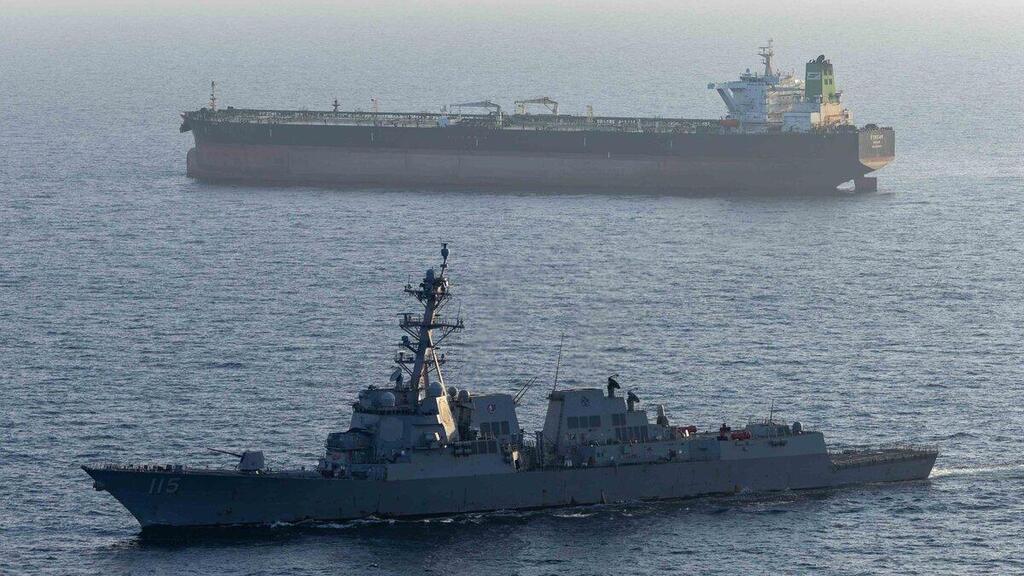
US destroyers in the Middle East
(Photo: CENTCOM)
Still, the Times reported that military officials privately acknowledge that victory could prove difficult. They said the U.S. military successfully carried out the missions it set for itself, including strikes on Iranian ballistic missile launch sites, Islamic Revolutionary Guard Corps ammunition depots and other military infrastructure facilities. However, according to U.S. intelligence agencies, Iran has managed to restore access to most of its missile sites, launchers and underground facilities.
In addition, it was reported this week that Iran has regained operational access to 30 of the 33 missile sites it maintains along the Strait of Hormuz, potentially threatening U.S. warships and oil tankers traveling through the waterway.
About 5,000 Marines and roughly 2,000 paratroopers from the U.S. Army’s 82nd Airborne Division are in the region awaiting orders, the officials told the newspaper. They said that beyond operations targeting nuclear sites, the forces could also be used in an effort to seize Kharg Island, a key hub for Iran’s oil exports. However, they cautioned that the military would require substantially larger ground forces to hold the island.