

About 400 high schools across France, roughly one in 10, were shut down on Friday at the end of a week in which more than 1,200 schools were blocked, disrupted or set on fire. As students burned trash bins in Toulouse and Lille, Prime Minister Sébastien Lecornu’s government submitted a 2027 budget to parliament calling for 54 billion euros in “efficiency measures,” or cuts.
The timing is no coincidence. The unrest and the budget fight are different manifestations of the same macroeconomic crisis that has been building in France for years and repeatedly erupts in new places. At its core is a widening gap between the level and quality of public services French citizens expect, including education, and what the state can still afford to provide.
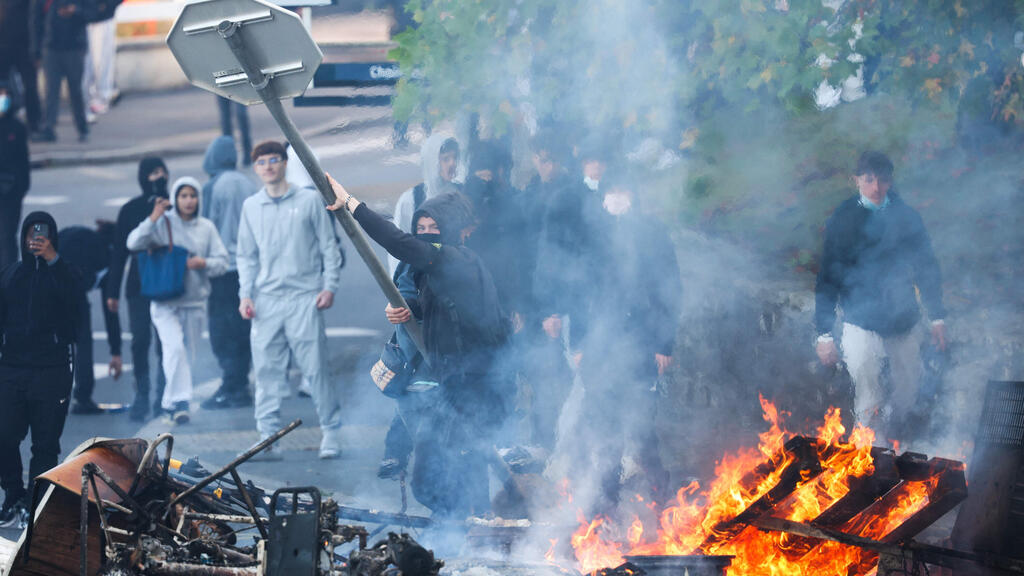
Protesters in the western French city of Brest on Friday
(Photo: AFP/Fred Tanneau)
France’s public debt is projected to reach 119.3% of gross domestic product this year, an all-time high, and rise further to 121.7% next year, according to Finance Ministry estimates submitted to the country’s independent fiscal watchdog.
Successive French governments have failed to bring the deficit under control. It currently stands at 5.4% of GDP, among the highest levels in the European Union and far above the bloc’s standard ceiling of 3%.
Financial markets have already registered the deterioration. On the day the budget was presented, the yield on France’s 10-year government bond climbed to 4.96%, its highest level in 24 years.
Interest becomes France’s biggest bill
Finance Minister Roland Lescure acknowledged that interest payments alone will account for more than half of next year’s deficit and could reach 100 billion euros by the end of the decade.
In 2027, France is expected to spend 74 billion euros simply servicing its debt, more than the 65 billion euros allocated to education and the 63 billion euros earmarked for defense, despite defense receiving the largest budget increase. Debt interest would therefore become the government’s single largest spending item.
The imbalance is not the result of one unusually wasteful year. It reflects a structural gap between what the French state promises and what its economy produces.
The European Commission estimates that without new measures the deficit will widen to 5.7% next year. Lecornu has said that without the proposed cuts it would exceed 6.5% of GDP. Even with the measures, Lescure has acknowledged that France is not expected to return to the 3% threshold until 2029.
When economic growth remains below the cost of borrowing, governments eventually have to decide what to cut, tax or reform. Those choices have repeatedly destabilized French governments over the past two years.
A bond yield approaching 5% for a sluggish economy is not simply a punishment from markets but a price attached to risk. France has lost two prime ministers in less than a year, both amid budget disputes, while successive governments have struggled to explain to voters which parts of the existing social model they are prepared to scale back.
Schools expose the fiscal trap
France’s education system illustrates the dilemma particularly clearly.
In 2026 recruitment drives, 24,351 of 25,000 teaching positions were filled, while 20 million hours of instruction went undelivered over the past year.
According to France’s national audit office, roughly one-tenth of scheduled teaching hours in public middle schools are lost because of teacher shortages despite billions of euros in additional government spending.
Against that backdrop, the new budget proposes freezing teachers’ salaries as part of a wider freeze on public-sector pay.
French classrooms also remain crowded despite a 20% decline in births since 2010. Rather than using that demographic contraction primarily to reduce class sizes, governments have also used it to cut teaching positions.
Another protest movement, the same underlying problem
France has repeatedly seen economic and fiscal disputes spill into the streets.
In 2018, a fuel tax helped trigger the Yellow Vest movement. In 2023, raising the retirement age brought millions of people out to protest. Last year, a government budget sparked mass demonstrations that ultimately contributed to the fall of François Bayrou’s government.
Now the education system has become the latest flashpoint. Combined with diesel prices climbing to new highs, public anger is once again rising.
France’s political crisis reflects a country caught between increasingly rigid political blocs. The left opposes spending cuts, the far right rejects tax increases, while the center has repeatedly tried to promise fiscal restraint without fully confronting the political cost of either approach.
The next eruption may come over a different issue, but the underlying bill will be the same: France must somehow reconcile the public services its citizens expect with a debt burden, deficit and interest bill that leave governments with steadily less room to maneuver.