


A helium balloon drifted into the railway station at Ben Gurion International Airport on Monday afternoon, causing electrical cables to short circuit and producing several loud bangs that disrupted train service at the country’s main international airport.
Passengers reported hearing explosions before people on the platform were directed into the airport terminal. Platform 2 was temporarily closed to train traffic following the incident.
A helium balloon triggers electrical explosions at the Ben Gurion Airport railway station, disrupting train service and forcing passengers off the platform


Israel Railways described the incident as a localized technical malfunction that was being repaired. Some trains halted their journeys before reaching their final destinations, while others were delayed.
“There was a localized malfunction that is currently being handled. Trains are running,” Israel Railways said. “There may be delays in the near future, but train traffic has not been halted.”
The company disputed reports that the airport railway station had been evacuated, saying it “was not evacuated of passengers and continues normal operations.”
‘There were three explosions’
One passenger who contacted ynet said an electrical cable had been severed and that the 3:09 p.m. train from Jerusalem to Herzliya became stranded several minutes before reaching Ben Gurion Airport.
“There was no electricity or air conditioning for 10 minutes,” the passenger said, adding that passengers were later informed that the train would return to Jerusalem.
Another passenger said the train stopped at the station before three loud explosions were heard. “They have now evacuated everyone from the platform to the terminal,” the passenger said.
Alex, who was aboard one of the trains at the time, told ynet that his train had already arrived at the airport station when he heard several explosions.
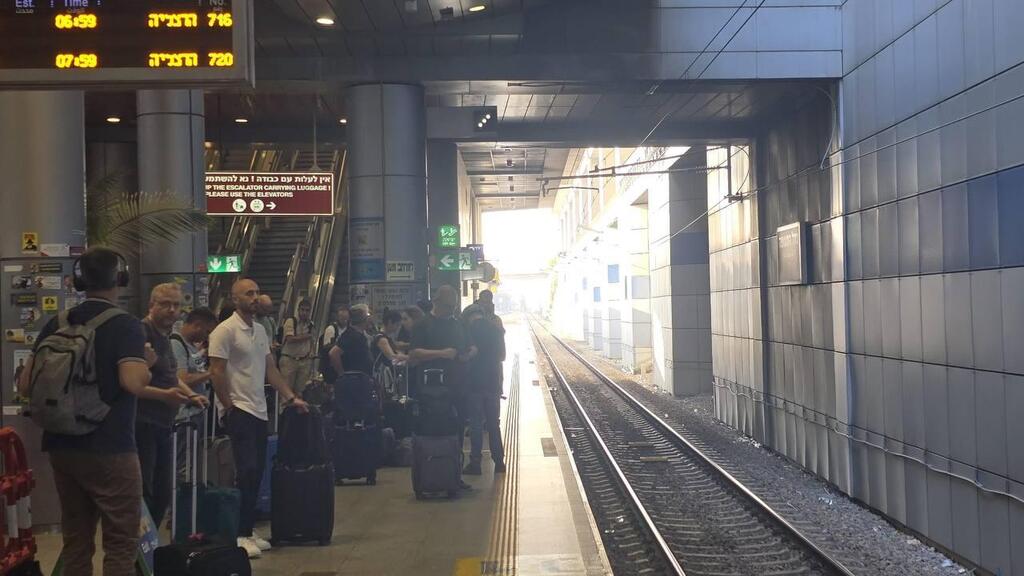
Ben Gurion Airport train station
(Photo: Israel Railways)
“We stopped at the station and then there were several sounds of explosions, and the cable for the train opposite us snapped and fell,” he said. “There were flashes of light from an electrical short circuit and then another explosion. They then announced over the public-address system that we had to evacuate the train and led everyone into Ben Gurion Airport.”
Because of the resulting disruptions, Alex left the station and continued his journey by bus.
A senior Israel Railways official offered a stark assessment of the incident, warning that the railway had repeatedly narrowly avoided a serious accident.
“Every time, only an obvious miracle saves civilians from a deadly disaster,” the official told ynet. “But everyone knows that even obvious miracles run out one day. Once again, they will look for a scapegoat to blame. The disaster will come; only the date is unknown.”
Leadership vacuum at Israel Railways
The disruption comes as Israel Railways, the state-owned company that operates the country’s passenger and freight rail network, has been without its two most senior permanent executives for nearly two months: a board chairman and a CEO.
Moshe Shimoni, who served as chairman for about six years, left the position last month after being appointed chairman of Mekorot, Israel’s national water company.
Meanwhile, nearly a year after CEO Moshe “Shiko” Zana left the railway, a permanent replacement has yet to be appointed. Avner Flor, a former head of the Transportation Ministry’s infrastructure administration, is serving as acting CEO.
Industry officials say the difficulty in filling the CEO position is unsurprising because it is considered one of the most complex management jobs in Israel’s public sector.
Along with overseeing infrastructure projects worth tens of billions of shekels, the railway’s chief executive must contend with a powerful workers union, operational failures that frequently cause service disruptions, safety incidents and accidents, as well as persistent public criticism over the quality and reliability of train service.
Years of management upheaval
Israel Railways has experienced significant management turnover in recent years.
During Shimoni’s tenure as chairman, two CEOs were replaced, while a string of senior executives left the company, including its chief financial officer, legal adviser, head of human resources and head of the railway electrification administration.
More recently, the executive responsible for freight operations was removed from his position following two freight-train accidents.
The company has also faced delays to its electrification program, the end of its contract with Spanish infrastructure company SEMI and operational challenges during the war with Iran.
The upheaval comes at a particularly consequential period for Israel’s railway network, which is preparing to operate and complete some of the largest infrastructure projects in its history.
They include the Eastern Railway, the Route 431 railway, a fourth track through Tel Aviv’s heavily congested Ayalon rail corridor and completion of the nationwide electrification project.
For now, Israel Railways continues to operate under interim leadership at a time when it is expected to carry out its most ambitious development plans while also working to restore public confidence in the reliability and safety of its service.