

An eyewitness in Varamin, a city near Iran’s capital, Tehran, said that on the night of Friday, Jan. 9, she and several others saw members of the Islamic Revolutionary Guard Corps and the Basij attack a teenage female protester near Beheshti Street in the city center.
According to the witness, the forces attempted to rape the girl, but local residents intervened and managed to save her. In recent days, human rights activists and citizen journalists have published numerous reports of sexual assault and rape of protesters, particularly teenage girls. Some of these allegations have been echoed by opposition and international media, and have also been cited by Sara Hossain, chair of the U.N. fact-finding mission on Iran.
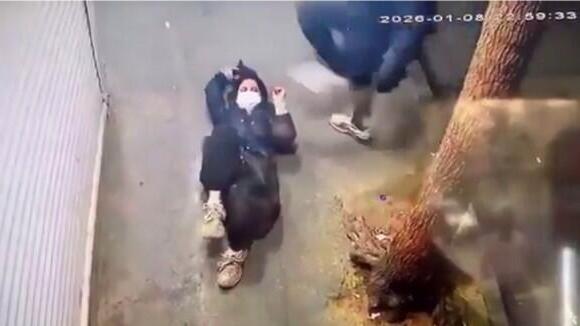
A female protester being attacked by paramilitary forces
Pariya, an Iranian woman who took part in protests on Thursday and Friday nights following calls by opponents of the Islamic Republic, said she was struck on the shoulder with a police baton on the first night. Despite visible bruising, she returned to the streets the following night. Videos posted on social media during the early hours of the nationwide nighttime protests in Varamin showed large crowds on the city’s main streets. Shortly afterward, internet access and both landline and mobile phone networks were completely cut off, and military forces began firing live ammunition.
According to eyewitnesses, the gunfire intensified on the second night. They state that the intent of the forces was not to disperse protesters, but to kill them, with targeted shooting. Numerous pieces of evidence suggest that in Tehran and surrounding cities, IRGC forces and allied proxy militias from other countries fired final shots at wounded protesters in the streets or even in hospitals, or deliberately prevented medical assistance so that the injured would die.
Pariya recounts that on the second night, shortly after people from various streets gathered near the governor’s office, police forces opened fire with pellet shotguns and used tear gas. Protesters responded by throwing stones and lighting fires in the streets to defend themselves. Suddenly, the police retreated, and military forces including the IRGC and Basij paramilitaries, opened fire on the protesters. As clashes escalated, many people scattered into the surrounding streets and alleys.
Testimony of Pariya regarding the sexual assault of a teenage female protester (her voice has been altered for security reasons)
Pariya and her companions fled into nearby alleys while being chased by IRGC and Basij forces, desperately knocking on doors in hopes of finding shelter. At that moment, they heard the screams of a teenage girl nearby who had been captured by military forces and whose clothes were being torn. Pariya says the attackers were beating the girl with rifle butts and boots, specifically striking her buttocks and genital area, while hurling insults and shouting that they would rape her. The girl, who appeared to be 17 or 18 years old, was covering her face to protect herself from the blows while screaming for help.
According to Pariya, the scene was so horrifying that they forgot their fear of being killed and began shouting and calling for help. Suddenly, another group of people who were fleeing the gunfire arrived and forced the attackers to flee. One of the attackers was caught by the crowd and beaten, after which the IRGC forces fired again at the people from the end of the alley.
Meanwhile, the crowd rescued the teenage girl, and one of the neighbours took her into their home. At the same time, some protesters, in order to save their lives, fled onto rooftops rather than into the alleys, moving away from the line of fire, yet continuing to chant slogans.
Pariya shared this testimony with me over several days via a messaging application, as many people who have recently managed to regain internet access can only remain connected for a few minutes at a time. Even so, during these brief windows, some have succeeded in sending images and videos abroad documenting the extreme violence used by military and security forces against protesters. Among them is a video published on Friday showing a plainclothes Basij member attacking a female protester with a machete.
While human rights activists say the number of people killed in Tehran is far higher than initial estimates of around 1,000, newer assessments suggest that even 20,000 deaths across the country may be a conservative estimate.
At the same time, citizen journalists have reported numerous cases of rape and sexual assault during the unprecedented nationwide protests in Iran following the 1979 revolution. One user on the X platform wrote that several girls arrested during the protests and held in Qarchak Prison were repeatedly raped during detention.
The Kurdistan Human Rights Network also reported the sexual assault of a 16-year-old teenager in Kermanshah. Sexual assault and rape of protesters in Iran have a documented history. During the nationwide protests of 2022, multiple reports of such abuses were published.
In the case of Nika Shakarami, the well-known young protester who was killed, leaked official reports indicate that the confrontation with paramilitary agents occurred after one of them attempted to sexually assault her in a vehicle while transferring her to detention. When she resisted, she was beaten to death with batons.
Amnesty International, in a detailed report in 2023, addressed numerous cases of rape against protesters during the "Woman, Life, Freedom" movement by regime forces, describing this action not as isolated incidents but as systematic behaviour to confront protesters. Some say this, in addition to its structural nature, is rooted in the religious beliefs of the Islamic Republic forces, who consider the rape of captured female infidels legitimate under various titles.
I myself, in July 1999, during the student protests, witnessed one of these cases in front of the girls' dormitory at the Tehran university campus, and due to the timely intervention of students, the girl was saved from them, but suffered psychological shock for a long time.
While the Islamic Republic has peaked its brutality against the country's people in recent weeks, rape of women on the streets and in detention centres has increased public hatred towards it, because it shows the savage nature of its security and military agents, who are sufficiently brutal and ruthless even without using psychotropic drugs like Jihadi pills before being dispatched to their bloody mission locations.