

The prolonged war with Iran and the depletion of U.S. missile and ammunition stockpiles are raising concerns that Washington’s global military posture could be weakened at a critical moment, potentially affecting calculations in Moscow and Beijing.
U.S. officials told The New York Times that the conflict, now nearing the six-month mark, has forced the Pentagon to move missiles, warships, aircraft and air-defense units from Europe and Asia to the Middle East.
Gallery
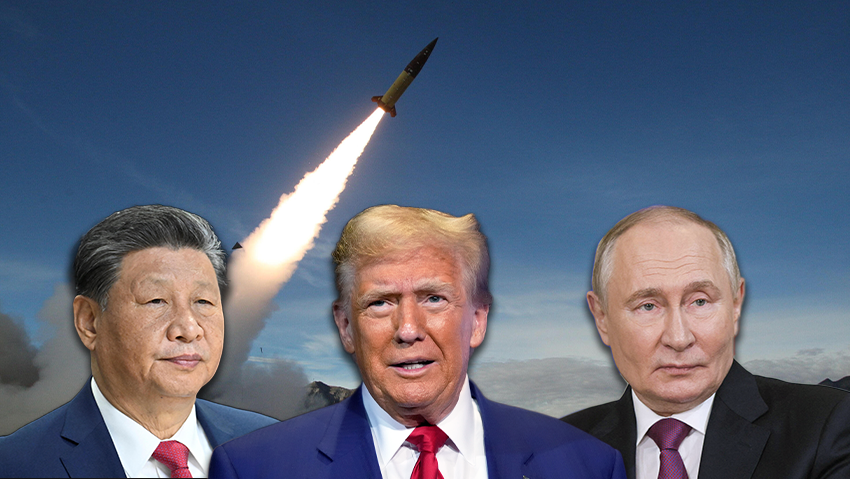
Xi Jinping, Trump and Putin
(Photo: AP PhotoAlex Brandon8, ALEXANDER NEMENOV/Pool via REUTERS, Sputnik / Alexander Scherbak / Pool via REUTERS ,AFP / JOHN HAMILTON / US DEPARTMENT OF DEFENSE)
According to the report, American and Western officials are increasingly concerned that pulling weapons and forces from those regions could influence decisions by Russia and China over whether to initiate military confrontations that could ultimately draw in the United States.
According to figures obtained by The New York Times, the U.S. military has fired more than 1,500 Patriot interceptors since the beginning of the war, leaving fewer than 1,700 in inventory. Even if production is accelerated, replenishing the shortfall would take more than two years.
The report also pointed to severe shortages of several types of long-range missiles, including ATACMS surface-to-surface missiles. Two officials familiar with the matter said Gen. Dan Caine, chairman of the Joint Chiefs of Staff, warned U.S. President Donald Trump before the war against drawing further on already depleted stockpiles.
Trump nevertheless chose to attack, believing the conflict would end quickly. That assumption proved wrong.
CNN reported overnight that Caine is now looking for an “exit path” from the war with Iran. According to three people familiar with the discussions, Caine has told senior members of Trump’s team in private conversations that the military options under consideration for escalating the conflict could produce the opposite of the intended result, and that air power alone is unlikely to achieve the president’s stated war aims.
The Ukraine connection
As the Iran war continues, U.S. officials told The New York Times that Washington has delayed weapons deliveries to “customers in Europe and Asia.” Ukraine appears to be among the countries feeling the effects of the shrinking American arsenal.
President Volodymyr Zelensky said this week that the number of air-defense missiles supplied to Ukraine by Western countries has fallen this year to roughly one-third of the amount delivered in 2025.
On Wednesday, Ukraine failed to intercept any of the 28 missiles Russia launched in an attack that killed at least 17 people. Zelensky said additional interceptors could have saved lives. Ukraine has become a major producer of offensive drones during its war with Russia, but Kyiv still lacks sufficient defenses against Russian ballistic and cruise missile attacks.
Speaking at a news conference in Belgrade alongside Serbia’s prime minister, Zelensky addressed the shortage of interceptors and also referred to Ukraine’s attempts to acquire air-defense systems from Israel. “We would also like to receive air defense from Israel,” he said. “We would be ready to buy, but we still do not have that opportunity, although we are in dialogue.”

Ukrainian President Volodymyr Zelensky
(Photo: AP Photo/Alex Brandon)
When it comes to the threat posed by Russia, Vladimir Putin’s military remains deeply engaged in Ukraine and, according to Western assessments, continues to sustain heavy losses. But Kremlin propagandists have repeatedly argued that the West itself is effectively waging war against Russia through Ukraine.
The Wall Street Journal reported this week that Western intelligence assessments suggest Russia could test NATO’s commitment to collective defense by attacking a member state in the coming years.
Leaders of Lithuania, Latvia and Estonia have repeatedly warned that the Baltic region could become a future confrontation zone between Russia and the West. Russian officials, including former president Dmitry Medvedev, have also repeatedly said that Western countries supplying weapons to Ukraine could be considered legitimate targets for Russian attack.
In Asia, meanwhile, the Pentagon has moved Tomahawk missiles and other long-range weapons to the Middle East that had been reserved for a possible conflict with China. Hundreds of advanced interceptors have also been transferred from South Korea and other countries, while an aircraft carrier and several of the U.S. Navy’s most advanced destroyers have been redirected to the Iran war.
One U.S. official said the removal of air-defense and surveillance systems from South Korea has left American forces there more vulnerable in the event of a conflict with North Korea.
‘Bureaucracy is strangling contractors’
The United States is now trying to accelerate efforts to rebuild its ammunition stocks. According to the Associated Press, the U.S. Army announced Friday that it is opening a series of testing ranges to private companies developing missiles, drones and other weapons, in hopes of purchasing new systems more quickly for battlefield use.
Army Secretary Dan Driscoll told reporters at one of the newly opened ranges in Michigan that the move would cut through “months and sometimes years of bureaucracy” that he said was “strangling defense contractors.”
“Sometimes it takes a private company 12 to 18 months to conduct a test of something that is supposed to improve a soldier’s life,” Driscoll said. “That is inefficient.”
Speaking to AP, Driscoll said the policy changes aimed at streamlining weapons production were partly inspired by Ukraine’s experience and Kyiv’s ability to develop and manufacture new systems, particularly offensive weapons, within relatively short periods.
The administration also plans to encourage smaller companies to enter the defense industry. “The Army is trying to break down every barrier we have built over the last 20 or 30 years,” Driscoll said.
Despite the military establishment’s increasingly explicit warnings about the need to replenish U.S. arsenals, the White House has rejected claims that Washington is running short of weapons.
White House press secretary Karoline Leavitt told The New York Times that the United States has “more than enough firepower to carry out any operation the president orders, anytime, anywhere.”
Trump also posted angrily this week denying reports of weapons shortages, calling the claims “treasonous” and saying those responsible would be punished.