

A day after a direct Iranian missile strike and complex rescue operations, authorities on Monday evening cleared for publication the names of all four members of the Gershovich family killed in the disaster: Lena, 70; her husband Vladimir, 73; their son Dima, 42; and his wife Lucille-Jane, 30.
“An extraordinary family, in a split second all their lives were cut short,” said family friend Lilach Levin through tears.
The scene in Haifa after the Iranian missile strike
(Video: Ido Erez)



Just hours before the strike, Vladimir had been released from a prolonged hospitalization in an underground ward at Rambam Medical Center. His son Dima, who lived with his wife Lucille in Herzliya, brought him back to the family home in Haifa after his condition improved.
“It’s unimaginable,” Levin said. “Dima managed to bring Vladimir home from the hospital, and then the missile hit the building and all four were killed. All the floors collapsed onto the ground floor where they lived.”
Vladimir was retired. His wife Lena, née Ostrovsky, was a longtime voice coach at the Nissan Nativ acting studio. Lucille worked at a kindergarten.
The Israeli actors’ union said it was “deeply pained” by Ostrovsky’s death, describing her as a veteran and beloved teacher who trained generations of actors over three decades “with dedication, professionalism and great love.”
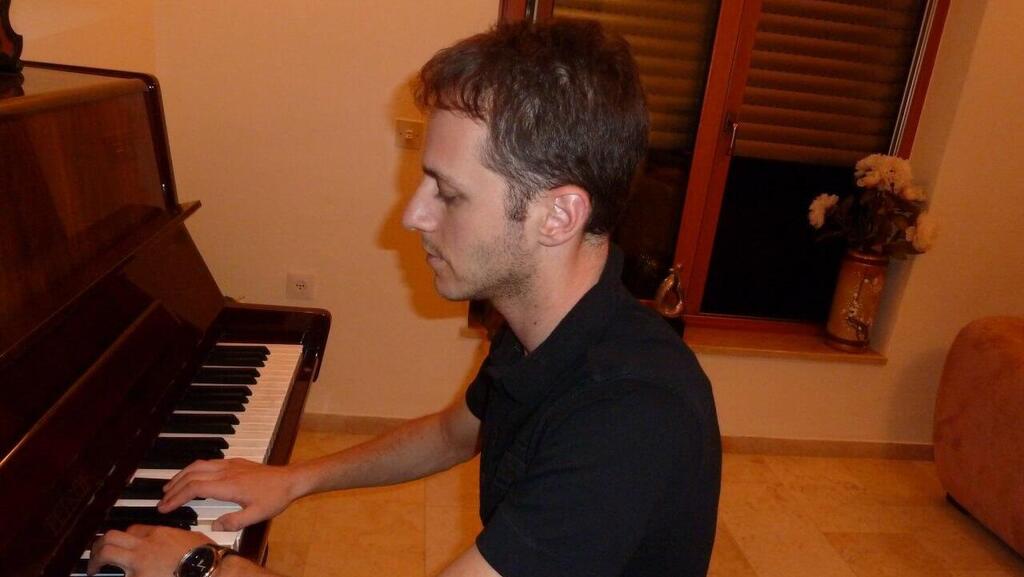
Dima Gershovich

Dima and his wife Lucille-Jane
Dima had worked for the past nine years as a software engineer at JFrog. He studied at the Technion in Haifa and later at Reichman University in Herzliya.
“Dima was an exceptional person,” Levin said. “From childhood, he stood out as a gifted child, a small genius who studied in gifted programs and continued in an academic track. But beyond his abilities, he was first and foremost a beloved person, with a big heart and a kind soul.”
A relative added that Dima spoke 11 languages, played piano at a high level, painted and loved to cook. “In Israel’s high-tech world, he was known as thorough, professional and committed, someone who did everything to the highest standard,” she said. “He was an only child to parents who immigrated from Kyiv, and their bond was deep and special.”
Dima met Lucille, a native of the Philippines, while traveling there. “For years, she was afraid to come to Israel, but chose to follow their love,” Levin said. “They married in April 2024. A few months ago, she made the move to build a home with him. They dreamed of a family and children, dreams that will never be fulfilled.”
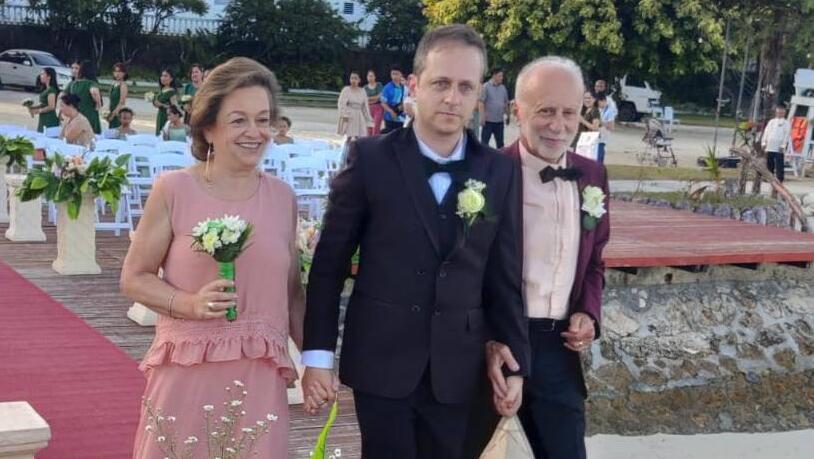
Dima and his parents at his wedding
“She loved him deeply,” Levin added. “Dima lit up his surroundings through his talent, humanity, and kindness. His loss is unbearable.”
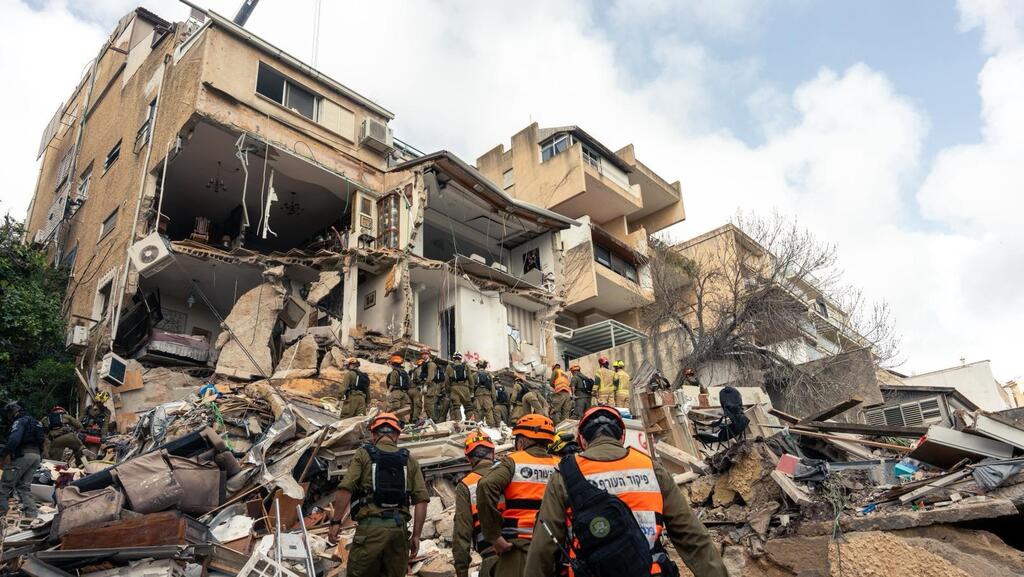
Rescue teams recovered the bodies after 18 hours of searching through the rubble. The four had apparently tried to shelter in the stairwell on the lower level and were buried under concrete when the building collapsed.
According to the military, the missile that struck Haifa broke apart midair and did not fully detonate. An interception failed, and part of the missile hit the building, causing multiple floors to collapse.
The six-story building sustained a direct hit, with the lower three floors completely destroyed. The victims were on the lower level during the sirens. The nearest protected space was outside the building, requiring them to exit and reach a shelter, but the elderly parents struggled to do so.
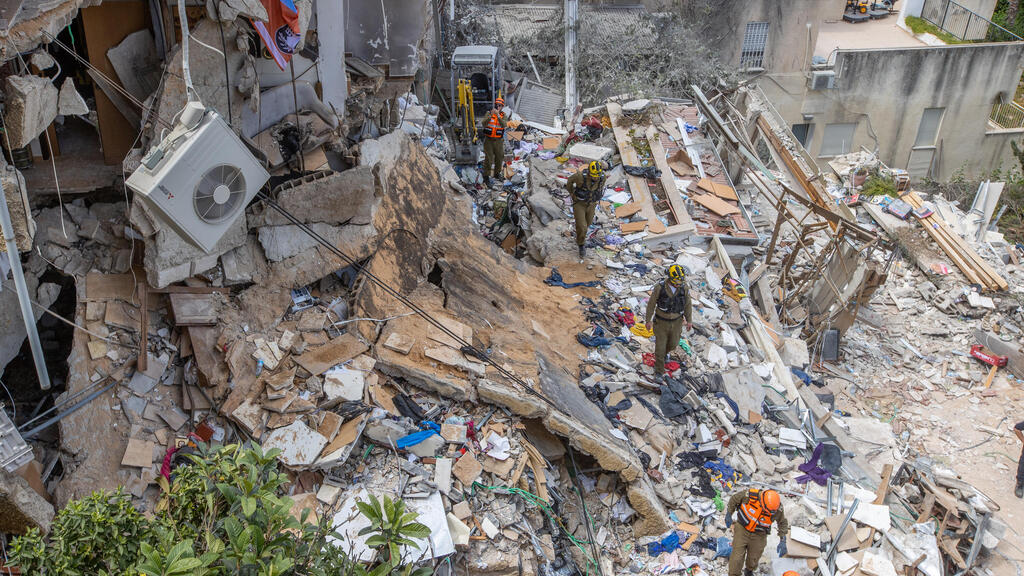
The Haifa scene
(Photo: Ido Erez)
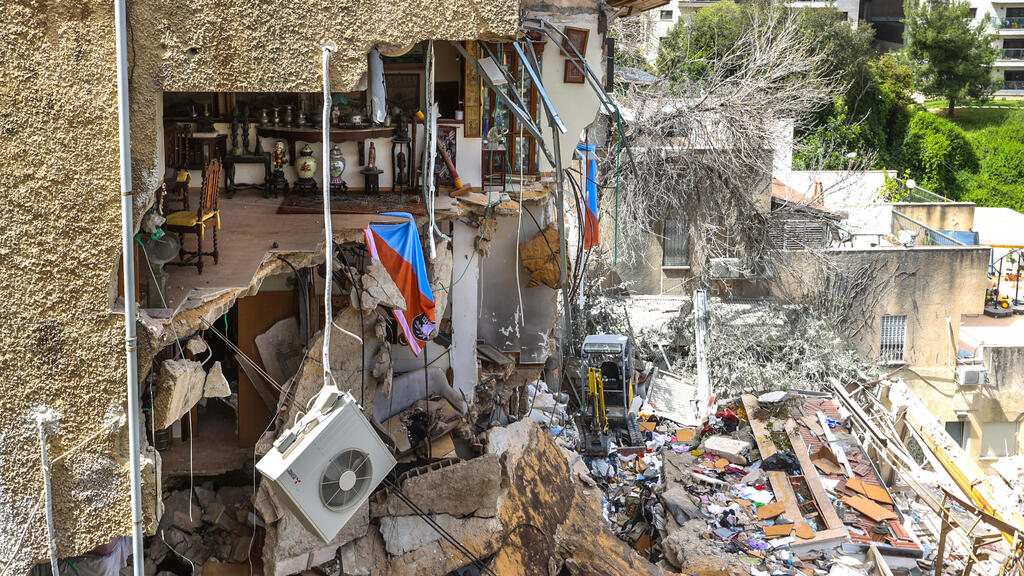
(Photo: Ido Erez)
(Photo: IDF)
Tal Aharonovitch, deputy head of security at Rambam Medical Center, who lives in the building, described the moment of impact.
“We had just bathed the baby when there were early alerts, but we didn’t hear them,” he said. “When we put the baby to bed, the siren sounded. The shelter is three floors below us. We realized we wouldn’t make it. Seconds later, there was an explosion.”
“We shielded the baby with our bodies. The house is filled with glass shards. My wife and the baby were lightly injured.”
He said they later went down to the shelter for help. “We didn’t yet know where the impact was or how severe it was, only that it was close. Minutes later, rescue forces arrived. When we went outside, we saw the scale of the destruction.”
“We have nowhere to return to. The building is slated for demolition.”
Large firefighting and rescue forces, along with Home Front Command search and rescue units, conducted extensive operations at the scene. A heavy crane was brought in to lift massive concrete slabs.
Rescue officials said it was one of the most complex scenes they have encountered, possibly the most difficult, even compared with the deadly missile strike in Beit Shemesh in which nine people were killed.
First published: 19:05, 04.06.26