

Hosted by Dr. Mike Evans, founder of the Friends of Zion, the evening brought together a remarkable and symbolic group of participants. Among them were four families who lost their homes and all their possessions in recent Iranian missile attacks, four survivors who had returned from captivity in the tunnels of Gaza, four soldiers currently serving in Jerusalem and protecting its holy sites, and four Holocaust survivors whose presence served as a living reminder of Jewish resilience across generations.
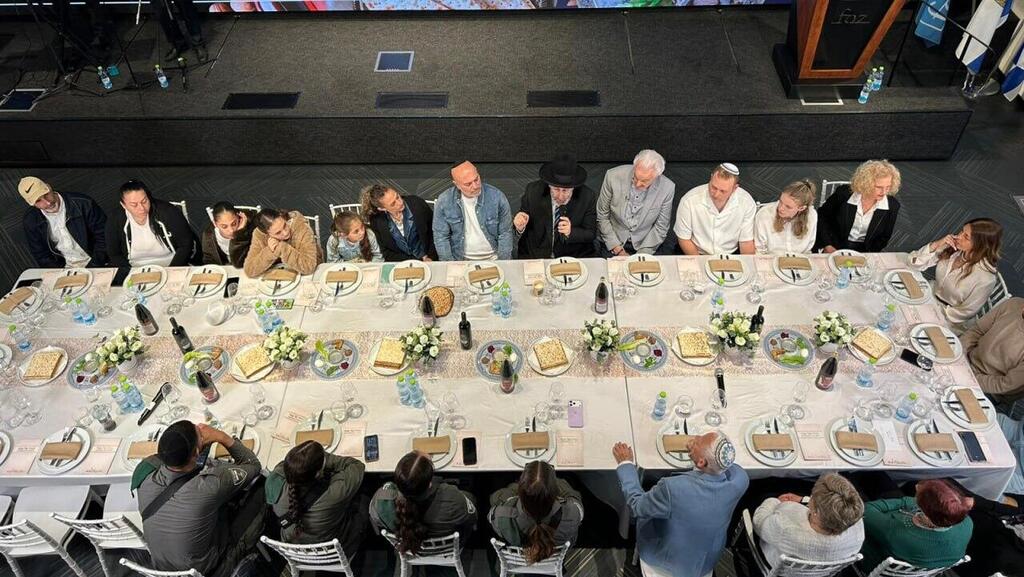
The Seder was led by Rabbi David Lau, former Chief Rabbi of Israel, whose presence brought spiritual depth and a profound sense of continuity to the evening. The stories shared around the table were almost beyond comprehension. Stories of devastation, survival, and moments that many described as nothing short of miracles.
Among those present were families whose lives were shattered in an instant, yet who arrived at the Seder with gratitude for life itself. Roni Vaxelman and Liza Rogachevsky, a young couple from Arad, lost everything when a half ton ballistic missile destroyed their entire residential complex. Moments before the strike, Liza had been preparing Roni’s bag for reserve duty. A siren sent them running to a shelter, where they felt the immense force of the explosion. When they emerged, they found total devastation. Dozens of children had been injured, and approximately 300 people were left homeless in an instant. Their home, their car, and every possession they owned were gone. Yet not a single life was lost. For them, that is everything. They are alive. And that, they believe, is a miracle.
Adva and Roi Zacharia, parents of five children, experienced their own moment of divine protection. Adva is a childhood friend of Pnina Cohen, who, tragically, was injured in the same wave of missile attacks and lost both her husband and her mother-in-law. The two women grew up together, studied in the same class, and continue to live as neighbors to this day. At the time of the attack, Adva was at home with her children. Their house has no reinforced safe room and no shelter, so she ran with them to the safe room of another neighbor. Inside, she and that neighbor stood together with the children. When the first missile struck, they instinctively called the children to come close and hold onto them. Moments later, a second explosion shattered the window of the safe room exactly where the children had been standing just seconds earlier. Had they not moved closer to their mothers, the outcome could have been very different. Though the family was injured, they survived. When Adva stepped outside, she documented what remained of their home. Nothing was left standing except an Israeli flag. Rescue teams later stated there was no doubt that a miracle had taken place.
Limor and Nir Arusi, parents of three children, endured not one but two devastating strikes within three weeks. With no shelter in their home in Beit Shemesh, they gathered in the innermost room as missiles struck. After the first explosion, the ceiling collapsed. The second blast destroyed the house entirely. Injured and traumatized, they prayed simply to survive, and they did. After approximately two and a half weeks, they relocated to the grandfather’s home in Eshtaol, but another missile struck there as well, destroying that home too. Today they are evacuated to a hotel. Their children are too traumatized to go outside. Limor and Nir attended the Seder alone. They have nothing left but their faith.
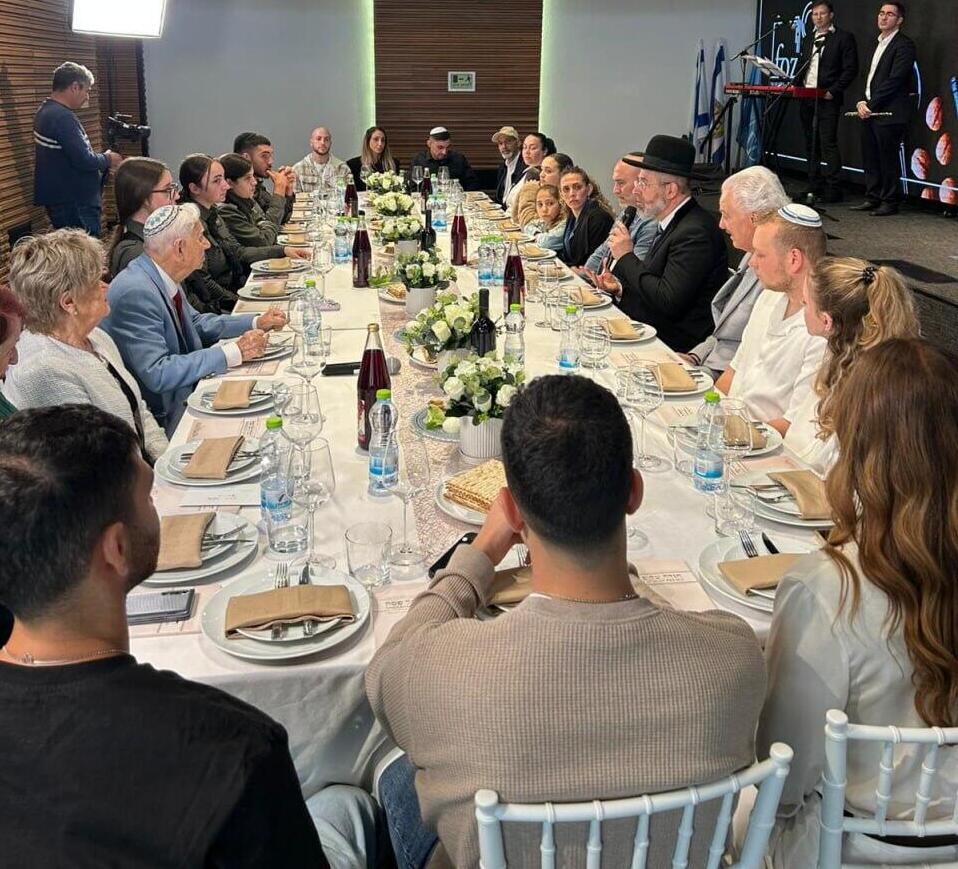
Friends of Zion Center in Jerusalem
(Photo: Gil Mezuman)
Reut Sultan, a single mother of four from Beit Shemesh, represents another kind of survival. After years of domestic abuse and repeated escapes to shelters for battered women, she had finally begun rebuilding her life. Following the death of her husband from an overdose, she raised her children alone .Then a missile destroyed her home. With no family support, she now faces the unimaginable once again, forced to rebuild her life from nothing. And yet, despite their loss, all of these families came to the Seder with a shared message. They are alive. They were protected. And they are not alone.
Alongside them sat four survivors who had been kidnapped by Hamas and held captive in Gaza, each carrying unimaginable physical and emotional scars, yet all arriving with something deeply powerful in common: faith. Each of them spoke of a profound sense that God was with them even in the darkest places. That they were not abandoned. That they were protected. And that belief, they said, is what gave them the strength to survive.
Rom Braslavski, a soldier who had been working as a security guard at the Nova festival on October 7, was kidnapped by Hamas terrorists after risking his life rescuing the wounded and attempting to prevent bodies from being taken into Gaza. After 738 days in captivity, more than two years, he was finally released as part of a hostage agreement. Upon his return, Rom shared that he endured severe and prolonged torture, including sexual assault and other brutal abuses. He described repeated attempts by his captors to force him to convert to Islam, offering food and improved conditions in exchange. Each time, he refused, insisting that he is Jewish and would return as a Jew or not at all. Yet despite everything he endured, he emerged with a strengthened sense of faith, holding onto the belief that God was with him, protecting him even in the darkest moments of captivity.
Evyatar David, who was 22 at the time, was kidnapped from the Nova festival on October 7 together with his close friend Guy Gilboa Dalal. Many of their friends were murdered that day. They were among the first to be taken, and throughout their captivity they endured severe physical and psychological abuse. They were starved, chained by their hands and feet, and at times had bags placed over their heads for days. The conditions were inhumane, with almost no access to basic hygiene. Evyatar, who was taken without his glasses, could barely see throughout his captivity. In one of the videos released by Hamas in August 2025, he appeared in extremely poor physical condition, holding a board marking days of hunger. In another, he was forced to dig his own grave.
Throughout those two years, Dr. Mike Evans stood closely by the family. He met several times with Evyatar’s brother, Ilay, who was also present at the Seder, and worked to raise international awareness of Evyatar’s condition. Following the release of the Hamas videos revealing the severity of the hostages’ physical state, Mike Evans personally appealed multiple times to President Donald Trump, sharing a video in which the mothers of Evyatar David and Guy Gilboa Dalal pleaded directly with the President to intervene and help secure their release. President Trump viewed the footage and publicly acknowledged the hostages’ suffering and dire condition. After two years in captivity, Evyatar was finally released as part of the most recent agreement. Despite everything he endured, he returned with strengthened faith and a deep sense that he was not alone, holding onto the belief that God was with him throughout his captivity.
Eitan Mor, who was kidnapped while working at the Nova festival as a security guard, spent long periods in isolation, was moved between dozens of locations, and survived on almost no food. Bound, displaced, and deprived, he endured conditions beyond imagination. And yet, even there, he found purpose. He cooked, he adapted, and he learned. Over time, he too found strength in faith. He returned after 738 days with a renewed sense of meaning and belief.
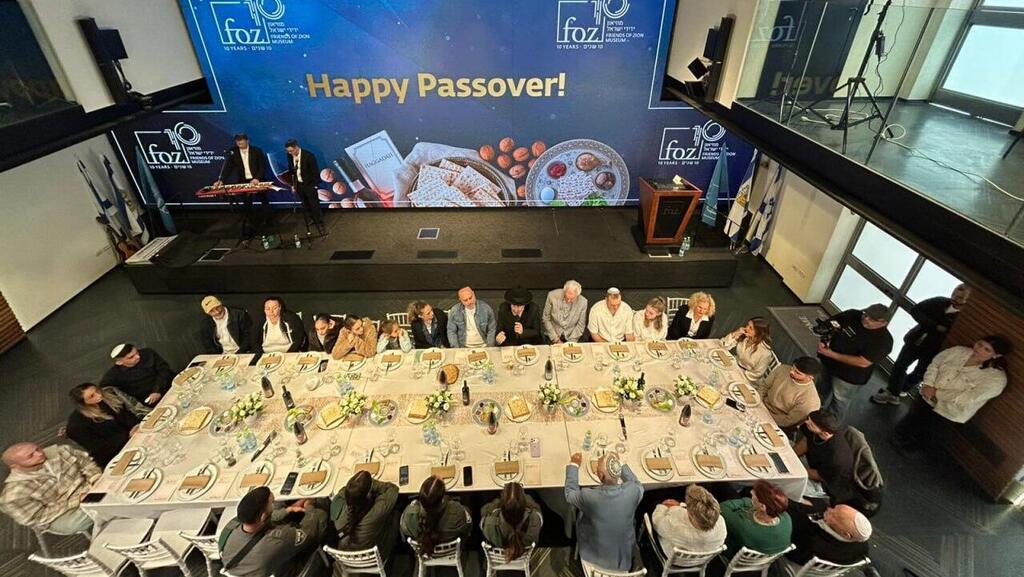
(Photo: Gil Mezuman)
Moran Stella Yanai, who was kidnapped after trying multiple times to escape, endured both physical injury and deep trauma. She was among the first to speak openly about the abuse she suffered in captivity. Since her release, she has transformed her pain into purpose, dedicating her life to speaking out, advocating, and standing up for Israel around the world. She speaks not only of survival, but of faith. Of a feeling that even in captivity, she was not alone.
Together, these four survivors shared a message that resonated deeply throughout the room: that even in the tunnels of Gaza, in the darkest and most terrifying conditions, they felt that God was watching over them.
The atmosphere of the evening was not one of despair.
It was one of faith.
It was one of unity.
It was one of an unshakable belief that there is a force greater than all of us, guiding, protecting, and sustaining the people of Israel.
Around the Seder table, Holocaust survivors sat beside survivors of modern day terror. Soldiers protecting Jerusalem shared a meal with families who had lost everything. Those who had emerged from the depths of Gaza sat beside those who had just escaped destruction.
It was not just a Passover Seder.
It was the living story of the Jewish people.
From generation to generation.
From destruction to renewal.
From darkness to light.
On this night, more than any other, one truth was felt by everyone present: We are still here. We are alive. And we are never alone.
First published: 14:57, 04.03.26