

Two objects in U.S. Ambassador Mike Huckabee’s Jerusalem office tell much of the story. In one corner stands a black bass guitar, the instrument he plays every Sunday with his church band.
On a nearby wall hangs a map taken from a classroom in Gaza: a map of “Palestine” topped by a Kalashnikov emblem, with Israel and all its cities erased. Between those two objects, the believer’s guitar and the map of an enemy, sits the man who over the past year and a half has become one of the most openly pro-Israel American ambassadors in recent memory.
When it comes to defending Israel, Huckabee does not hesitate. There is an intensity to the way he makes Israel’s case that can be difficult to find even among official Israeli spokespeople. He reaches for arguments that are not part of the standard political script: the growth of Israel’s Christian population from 34,000 in 1948 to nearly 200,000 today; Arab doctors heading departments at Hadassah Medical Center and supervising Jewish staff; and the fact that his own wife was treated by an Arab doctor and a Jewish doctor who have worked together for 20 years. “So if that’s apartheid, they’re not good at it,” he said.
Appetizer and entree
Asked what the United States would be prepared to do to defend Israel in a broader regional war, Huckabee turned the premise of the question on its head. “America has never defended Israel,” he said. “Not one time since 1948 has America ever put boots on the ground for Israel.” When Washington acts against Iran, he argued, it is not defending Israel but protecting its own interests. “When we are partnering against Iran, we’re not defending Israel, we’re defending the United States,” he said. “Israel is maybe the appetizer, but we’re the entree.” For nearly 50 years, he added, Tehran has been saying “death to America,” and Washington should take that threat seriously. In Huckabee’s view, the United States is not simply supporting Israel but partnering with it because that partnership also serves American interests.
Asked whether Trump had been misled into believing the war with Iran would end in regime collapse, Huckabee was emphatic. “I disagree with the idea that he was nudged in or led or pushed or deceived. That simply didn’t happen.” He said he was in the White House Situation Room when the decision was made on Operation Roaring Lion. “A lot of what happened in that room I cannot disclose because it was classified. Someday maybe I’ll write a book and tell the whole story, but I don’t leak,” he said. “Nobody pushed President Trump into anything. Nobody misled him into anything.” Israel, he stressed, never pressured Trump to intervene. “He did it from his own volition.”
Huckabee was more cautious about what comes next with Tehran. “I can’t predict what might happen in terms of a kinetic military activity,” he said. “It’ll be made in Washington by the president.” But he said Iran is now “the weakest that they have been probably in 47 and a half years,” both militarily and economically, and is “growing weaker.”
In his view, the American definition of victory is clear: no Iranian nuclear weapon, no uranium enrichment and the reopening of the Strait of Hormuz, with possible limits on Tehran’s missile capabilities as well. Huckabee said Iran had expanded its missile range from 2,000 kilometers to 4,100 kilometers in a single year. “From Iran they can hit London, Paris, Berlin, Brussels, Rome, Athens. Pretty much all of Europe,” he said. “I was shocked that there was not a greater level of reaction from throughout Europe when that was evident once they hit Cyprus.”
He described the relationship between Netanyahu and Trump as “still strong and solid.” The two continue to speak regularly, he said, and maintain a personal relationship built over years. Huckabee portrayed ties between Washington and Jerusalem as unusually close. “We’re partners. We work incredibly close together, more than most people will ever, ever understand.”
On Israel’s approaching election, Huckabee was more guarded, particularly after earlier comments about a possible national unity government drew accusations of US interference in Israeli politics. “The US policy would be that’s a decision for the voters of Israel to make,” he said. “It’s not the US position to say this is how the government ought to look after October any more than it would be for Israel to say this is who we want you to vote for.” Whether Israelis return the current government, produce a different coalition under the same leadership or elect an entirely different government, Huckabee said the relationship will endure. “Our relationship to Israel is not built upon the next election, it’s built upon our mutual interest.”
Asked how the US midterm elections could affect ties with Israel, Huckabee said: “I’d like to believe that people in America largely, mostly recognize Israel is an incredibly valuable, important strategic partner, not just an ally, but a partner.” He pointed to cooperation during Operation Roaring Lion, saying Adm. Brad Cooper, the head of US Central Command, had told him there had never been a US military operation with such seamless coordination.
‘Unsettlers’
Ten days earlier, Huckabee visited Turmus Ayya in the West Bank, where he used his phone to film extremist settlers who entered a Palestinian family’s property in a security vehicle while he stood at the family’s home. Huckabee said he distributed the footage widely but would not disclose Trump’s reaction.
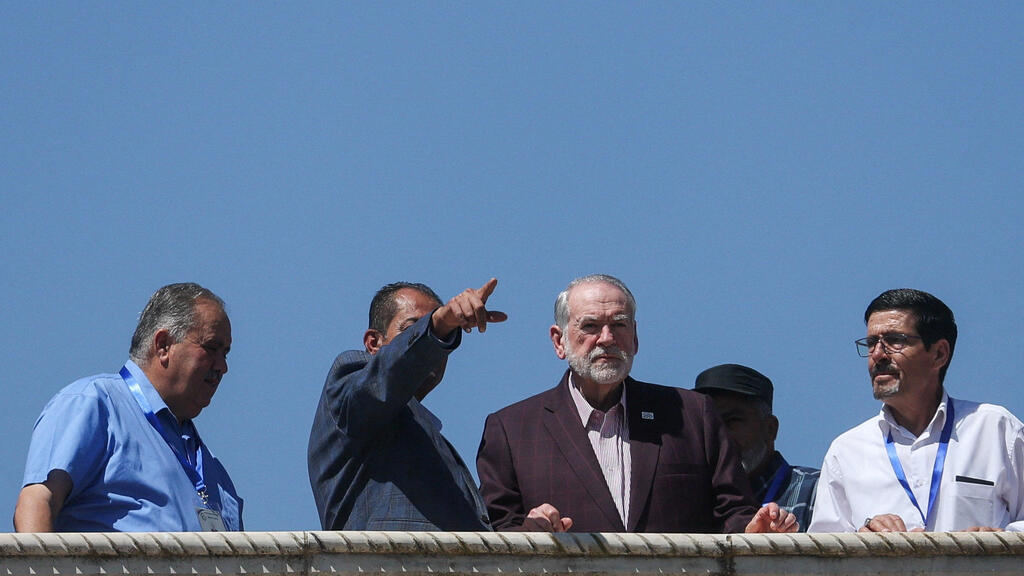
Huckabee visiting Turmus Ayya in the West Bank
(Photo: REUTERS/Ammar Awad)
He acknowledged being surprised that the men entered the Palestinian property while his security detail and the media were present. “It was one of those things that I felt like people needed to understand,” he said. The individual, he said, “was not protecting or guarding his property. He was actually encroaching on someone else’s.” Huckabee added: “It’s perfectly legitimate to protect your own property. That’s something every person has a right to do. But what they don’t have a right to do is to go to someone else’s property and to drive around on it and to potentially intimidate or frighten people as to why you’re there.”
He stressed, however, that he does not attribute such acts to settlers as a whole. “I have never attributed all of these actions to settlers,” he said. “In fact, I say they’re not settlers, they’re unsettlers.” Many of those involved, he added, do not live in the West Bank at all.
Huckabee said he remains convinced that “probably 99.9%” of residents of West Bank settlements are responsible people. “People have built beautiful communities,” he said, citing Ma’ale Adumim and Efrat. “They’re just wonderful places where people live and they just want to raise their families.” He also criticized international media coverage that, in his view, too quickly labels anything that happens in the West Bank as “extreme settler violence.” “It’s not accurate,” he said, adding that such coverage unfairly “besmirches” the people who live there.
On cases involving American citizens harmed in the West Bank, Huckabee acknowledged the limits of Washington’s authority. “We are guests in a foreign country,” he said. “The US government does not have the authority to investigate criminal activity or adjudicate criminal activity.” What Washington can do, he said, is exert influence, draw attention to cases and demand investigations and consequences. He cited one case in which an investigation was complicated because a Palestinian family declined, on religious grounds, to allow an autopsy. “I respect that may have been on religious grounds,” he said. “But the failure to have a forensic autopsy makes the investigation very challenging.”
The Hamas challenge
Huckabee rejected calls by Israeli ministers to encourage mass migration from Gaza, but he was equally critical of efforts to prevent Gazans who want to leave from doing so. “I know of no one in a position of genuine authority who is for the forced displacement of anyone in Gaza,” he said. “But I also find it incredible that some people seem to be in favor of forcing people to stay in Gaza who would like to leave. Why would there be such a desire to imprison people and to hold them hostage in a place that they no longer wish to live?” Huckabee said he had heard both Netanyahu and Trump address the issue directly. “Everyone that I have heard, from the prime minister to the president, has been crystal clear: no one’s going to be forced to leave. But neither should anyone be forced to remain who would like to leave and start a new life somewhere else.”
(Photo: Alex Kolomoisky)
On Hamas disarmament, Huckabee was categorical. Since the October 2025 ceasefire, he said, Hamas has not surrendered a single weapon. “Not one gun, not one bullet, not one bomb, not one rocket.” He added: “They have no intention of voluntarily doing it. At least they haven’t given any demonstration of it.” At the same time, Huckabee pointed to what he described as progress on the humanitarian front: 600 to 700 trucks carrying humanitarian and medical assistance entering Gaza every day, one million doses of polio vaccine supplied to Gaza, and a population he said had grown by 4% annually. “How do you commit genocide when you’re sending 700 trucks of supplies and food in?” he asked. “Israel deserves credit for ensuring that happens. They don’t get the credit. They’re accused of genocide.”
Huckabee also addressed talks in which he is involved over a new US-Israel security memorandum of understanding expected to take effect in 2028. The next agreement, he said, is already being developed, after Netanyahu proposed rethinking the structure of US financial assistance, much of which ultimately returns to the United States through Israeli purchases of American military equipment.
The chemist and the pharmacist
Asked about the sharp decline in support for Israel among Americans, Huckabee said he believes much of it stems from misinformation. “I think most of it is misinformation, because I would ask myself, what are they critical of?” He rejected accusations of apartheid, pointing to Israel’s Arab population and Arab participation in public life. “Twenty percent of the population is Arab. Arabs serve in the Knesset. Arabs sometimes are the CEO of the largest bank in Israel. Arabs are on the Supreme Court. Arabs serve in the military,” he said. “They vote, so it’s nonsense.”
On hostility toward Christians in Israel, Huckabee said: “I live here. I’ve been coming here for 53 years. I’m a Christian. I’ve never been heckled. I’ve never been spat upon.” He acknowledged isolated incidents but said they should not be used to characterize an entire country. “You cannot blame a country of 10 million people for the actions of a very small minority of thugs who do terrible things,” he said, adding that such incidents are widely condemned in Israel.
On possible normalization between Israel and Saudi Arabia, Huckabee said “only the Saudis can answer that,” but expressed hope that Riyadh would look to the United Arab Emirates and the benefits it has gained through the Abraham Accords. He cited “increased trade, increased tourism, decreased hostilities, better educational environment for everyone” and greater acceptance and tolerance. “A person can walk around Abu Dhabi, Dubai wearing a yarmulke and nobody’s going to attack them or even scream at them,” he said. “I think they’re the gold standard.”
Asked whether he supports a two-state solution included in Trump’s 20-point plan, Huckabee answered cautiously. “It’s a great question, but it’s not one that I have the solid answer to because I don’t get to make the policy that determines it,” he said. “When the president makes a firm decision about that, I’ll let you know.” He then pointed to what he described as a long history of Palestinian leaders rejecting Israeli peace offers. In Huckabee’s view, opportunities dating back to Yasser Arafat were repeatedly turned down.
Asked whether he could ever be required, as ambassador, to deliver a message to the Israeli government that he personally disagreed with, Huckabee did not hesitate. “Sure, that’s part of being an ambassador. You don’t make the policy, you carry it out.” He illustrated the point with an analogy. “I’m not the chemist. I don’t get to make the medicine and concoct the formula. I’m the pharmacist. I take the medicine that I’m given and I dispense it,” he said. “If I’m given an instruction by my president to deliver a message, it’s not my job to argue with the president or to agree or disagree. It’s my job to carry out what I’m here to do.”
That led to the question of what Trump would do if Israel faced a genuine existential threat, even at the cost of direct confrontation with Iran or another major power. “That’s a loaded question,” Huckabee said with a smile. “I can only answer if it was in America’s best interest, the president would act. But that’s what he’s required to do.” He said Trump had already made that calculation twice during Huckabee’s tenure, first by sending B-2 bombers against Iran and then during Operation Roaring Lion. “He didn’t do that because Israel was over here begging, saying, ‘Please help us, we can’t handle it,’” Huckabee said. “Israel never begged anything. Israel never pushed President Trump into engaging. He did it from his own volition.”
“He did it because he sees Iran as a threat to America and to Americans,” Huckabee said, adding that Trump is also mindful of the roughly 700,000 American citizens living in Israel.