

U.S. President Donald Trump is reportedly considering an operation that so far has been seen as the U.S. “endgame” against Iran, while one of America’s and Israel’s closest regional allies is tightening ties with Tehran.
Bloomberg reported that senior security officials from the UAE and Iran met for the first time since the war began. Sources familiar with the discussions described the meeting as “a sharp turn for both sides.”
Donald Trump talks about Kharg Island
(Video: Fox News)


Thursday afternoon, Donald Trump publicly threatened to seize Iran’s Kharg oil island in the Persian Gulf, posting on Truth Social and in interviews. He acknowledged, however, that “it is not certain that the country has the courage for this step.”
Pentagon officials and two senior U.S. administration officials told CNN that U.S. military plans to attempt control over the island had been developed over months but repeatedly postponed because the operation was considered too dangerous.
According to officials, the White House and Pentagon estimate that seizing Kharg or destroying its energy infrastructure would severely damage Iran’s economy and reduce its war capabilities, potentially preventing it from continuing the conflict. However, they also warned Trump that such an operation would likely require significant ground forces and could result in heavy casualties.
Because of these considerations, the Pentagon and White House viewed any operation against Kharg as a potential “endgame” — a last-resort measure that could shift the balance of the war, but at high risk. The U.S. military has previously carried out airstrikes on military facilities on Kharg, intentionally avoiding damage to the island’s critical energy infrastructure.
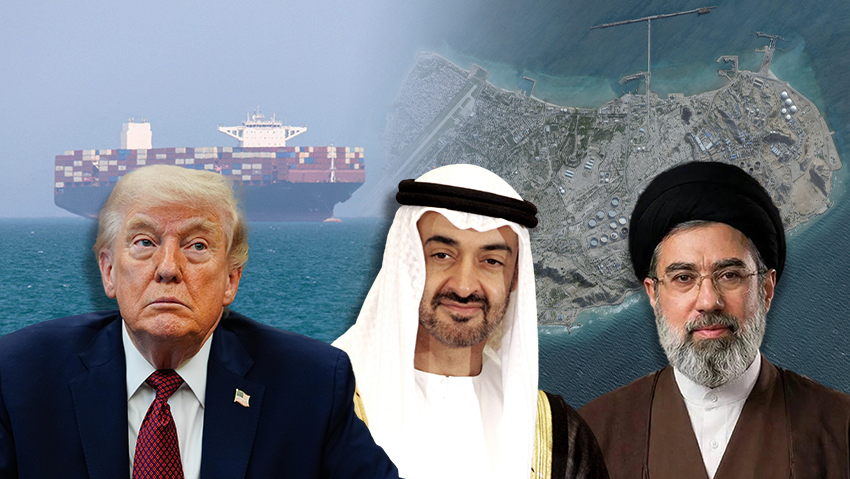
Donald Trump, Mohammed bin Zayed, Mojtaba Khamenei
(Photo: AP Photo/Julia Demaree Nikhinson, Planet Labs PBC/Handout via REUTERS , Amirhosein Khorgooi/ISNA/WANA (West Asia News Agency) via REUTERS )
Trump’s threats followed two days of exchanges of fire between the United States and Iran, just before the start of the World Cup hosted by the U.S., Canada, and Mexico. These warnings came after the first meeting since the start of the war between senior officials from the UAE and Iran.
According to Bloomberg sources, the UAE initiated the talks mainly to reduce further damage to its economy and security while understanding that the Iranian regime would remain in power. UAE leaders aim to protect their economic plans, including multi-billion-dollar oil production investments and artificial intelligence data center projects. For Tehran, maintaining ties with the UAE is also important, as it was one of Iran’s largest trading partners and a key route for oil exports prior to the war.
Since the war began in late February, Iran has attacked the UAE more than any other country, launching nearly 3,000 missiles and drones. Most were intercepted, but at least 13 people were killed, and oil and gas facilities, ports, and hotels suffered billions of dollars in damage. Abu Dhabi responded with counterstrikes and used Iron Dome systems, taking the most aggressive stance among Arab neighbors against Iran.
Now, the UAE appears to be following the example of Qatar and Saudi Arabia, seeking diplomacy to reduce tensions after earlier failed efforts to coordinate a joint response with these countries. The ongoing closure of the Strait of Hormuz, fragile ceasefires since April, and slow progress in U.S.-Iran negotiations have prompted this shift.
According to the report, the UAE’s main goal is to minimize further damage to its economy and security. There are indications that these efforts are beginning to succeed: Iran has not attacked the UAE since last month’s strike on the Bushehr nuclear power plant. This week, as U.S.-Iran tensions escalated, Tehran chose to attack Kuwait, Bahrain, and Jordan.