

The World Zionist Congress returned to Jerusalem with 1,400 Jews from more than 40 countries — equal parts family reunion and political brawl — testing what Zionism means in 2025 and who gets to define it.
One appointment in particular has sparked debate.
Inside the ICC Jerusalem, the “Parliament of the Jewish People” convened for the first full in-person congress in a decade — 700 delegates and 200 alternates spanning 42 countries. The U.S. delegation arrived with 155 elected delegates and roughly 100 alternates, marking the largest American showing ever after a record turnout in this year’s AZM elections.
“So the resolutions that come out of the Zionist Congress reflect the viewpoint of global Jewry," explained AZM Chief Herbert Block. "The statements and resolutions either set policy or make declaratory statements on the priorities of world Jewry — both regarding issues happening in Israel and support for Jewish communities around the world.”
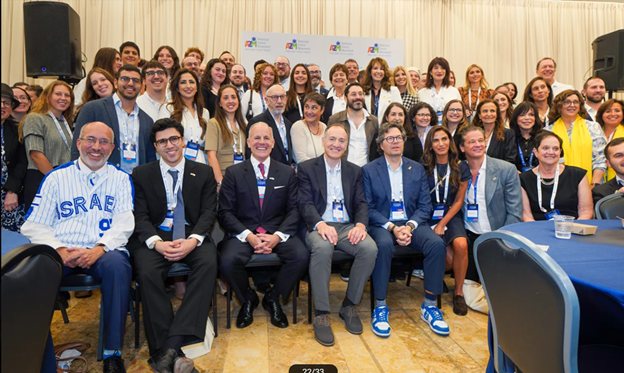
A group photo of AZM delegates attending the 39th World Zionist Congress
(Photo: Liam Forberg)
But the biggest headline here was political.
A center-left/center-right power-sharing deal, meant to split leadership of the WZO and KKL-JNF, collapsed just hours after it was struck, following a plan to appoint Yair Netanyahu to a senior WZO post. The plenary then voted to extend the congress by two weeks to salvage a coalition. Tempers flared behind closed doors as ministers traded accusations over who was cutting deals with whom. It was messy and very Jewish.
“Zionism is in our soul and in our firm, so no matter what happens on the streets of New York or around the world, those of us who are really passionate about it — we can’t let that stop us," Rhoda Smolow, past National President of Hadassah told ILTV.
ZIONIST CONGRESS CLASH
(ILTV)


Beyond the drama, committees advanced a raft of resolutions: combating antisemitism, strengthening Jewish education, and expanding mentorship and leadership pipelines for women. Delegates also spotlighted service tracks for young women volunteering in Israel, an often overlooked cohort.
“Some really do have bearing on what the World Zionist Congress and the World Zionist Organization can do moving forward," explained Meira Lerner, director of World Emunah. "One of them talks about programming that will encourage female leadership and mentorship of female leaders.”
“Women have to play a pivotal role in it," added WIZO President Anat Vidor. "We need to make it through resolutions, through positions, through keys of influence. It’s not just about quantity — it’s also about the quality of what we do here.”
For first-timers, the sight of a global Jewish town hall was the story.
“It’s very cool and special to see so many different types of Jews coming together in Jerusalem, the undivided and eternal capital of the Jews, and discussing so many important issues that obviously have a big effect on our future," said Yona Groisman, 18, who came to observe.
Inside the committees, arguments were sharp over borders, peoplehood, identity, and priorities after two years of war. For some, the danger is external; for others, it’s internal division. For all, the work is to turn debate into budgets and programs that touch real lives from Jerusalem to the Diaspora.
“It’s beautiful to see people come together in Jerusalem, more than anything," noted Tila Falic-Levi, the top delegate for the Israel365 Action list.
Although she added that, "it's a little bit hard to be with so many people with so many different ideas, because the discourse is healthy, but the disagreement puts people in very different places.”
“What I see here is a proud people who come and raise their hands, raise their heads, and say, ‘We are Jews, we’re Zionists, and we will make this state stronger," said Israel Ganz, head of the Binyamin Regional Council. "This is our home.’”
Zionism in 2025 is not one thing. At the congress, it’s sovereignty and security, social infrastructure and equal opportunity — argued loudly, voted on democratically, and funded at scale — over a billion dollars a year across Israel and Jewish communities worldwide.
Even with coalition chaos, the work continues: set priorities, pass budgets, and remind a fractious world that Jewish peoplehood still gathers, debates, and builds in Jerusalem.
In a week of sharp elbows and shared purpose, the World Zionist Congress showed that the family fight is real, but so is the family.