

A right-wing attorney who recently said it would be "good" even if IDF soldiers were killed in a violent confrontation with Jewish settlers has acknowledged meeting the mathematics professor accused of planning terror attacks targeting hundreds of Arabs, but said he did not report the encounter to police. "It was a mistake in judgment. At the time, I had the impression that this was a man around 60 years old presenting a delusional plan," attorney Tamir Dortal said.
At the same time, a densely written letter the professor sent to Zehut chairman Moshe Feiglin has been revealed. Its title was "The people will carry out transfer," the phrase from which the professor derived the Hebrew acronym he allegedly used as the name for his plan.
Gallery
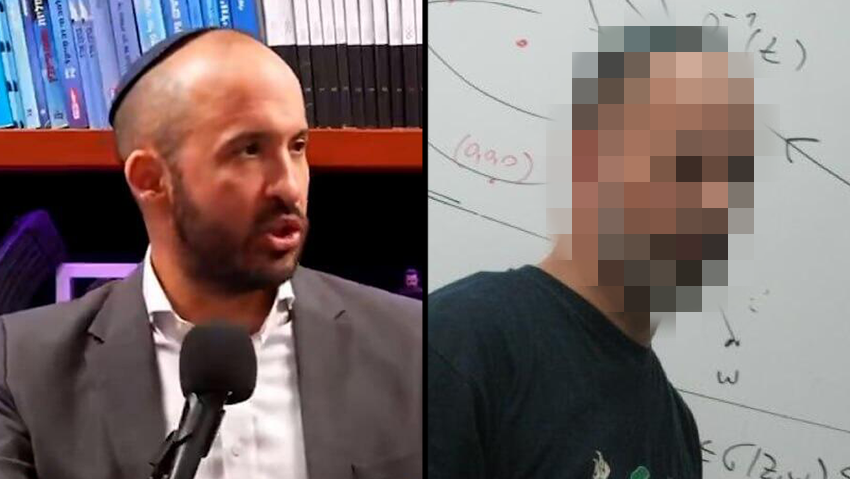
Attorney Dortal and the professor
(Photo: Bar-Ilan University; from the ‘Al HaMashmaut’ podcast)
The professor’s neighbors said they were stunned by the indictment against him. One woman said she witnessed the forces arriving to arrest him.
"I came back from work and saw them taking the guy who lived here, pretty much by force," she said. "They put him into a car. They weren’t wearing uniforms or anything. I asked one of them what was going on, and he told me they were the police and not to worry, everything was fine."
Another neighbor said the allegations appeared completely out of character. "It doesn’t fit him," he said. "Do you know how intelligent he is? He is very nice and mild-mannered. His clothes and appearance were a little strange, but he didn’t seem extreme at all. We even talked a little about politics. I understood that he was right-wing, but he didn’t strike me as an extremist."
Ron, who has lived on the street for 12 years, said he rarely saw the professor. "It’s a huge shock. This is a very quiet street," he said. "We would always say hello to each other. I knew he lived here alone and that he was pleasant."
Dortal told ynet that the professor had come to see him and "introduced himself as a retired professor who wanted to promote a bizarre and absurd theoretical idea."
"From the moment I understood the nature of the plan he was presenting to me, I completely opposed it and made clear to him that it was a grave, unacceptable and dangerous idea," Dortal said. "I told him the meeting was over and demanded that he leave my office. I made clear to him that his idea was terrible, both morally and in terms of the goals he himself claimed to believe in. I explicitly asked him whether he had a weapon, and he said no."
"I regret that I did not go to the police at that moment," Dortal added. "It was a mistake in judgment. I assessed that he was only speaking theoretically and did not pose a real danger."
Dortal said he nevertheless told the professor that he would contact the head of the Shin Bet and report what he had heard. "I had the impression that the warning deterred him and that he would stop spreading the idea," he said. "After I ordered him to leave, he initially refused to leave my office. Eventually, he agreed and left."
Dortal said that after the mathematics professor was arrested, he gave police everything he knew and cooperated fully. The professor’s name remains under a court-imposed gag order.
"I was never a partner in the plan, I did not support it and I did not help advance it," Dortal said. "On the contrary, from the moment I understood what it was about, I rejected it clearly and unequivocally and tried to make him understand that such a plan would actually harm the very goals he claimed to believe in."
Dortal hosts the right-wing political podcast "Al HaMashmaut." Last month, he sparked controversy after saying during an episode that even if soldiers were killed in a violent confrontation with Jewish settlers in the West Bank, that would still be "good" if it prevented a mass evacuation of Jews from the territory.
In a clip circulated on social media, Rabbi Benny Lau told Dortal that "anarchy is bad." Dortal then asked him: "If the sovereign Jewish people decided to carry out the ethnic cleansing of Jews from Judea and Samaria, is it good or bad if that is prevented by force and bloodshed?" Lau replied firmly: "It is bad."
Dortal disagreed. "I think it is good," he said. "Even if IDF soldiers die in that event, and 20 or 100 times as many settlers die, but ultimately the event is prevented and the Land of Israel remains in our hands, that is good."
Dortal has previously hosted senior political figures on his podcast, including Finance Minister Bezalel Smotrich, Knesset Constitution Committee chairman Simcha Rothman and former ambassador and minister Gilad Erdan.
After the comments were publicized, Dortal issued a response seeking to explain the discussion but did not retract the statement itself.
"The clip being circulated is a short section from a long discussion in which we raised an extreme and hypothetical thought experiment: What should be done if the Israeli government decides to forcibly evacuate all Jews from Judea and Samaria?" he said. "It was a moral question within a debate, not a call to action, and certainly not a call to kill, shoot or harm IDF soldiers."
72 attackers in 12 cells
The mathematics professor from Bar-Ilan University, a Petah Tikva resident in his 60s, has been charged with planning attacks against hundreds of Israeli Arabs as part of a scheme he called by a Hebrew acronym derived from the phrase "The people will carry out transfer."
A court has barred publication of the defendant’s name for at least the next two days. The Central District Prosecutor’s Office has charged him with security offenses including preparation to commit an act of terrorism under Israel’s Counter-Terrorism Law, extortion by threats and obstruction of justice. Prosecutors are seeking to keep him in custody until the end of legal proceedings.

Bar-Ilan University
(Photo: Dana Kopel)
According to the indictment, the professor’s plan envisioned 72 Jewish attackers, at least half of them licensed gun owners, including himself. They would be divided into 12 cells of six people each.
The cells would allegedly arm themselves with weapons including handguns, rifles, axes and hammers and launch surprise mass attacks in mixed Jewish-Arab cities and Arab communities across Israel.
The plan also called for advance coordination with what the professor described as subversive elements recruited from within the IDF, who would provide assistance and support to the attackers. According to the indictment, the proposal included strikes on Arab population centers by the Israeli Air Force, Artillery Corps and Armored Corps.
Prosecutors said the professor also laid out a practical section describing how the plan could be carried out "here and now." According to the indictment, it called on participants to carry out mass killing, rapidly seize friction points, roads and entrances to and exits from Arab communities, mixed cities and hospitals, and continue despite pleas to stop.
Attempts to recruit supporters
Prosecutors say the defendant spent about a year and a half trying unsuccessfully to recruit supporters and partners for the plan. He also allegedly conducted a reconnaissance trip around the Arab town of Tuba-Zangariyye in northern Israel to study access routes and determine what he believed would be the best ways to attack the community, which he wanted to make a central target.
According to the indictment, his covert recruitment plan centered on approaching Moshe Feiglin, who heads the Zehut party and is running in the coming election for Israel’s 26th Knesset. The professor allegedly hoped to recruit Feiglin and, with his assistance, enlist additional activists.
Under the plan described by prosecutors, selected activists would be identified in advance and invited to a Zehut election gathering. During the event, they would allegedly be told that they had been recruited for a terror attack scheduled for the following day and would receive detailed operational instructions.

Zehut chairman Moshe Feiglin
(Photo: Orel Cohen)
The professor attended two public events held by Feiglin and tried to arrange a meeting with him and give him a summary of the plan, according to the indictment. Feiglin did not agree to any of his requests. About a month ago, as the election approached, prosecutors say the professor wrote a threatening letter to Feiglin criticizing and insulting him over his refusal to cooperate.
The indictment alleges that the professor threatened to make the letter public unless Feiglin quickly agreed to cooperate and help promote the plan, believing its publication would cause Feiglin political damage ahead of the election.
About two days later, the professor allegedly went to Feiglin’s home and handed the letter to a neighbor who happened to be passing by, asking her to deliver it. She did so.
He later arrived at a Zehut party event at Jerusalem’s Mahane Yehuda market and, through another woman, gave the party’s director-general several copies of the letter along with another message containing a similar threat, according to prosecutors.
Zehut and Feiglin said after the indictment was filed that they contacted police immediately after receiving the letters. "Immediately upon receiving the extortion and threatening letters from the defendant, Moshe Feiglin and the party leadership contacted the Israel Police without delay and filed a formal complaint," they said.
"We thank law enforcement authorities for their swift and determined action and trust the security and judicial authorities to deal with those responsible to the full extent of the law. Zehut will continue to act with public responsibility and without fear."