


"I remember the elections to the first Knesset. I was a soldier in the Golani Brigade's 13th Battalion, and I voted in the army. We were out in the field. They brought a cardboard box and called it a ballot box. We voted, and they immediately left."
Seventy-seven years later, Zir Luz can still recall the moment with remarkable clarity. Now 97 and approaching his 98th birthday next month, he was among the Israelis who cast their ballots in the country's first national election in January 1949. Next Tuesday, when Israel returns to the polls, he intends to vote once again.
Gallery
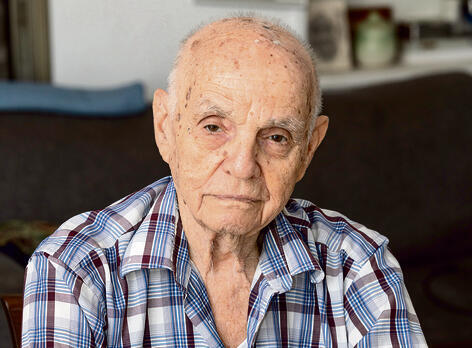
Zir Luz, 97, who cast his first ballot as a Golani soldier in Israel's 1949 election. 'I don't try to convince them,' he says of relatives with opposing political views
(Photo: Gil Nehushtan)
Luz was born in 1928 at Kibbutz Ein Harod, in northern Israel's Jezreel Valley, to pioneering parents who helped settle the region. Today, he lives at Ein Harod Meuhad, one of two kibbutzim created when the original community split during the political and ideological disputes of the 1950s.
For much of his life, his political identity was shaped by the socialist Labor movement that dominated Israel's early decades. But his voting record also includes one significant break with tradition.
From the Labor movement to a family spanning Israel's political divide
"For years, we were identified with the Labor movement and the Histadrut," Luz says, referring to Israel's powerful labor federation. "In the first Knesset election, I voted for Mapam. Since then, throughout my life, I've voted only for Mapai and the Labor Party, and I intend to vote for the Democrats."
There was one exception: the historic 1977 election, which brought Menachem Begin's Likud to power and ended nearly three decades of Labor-led rule.
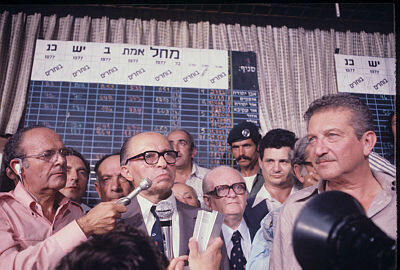
Menachem Begin addresses supporters following his historic election victory in 1977
(Photo: David Rubinger)
"Only in 1977 did I not vote for the Labor Party. I voted for the National Religious Party," Luz recalls. "I felt that Mapai had become corrupt, and I wanted change."
The political landscape of his kibbutz has changed considerably since then. Once firmly associated with the Labor movement, Ein Harod now includes supporters of parties across the political spectrum.
"Today, the vote in Ein Harod is spread among all the parties. That's not how it used to be," he says. "Everyone in the kibbutz knows who I vote for."
The political differences extend into his own family, where views range from the left-wing Democrats to supporters of far-right politicians Itamar Ben-Gvir and Bezalel Smotrich.
"Everyone in my family knows my opinions, and my family spans the entire spectrum, from the Democrats to Ben-Gvir and Smotrich," Luz says. "I talk to them about political issues, but I don't try to convince them, and they don't try to convince me. Neither of us has a chance."
Despite the ideological divisions, politics remains a familiar subject of conversation rather than something he avoids.
Luz also remembers serving at a polling station during the election to the second Knesset in 1951, this time as a representative of an Arab party affiliated with Mapam.
"I sat at a polling station in an Arab village as the representative of an Arab satellite party of Mapam," he recalls. "It was nice to sit there. If I were younger, I'd do it again today."
As for how many more elections he hopes to participate in, he has a simple answer: "As far as I'm concerned, I intend to vote for as long as I live."
‘I miss hearing Ben-Gurion's voice on the radio’
Pinchas Avhar, 91, was too young to vote in Israel's first election. In 1949, when the country's first Constituent Assembly was elected, he was just 13.
But since reaching voting age, Avhar has not missed a single election. He will celebrate his 92nd birthday in February and still recalls the early years of Israeli democracy with affection.
Like Luz, he grew up in the Jezreel Valley. His parents immigrated from Yemen in 1914, decades before Israel's establishment. After the family's early years in the Neve Tzedek neighborhood of Tel Aviv, Avhar moved to Kibbutz Beit Alfa, not far from Ein Harod.
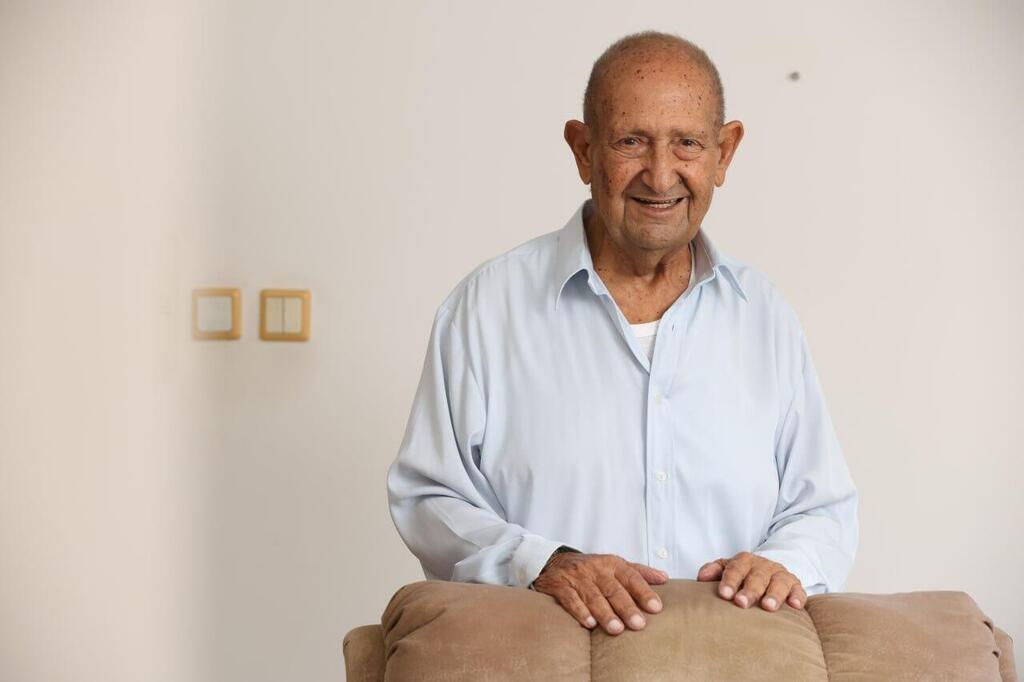
Pinchas Avhar, 91, who first voted in 1955. 'There weren't as many party lists as there are today'
(Photo: Elad Gershgoren)
"I miss that period in the kibbutz very much," he says. "There was a lot of simplicity there, and above all, love between people."
Later, Avhar joined the Working and Learning Youth movement, where he spent 35 years guiding and supporting teenagers who had left school and entered the workforce. He also took an active role in efforts to establish minimum-wage protections for young workers.
His commitment to younger generations has continued into old age. For the past 12 years, he has volunteered at Yizre'elia School in Haifa, mentoring and accompanying students.
At his carefully maintained home in Haifa's Neve Sha'anan neighborhood, Avhar is particular about historical details.
"The state was established in 1948, but the elections to the Constituent Assembly were only held in January 1949," he explains. "I voted for the first time in 1955. That really was the beginning of the state."
He remembers the voting process as far simpler than today's crowded election ballots.
"There was a big curtain, and behind it were just a few party lists. That's where I made my choice."
And which party received his vote?
"Mapai, of course," he replies with a broad smile, referring to the dominant political party led by Israel's founding prime minister, David Ben-Gurion.
"I loved Ben-Gurion very much. I miss hearing his voice on the radio. There weren't advertisements like there are today. Those were leaders of another era: Ben-Gurion, Shapira, Tabenkin, Rokach and Begin."
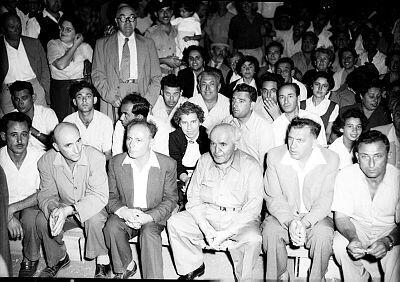
David Ben-Gurion at a Mapai election rally in 1955
(Photo: David Rubinger)
For Avhar, the contrast with contemporary Israeli politics is striking.
"Today, people will go to the polling stations and be confused about whom to vote for," he says. "There are so many small parties joining together and demanding positions, otherwise there's no government. That really troubles me, election after election."
He remains committed to voting for a party on the political left, but has not yet made his final choice ahead of Tuesday's election.
"The left, as always. Exactly which party? We'll have to see what happens in the coming days, and then I'll make an informed decision," he says.
He also believes the political landscape could shift following Benny Gantz's decision not to run, suggesting that Gadi Eisenkot may attract additional support. But he prefers to wait and see how events unfold before deciding.
‘We have to heal the rift’
Sitting in a large armchair in his living room, beside the balcony, Avhar grows noticeably more serious when discussing the country's current condition.
"I am very, very worried about the state of the country," he says firmly. "There is a deep rift between people, especially after the disaster of October 7, and it hurts me."
For someone who has lived through Israel's entire existence, watched governments rise and fall and taken part in nearly every chapter of its democratic history, the divisions have become deeply personal.
"It hurts me to see my country, where I've lived since its establishment and where I've always voted, in such a state."
The concerns go beyond political disagreements. Avhar points to the cost of living, continuing security pressures and the growing distance between different parts of Israeli society.
"Where are we even heading? It's difficult here, with the cost of living, the internal divisions and the security pressure. But we have to heal the rift," he says.
"It's time for us to live in peace, at least among ourselves. That's my hope at my advanced age, to feel here the way I once did, that we're all united."
Avhar is the father of three children, grandfather of six and great-grandfather of five. This year's election carries particular significance for his family because his grandson Ido, an IDF soldier, will be voting for the first time.
"It's the first time in his life that he'll vote," Avhar says. "I hope he makes the right choice among all those party lists."
The moment marks another chapter in a family whose experience of Israeli elections now spans generations, from a grandfather who remembers the early years of the state to a young soldier casting his first ballot.
For Avhar, who has never missed an opportunity to vote, participating in the democratic process remains as important as it was in 1955.
And despite his concerns about Israel's future, he ends with a message to the public:
"I tell everyone: Go out and vote this coming Tuesday. This is the most important election for our country."