

The thud of a body hitting the ground startled the group. "Oh, Jerry, what happened?" the volunteers called out in English as they rushed toward an elderly man sprawled across a black plastic sheet, trying to assess the damage after falling from a ladder.
"I'm fine," he groaned, also in English, before getting to his feet with a smile and some help from his companions. "An accident while picking olives. That's a first for me." Satisfied that he was unharmed, the others picked up their small plastic rakes and returned to work.
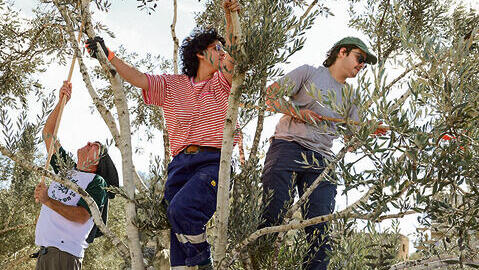
The scene unfolded in a modest olive grove of just a few dozen trees in Jalud, a Palestinian village near Nablus in the northern West Bank. The village is surrounded by 13 Israeli settlement outposts. Its residents own approximately 23,000 dunams, or 5,700 acres, of agricultural land, most of it planted with olive trees. But fear of attacks by violent settlers prevents them from reaching much of it.
"Because of the fear, we only harvest the olives inside the village, between the houses," said Riyad Haj Mohammed Abu Amr, head of the village council. "Even inside the village, we're not safe. Just yesterday, settlers came and threw stones at our elementary school. The children were terrified and crying. You can't imagine how frightening it was."
Standing in the grove, less than 100 meters from the school building, with nearby settlement outposts visible in the distance, Rabbi Toba Spitzer described the fear she and her fellow volunteers experienced when they first arrived.
"It was our second day picking olives," said Spitzer, 63, who leads Congregation Dorshei Tzedek in Newton, Massachusetts, outside Boston. "We had only arrived in Israel on Friday, and before Shabbat our families back home started sending worried messages asking whether we were all right."
The concern followed the attack on Heidi Levine, a photographer working for The Washington Post, who was beaten by Israeli settlers while covering the Palestinian olive harvest. Footage of the assault circulated widely across American news outlets.
"Our families thought that if someone could attack a Washington Post photographer who had come to document Palestinians harvesting olives, who knew what might have happened to us?" Spitzer said. "We weren't there to take photographs. We had actually come to harvest. We reassured them that we hadn't gone into the fields yet and wouldn't begin until Sunday."
The following day, around noon, the group heard screams from the village.
"People were shouting, 'The settlers are attacking the school,' and we didn't know what to do. We were in the middle of our work and, of course, we were very frightened. We know that if settlers come into the village and see us, they won't spare us."
Then she offered a dose of humor.
"They say we're anarchists who came here to provoke people. Look at me. I'm 63. Another woman in our group, Sue, is 82, and Jo is 80. We're very, very frightening. I wouldn't advise anyone to cross our path," she laughed. "I'm joking, of course. Heaven forbid someone takes that seriously."
Hundreds of Jews travel to the West Bank to help Palestinian farmers
Every day during the current olive harvest, Israeli volunteers travel to Palestinian communities to help residents pick their crops. Their presence does not necessarily prevent violent settler attacks, and sometimes the volunteers themselves become targets. Still, for farmers who are afraid to enter their fields alone, even a small sense of security can make a difference.
The Israeli human rights organization Yesh Din documented 640 incidents of violence involving settlers and soldiers against Palestinian residents during the first 24 days of the harvest, an average of 26.7 incidents a day, across 189 West Bank communities. Of those, 316 were directly connected to the olive harvest, averaging 13.2 incidents daily.
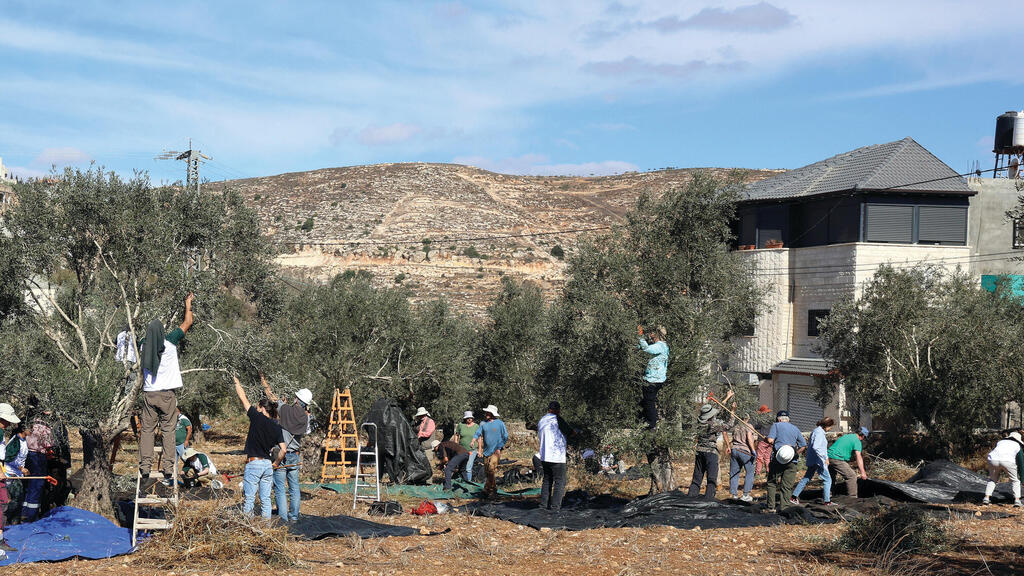
Olive harvest in Jalud this week. 'The children here aren't used to seeing Jews come to help us. There have been four attacks just this week'
(Photo: Shaul Golan)
Against that backdrop, it is hardly surprising that many Palestinian farmers are reluctant to harvest their trees without accompaniment.
Alongside the Israelis are several hundred volunteers from abroad, most of them Jews from communities in the United States and Britain. Like Spitzer, many say they could no longer remain at home watching the disturbing images emerging from the West Bank.
Their motivation goes beyond the basic humanitarian desire to help people in distress. For many, including committed Zionists, it reflects a profound concern about Israel's future and the direction in which the country is heading.
Under the olive trees, with the possibility of another settler attack never far from their minds, the volunteers explained why they felt compelled to come now, just days before Israel's October 27 election. Its outcome, they believe, will affect not only Jews living in Israel but Jewish communities around the world.
Newton, where Spitzer lives, is a prosperous Boston suburb known for its expensive homes, strong schools, parks and gardens. For its residents, there is little obvious reason to leave the comfort of their surroundings to spend days harvesting olives in one of the West Bank's most volatile areas.
"It's a place with many different Jewish communities," Spitzer explained. "Our congregation, for example, has 270 households. These are people for whom Israel is a meaningful part of their Jewish identity. Israel matters to them in the deepest, most fundamental way. We have family and friends here."
"Our community follows the Israeli-Palestinian conflict. We understand the fears of Israelis living here. Those fears aren't imaginary. They are real and justified. But we also care about human rights, whoever the person may be."
She said the images emerging from the West Bank convinced the group that they needed to witness the situation firsthand.
"This is the first time any of us has harvested olives in a Palestinian village in the West Bank. After just two days here, I can tell you that I don't think American Jews understand the scale of settler violence, how widespread it is, how it happens every day and how severe it has become."
"And it's not just American Jews who don't understand what's happening. I think most Israelis don't know what's going on here either, barely an hour from Tel Aviv."
‘We're here for the soul of the Jewish people’
Some members of the group asked that the location of their accommodation in Israel not be published. Others agreed to speak only if their names were withheld. Their concern was not about criticism from their communities back home, but about possible action by Israeli authorities.
Since the beginning of 2026, Israel has deported 54 foreign nationals, many of them Jews, who came to participate in solidarity activities with Palestinians in the West Bank. The authorities have also halted the immigration processes of two young people following their participation in protective-presence activities in Palestinian communities.
Spitzer, however, refuses to be intimidated.
"I would be deeply saddened if they decided to deport me or take away my right to visit Israel in the future because of this activity," she said. "What we're doing here isn't against the Israeli establishment. It's not against anyone or anything. It's an act of human solidarity. We're here for the soul of the Jewish people."
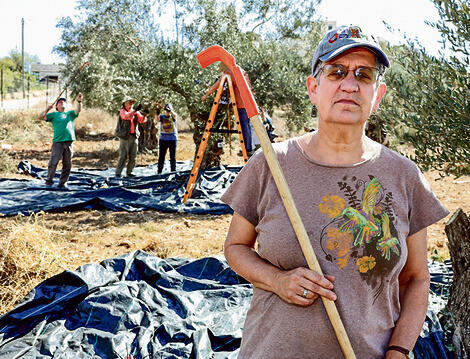
Rabbi Toba Spitzer: 'They say we're anarchists. I'm 63, Sue is 82 and Jo is 80. We're very frightening'
(Photo: Shaul Golan)
She pointed to the case of Lila Stillman-Utterback, the daughter of her friend Danielle, who was detained and had her passport confiscated before being deported.
"She was banned from entering Israel for 10 years. She grew up in America loving Israel. She came here to promote coexistence, to show Palestinians that there is also a Judaism that brings goodness into the world, that cares about basic human rights. She paid a heavy price for it."
By lunchtime, the volunteers had settled beneath the olive trees in Jalud to eat. One of them agreed to speak on the condition that only his first name be published.
"The reason is simple. I want to be able to return to Israel in the near future," he said. "My wife has relatives here, and I have friends here. We're both retired, and we love visiting Israel."
His name is Mitchell. At 78, he is a retired philosophy professor from a major university in Massachusetts, and he is deeply troubled by what he sees happening in Israel.
"We didn't have to come here," he said. "But when you see the horrors taking place here, you can't just sit at home and do nothing, even when you live across the ocean."
"I care about Israel. I care about the Jewish people. I'm part of that people. That's why I came here and not to Sudan, where terrible things are also happening."
What frightens him most, he said, is the damage Israel may be inflicting on itself.
"I'm very afraid because it seems you've set a mechanism of self-destruction in motion without understanding the disastrous consequences it could bring."
"How do you think what's happening here looks in the United States? It's shameful, truly shameful. American media outlets can't understand how something like this can happen, how the Israeli military and government allow masked Jewish extremists to attack women and elderly people with clubs, burn Palestinian homes and property, without being arrested or anyone trying to stop them."
He said the violence and the response of the authorities were beginning to shape how Americans viewed Israel.
"In mainstream American media, they ask, 'How can this happen?' And commentators answer, 'Because this is the policy of the Israeli government.'"
"That makes me deeply anxious about Israel's future. You're approaching a crucial election. But it's not crucial only for Israelis. It's crucial for me as an American Jew, too."
"If the outcome is that the same government remains in power, more and more Americans will ask whether Israel is truly an ally of the United States, whether we share the same values and whether maintaining such strong ties with Israel is really in America's interest."
His concern, he stressed, goes far beyond politics.
"Israel is an idea. Every Jew in the world has a meaningful and profound connection to this place."
When helping farmers is treated as a provocation
As the school day ended in Jalud, children ran into the olive grove and wandered among the elderly volunteers.
"They're not used to seeing Jews coming here to help us," one village resident said. "There have been four attacks on our village in the past week alone."
One of the most striking aspects of the situation is the way humanitarian activities of this kind are increasingly portrayed as provocations intended to disturb public order.
Against the backdrop of violence by extremist settlers, the foreign Jews and Israelis helping Palestinian farmers are sometimes treated as anarchists and lawbreakers who should be detained and removed. It represents a profound reversal of how acts of solidarity are understood.
The only Israeli lawmaker encountered in the fields on Tuesday was Gilad Kariv of the Democrats, an opposition party.
While fellow Knesset member Zvi Sukkot has visited Palestinian villages under military and parliamentary security escort, including during incidents in which he smashed memorials, Kariv was moving around the West Bank alone, without protection.
"Two days ago, I informed the Knesset Guard that I intended to visit Sinjil and Suwaya to see how the olive harvest was going," Kariv said.
"A few hours later, my contacts in those villages called and begged me not to come. One of them told me, 'The army came to us and said that if an Israeli Knesset member visits, we won't allow you to harvest anymore.'"
"So today, I went into the area without informing anyone."
Anton Goodman, acting CEO of Rabbis for Human Rights, said his organization was in contact with Jewish communities around the world and repeatedly encountered the same questions.
"People ask us, 'What's happened to you over there? Have you lost your minds? What kind of Judaism is this?'"
"What they see in the photographs and videos are Jews wearing ritual fringes, sidelocks and large skullcaps doing terrible things. On Shabbat and religious holidays, they're driving vehicles, filming on their phones, burning homes and attacking people with clubs. They're imposing terror based on an ideology of Jewish supremacy."
Goodman said these images were prompting a growing number of Diaspora Jews to take action.
"We're seeing an awakening among Jews abroad who simply cannot bear to watch these scenes any longer and stand aside. They're willing to buy plane tickets with their own money, come here and put themselves at risk to help Palestinians."
Kariv described the volunteers' work as a Jewish and Zionist act reflecting deep concern for Israel, its future and its character.
"I hope more and more Israelis and Jews from around the world join activities like these," he said.
He also promised that if an alternative government emerged from the coming election, it would do everything possible to stop violence by Jewish extremists.
‘Iran isn't Israel's greatest danger’
The visit ended beneath Spitzer's olive tree. We held the ladder as she stood above us, working a small plastic rake through the branches to knock the olives loose.
After several days in the West Bank, she said, her understanding of the threats facing Israel had changed.
"I've come to realize that Iran isn't Israel's greatest danger," she said. "It's the brutal violence of settlers against Palestinians in the West Bank. That's the greatest danger facing Israel today."
"If you don't put an end to it, if you don't make a determined effort to stop it through real action, Israel will become internationally isolated. It will turn into a Jewish ghetto."
Dozens detained during olive harvest, including US congressional candidate
The following day, Wednesday, Israeli security forces detained 42 American and Canadian Jews who had joined 28 Israeli activists from Rabbis for Human Rights to harvest olives in Nahalin, a Palestinian village south of Bethlehem.
The official explanation was that the group had entered agricultural land for harvesting without prior coordination or authorization from the IDF.
The volunteers were taken by bus to a police station in the Israeli settlement of Beitar Illit. Among those detained was Brad Lander, the Democratic nominee for New York's 10th Congressional District in the U.S. midterm elections scheduled for early November.
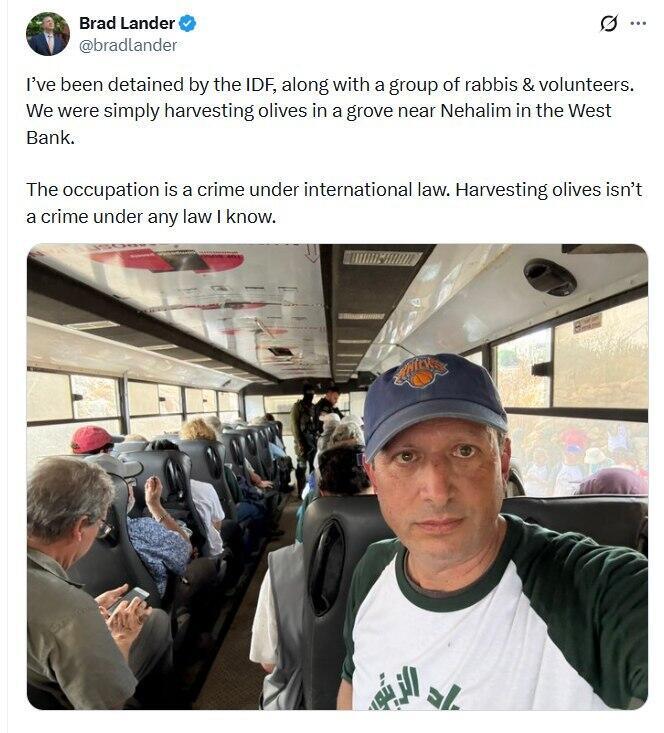
Brad Lander's social media post following his detention during the olive harvest in Nahalin
After a lengthy day at the police station, the 28 Israeli activists were barred from entering the West Bank for periods ranging from 15 to 30 days.
Thirty-eight foreign nationals, most of them Americans, were released without conditions. Four Americans were questioned on suspicion of supporting a terrorist organization before being released under orders prohibiting them from entering the West Bank for 15 days.
For the activists, the incident underscored the risks of an effort they regard as a basic expression of Jewish solidarity and a moral obligation toward Palestinian farmers.
"What happened in Nahalin was simply madness," Goodman said. "We are determined to continue showing solidarity with Palestinian farmers throughout the olive harvest."