


Israel's High Court of Justice on Thursday evening rejected a petition filed by Finance Minister Bezalel Smotrich against Attorney General Gali Baharav-Miara over her directive to postpone construction tenders in the E1 area near Ma'ale Adumim until after the Knesset elections.
The tenders, promoted by Smotrich, involve the construction of more than 1,000 new housing units in the area. Baharav-Miara ordered the tender process delayed over concerns that it could constitute "prohibited election campaigning." Smotrich, however, accused the attorney general and her staff of "becoming active players in the elections and trying to prevent the right from forming a government."
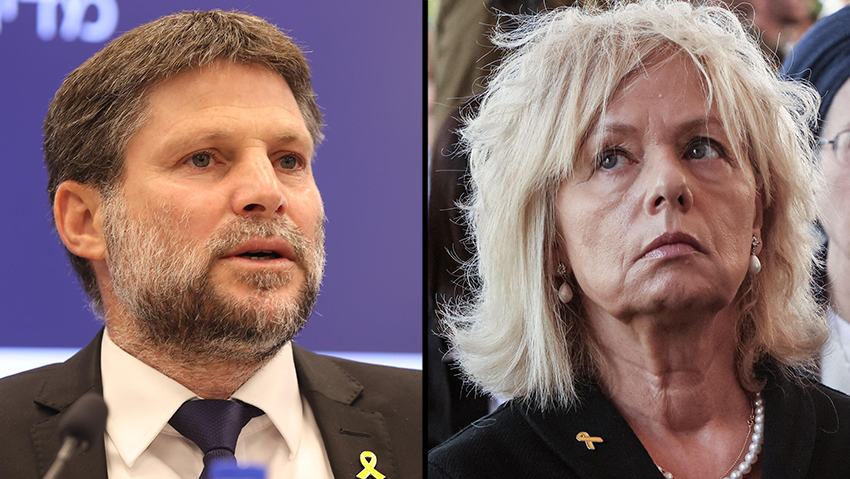
Another legal confrontation: inance Minister Bezalel Smotrich and Attorney General Gali Baharav-Miara
(Photos: Gil Cohen-Magen / AFP, Amit Shabi)
In rejecting Smotrich's petition, Justices Daphne Barak-Erez, Ofer Grosskopf and Khaled Kabub upheld the attorney general's position, emphasizing the restrictions governing caretaker governments.
"The decisions concerning the tender process are therefore subject to the rules requiring restraint in the actions of a caretaker government," the justices wrote. "The question is whether, under these circumstances, there are grounds for judicial intervention in the attorney general's determination that applying these rules justifies a limited delay in the opening of the tender bids. In my view, the answer is clearly no."
The justices explained that the decision to delay the tenders was based on the politically sensitive nature of the project and the potential implications of advancing it so close to Election Day.
"The attorney general's directive is based on other considerations that tip the balance in favor of limited intervention in the tender process," they wrote. "The decisions concerning the tender involve an issue of considerable public sensitivity. Given this, the timing of the tender could be used for election campaigning and could even constrain the next government's freedom of action. By contrast, the municipality's arguments concerning the urgency of completing the tender carry limited weight."
'It is appropriate to examine whether that timing could have an unfair influence on the electoral process'
The court further warned that scheduling government decisions immediately before elections could create opportunities for the political exploitation of executive powers.
"The proximity to Election Day raises concerns that the timing could be exploited to advance the political interests of members of the current government in the elections," the justices wrote. "Of course, there is nothing improper about a candidate for the Knesset presenting their achievements to the public. However, when a particular action is scheduled to take place, or not take place, on a date close to the elections, it is appropriate to examine whether that timing could have an unfair influence on the electoral process."
The justices concluded that such scrutiny was necessary to prevent government powers, which must be exercised solely for their legally authorized purposes, from being used in ways that could unfairly affect election results.