

Nearly a week after the Hezbollah terrorist organization joined the fighting and fired toward Israel, the IDF says it was not surprised by the development and had prepared in advance for the scenario.
“Our working assumption was that fighting with Iran could draw Hezbollah into the war,” IDF officials said. “Northern Command fully prepared for this scenario. There was no surprise from our side. There were orderly plans and advance preparations.”
Footage of a strike on a rocket launcher in Lebanon
(Video: IDF)


According to the officials, the central objective is to weaken Hezbollah and ultimately disarm the organization.
“The combination of strikes on Iran and Hezbollah will give the IDF a unique window of opportunity in which conditions may emerge to dismantle Hezbollah,” they said.
The officials also elaborated on Israeli strikes and Hezbollah’s current position, describing the terror group as operating under difficult circumstances.
“The IDF began with a preemptive strike targeting command-and-control components and senior Hezbollah figures across Lebanon,” they said. “The IDF continues to strike everything connected to the Iranian axis, including its economic infrastructure and senior operatives.”
They added that intelligence assessments indicate an almost complete disconnect between Iran and Hezbollah.
“Hezbollah is managing the war independently, unlike during Operation Northern Arrows when there was extensive coordination,” the officials said.
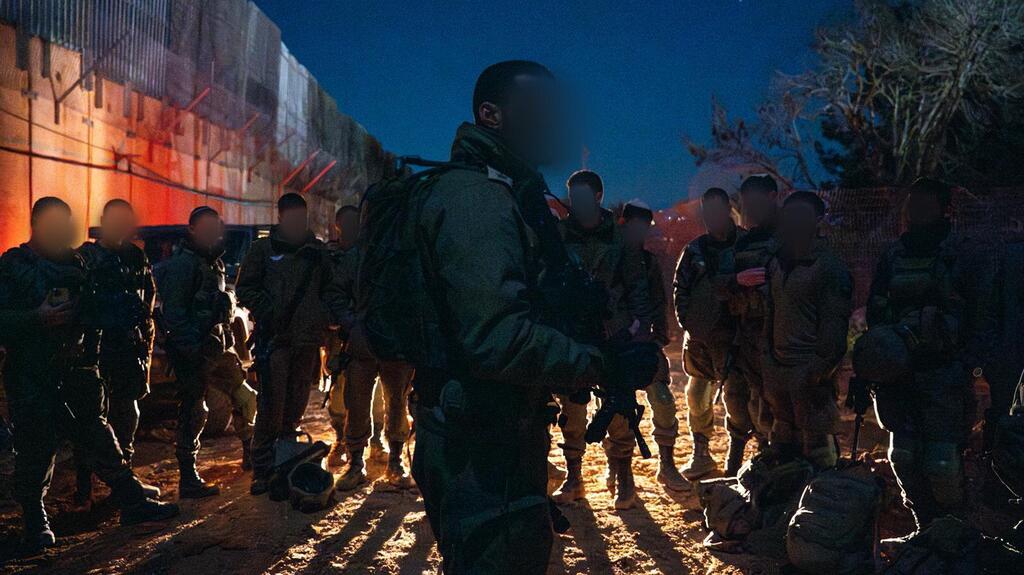
IDF forces in southern Lebanon
(Photo: IDF)
Security officials say they have not identified intelligence links between Iran and Hezbollah regarding missile launches. Some, however, offered a possible explanation for what appears to be coordinated barrages from Iran and Lebanon in recent days.
According to the officials, when early warning alerts are issued for Iranian launches, the alerts appear simultaneously on public applications and are widely visible. Hezbollah fighters already positioned in combat posts may see the alerts, realize that Iran has launched missiles and then organize their own fire in parallel.
Officials stressed there is no confirmed intelligence indicating such coordination, but said it remains one possible explanation.
“The command has prepared for strikes reaching the heart of the Dahiya district in Beirut,” the officials added. “The Radwan force made a mistake by moving south. From our perspective, it is in a strategic ambush. We are concentrating major efforts on reducing casualties and damage.”
According to the officials, there has also been a real shift in Lebanon’s attitude toward Hezbollah, with growing pressure on the terrorist organization.
Hezbollah entered the war in a difficult economic situation, and Israeli officials say there is hope that internal Lebanese pressure will weaken the group’s standing in the country.
“The IDF is prepared without a time limit,” military officials said. “We understand the war could be long. Our focus is on striking anyone who intends to harm us.”
IDF strikes in Lebanon
(Video: IDF)
Hezbollah is firing from locations known to the Israeli military, they added, noting that nearly 40 launchers have already been struck.
“There will not be a launcher that fires and is not attacked,” the officials said. “The policy is clear: every threat to Israel will be removed immediately. It is not hermetic, but it is a central effort.”
The officials also detailed operational activity in southern Lebanon.
“We enter every night with battalion and brigade raids into villages along the front line,” one official said. “Last night we entered Aitaroun with two battalions.”
The series of operations carried out in recent days, and planned in the coming days, are intended first and foremost to ensure a forward security zone that is demilitarized and cleared of civilians and enemy forces.
“This is a type of defensive buffer that gives us high confidence in our goal of avoiding the evacuation of residents,” the official said.
The IDF is also working to eliminate indirect-fire weapons and ensure that no Hezbollah cells remain within the division’s operational depth.
“The plan is to advance further and clear the villages along the first line,” the official said. “We are doing everything to suppress enemy fire. The goal is to push the anti-tank threat north as much as possible.”
In recent days, he said, Israeli forces have eliminated a significant number of terrorists and commanders.
“We knew Hezbollah had considerable capabilities, even if not at the level seen in the previous maneuver,” Northern Command officials added. “We are preventing Hezbollah from moving south of the Litani River.”
In parts of the third line of villages, Hezbollah retains a greater ability to entrench itself, and the IDF’s mission is to wear down those forces there and wherever they have managed to infiltrate farther south.
“We are focused on pushing Hezbollah’s line of fire back toward the border area,” the officials said.
“Since October 7, we understood that we need to talk less and show more results. It is completely clear to us that the IDF must be forward. When you are forward, you are exposed, and we understand that.”
“We have no intention of staying behind cover. We will seek contact with the enemy, kill him and push him north.”
Brig. Gen. Gaz also addressed the impact of fighting with Iran on the Lebanese front.
“The more pressure placed on Iran, the more Hezbollah’s fuel and oxygen pipeline drops dramatically,” he said. “The fighting against Iran has a dramatic impact on the front in Lebanon.”
According to IDF figures released Sunday, more than 600 targets in Lebanon have been struck so far, including 27 waves of strikes in the Beirut area, five of them in the Dahiya district.
About 200 Hezbollah terrorists have been killed, including around 80 Radwan force operatives. Among them were one operative with a rank equivalent to a major general, two with ranks equivalent to colonel, three battalion commanders and roughly 70 artillery operatives.