


Outgoing State Comptroller Matanyahu Englman published a report Tuesday on prostitution and human trafficking for sexual exploitation, pointing to deep gaps in the implementation of Israel’s law banning the purchase of prostitution services and warning of possible under-enforcement.
Six years after the law took effect, Englman wrote, “the enforcement actions taken are insufficient, even though they are essential to reducing the phenomenon. The implementation of measures to combat human trafficking for prostitution, protect victims and provide them with treatment is also flawed and incomplete.”

He called on the police and Justice Ministry to take steps to increase enforcement, and said the Population and Immigration Authority in the Interior Ministry must ensure that trafficking victims receive residence permits in accordance with its authority and procedures.
“The constitutional duty to protect human dignity, liberty and bodily integrity lies at the core of the state’s obligations,” Englman wrote. “Implementing the recommendations will help the State of Israel meet its moral and legal obligations.”
The audit was conducted between December 2024 and July 2025 and examined various aspects of the fight against human trafficking for sexual purposes and prostitution. According to the only national survey on the issue, conducted in 2016, about 12,000 people were in prostitution in 2014, 95% of them women, along with 1,300 minors. The average age of entry into prostitution was 13 to 14.
In 2014, the accumulated estimate of payments for prostitution services stood at about 1.3 billion shekels. According to the report, professionals working in the field estimate that as of 2025, the number of boys and girls in prostitution stood at 3,000 to 5,000.
Israel’s law banning the purchase of prostitution services entered into force in 2020 as a temporary order for five years and was extended in 2025. Since 2020, Israel has been placed in the intermediate tier of the U.S. State Department’s trafficking reports, putting it at risk of being downgraded to the lowest tier, which carries broad sanctions.
The comptroller found that in 2022 and 2023, the number of fines imposed by police for purchasing prostitution services fell by about 70%, from 3,004 to 902. The decline continued the following year, dropping another 58% to just 378 fines. In 2025, the number rose significantly to 1,061, but remained far below the number issued in 2022.
The audit noted that between 2021 and 2025, administrative enforcement in four of the police’s seven districts “was negligible and at most very limited.” It found that 99% of the fines issued by police during those years were imposed in only three districts: Tel Aviv, Central and Coastal. Enforcement was carried out almost exclusively by only three police stations: Zevulun, Rishon Lezion and Sharet.
“The data indicate an absence of engagement, or almost no engagement, by most stations,” the report said.
The comptroller said that although police had accumulated information about hundreds of addresses suspected of being prostitution sites in the Southern, Jerusalem and Northern districts, no fines were issued there. “The findings indicate a gap between the police concept and the way it is actually implemented for the purpose of enforcing the law,” the report said.

Outgoing State Comptroller Matanyahu Englman
(Photo: MUNI EXPO 2026 Local Government Conference)
Only 2% of those fined between 2022 and 2025, 111 out of 5,345, completed the alternative rehabilitative-educational process instead of paying the fine.
The report also examined information sharing between the Health Ministry and police. It noted that Levinsky clinics treated 3,453 people in 2023 and 2024, and that information about prostitution sites could help police enforcement. However, the report found that such sharing was “only partial and preliminary” in the Tel Aviv and Jerusalem districts and was not being implemented in all districts where the clinics operate.
The audit also found that according to police assessments, the intelligence picture on human trafficking is relatively limited compared with the actual scope of the phenomenon. In 2024, police translated only 44% of the intelligence information in their possession into practical activity.
The comptroller found that until 2025, police had not set national targets for the number of fines to be issued under the law banning the purchase of prostitution services. In 2024, there was information about suspicious addresses in the jurisdictions of 26 police stations, but only 18 of them were given targets for the number of fines to issue.
Between 2022 and 2024, police failed to meet the targets they had set for cracking human trafficking cases. In 2022, only a quarter of the targeted cases were solved, two out of eight, reflecting activity by the Tel Aviv District alone, out of seven districts that had been given targets. The Coastal, Central and West Bank districts did not crack any such cases during those years.
The report also pointed to failures in the division of responsibility within police between headquarters, district and station-level officials. Police officials told the audit team that the established procedure is not implemented. In practice, the officials responsible for enforcement under the procedure, detective units, are not the ones carrying out enforcement in the field, which is being done by patrol units. As a result, those units do not view themselves as responsible for promoting enforcement or improving its scope and quality.
“This leads to a blurring of responsibility and harms the ability to carry out consistent and professional enforcement,” the report said.
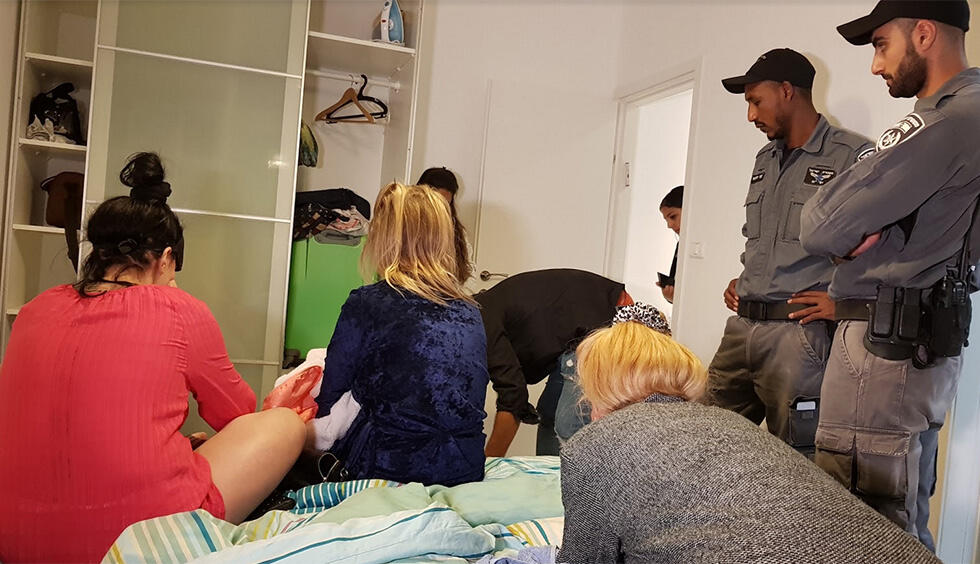
Police raid on a brothel
(Photo: Israel Police)
The audit also addressed the internet as a platform for soliciting prostitution. Since 2018, enforcement authorities have been aware of the significant challenge involved in exposing online offenses and enforcing the law against them, as well as the gaps in their capabilities. Despite this, the audit found that no steps had been taken to significantly expand activity in the online sphere, and that the current activity does not provide an effective response.
In 2024, despite police information on more than 1,300 addresses suspected of being prostitution sites, only 13 brothels were closed. Between 2022 and 2025, only 60 brothels were closed. The comptroller said this reflected a failure to fully use an existing tool as a complementary means of combating prostitution and human trafficking for prostitution.
Englman said that at the time the audit ended, the police human trafficking unit suffered from a significant manpower shortage and employed only one female officer. This was despite the fact that the need to increase staffing had already been raised in 2020 by the police, the National Security Ministry and the U.S. State Department in its annual report on the issue.
In 2025, additional positions were approved, but they had not been filled by the time the audit ended. Englman also noted that Tel Aviv District is the only district with a dedicated morality unit handling human trafficking offenses and related crimes.
The audit also found flaws in the way the Population and Immigration Authority used its power to grant residence permits to people recognized as victims of human trafficking for prostitution. According to the findings, the decision-making process was at times conducted not in accordance with procedures and beyond the authority’s powers.
Over the past two years, substantial disputes have emerged between the Population and Immigration Authority and the Legal Aid Department in the Justice Ministry over the granting of residence permits.
“The disputes harmed cooperation and working relations,” the comptroller wrote. “As a result, the Legal Aid Department is using legal tools intended to compel the authority to approve permits in accordance with the law.”

(Photo: Shaul Golan)
The audit team noted that the Legal Aid Department described these as unnecessary proceedings that could have been avoided had there been cooperation between the bodies, and said they waste public resources without addressing the root of the problem.
The coordinator in the Government Anti-Trafficking Coordination Unit at the Justice Ministry told the audit team that the conduct of the Population and Immigration Authority, including what she described as the systematic denial of work permits to trafficking victims, is unreasonable. She said it severely harms victims and even pushes them back into prostitution.
Despite a 2022 government decision, the Justice Ministry has not completed the expansion of the range of offenses for which funds can be seized for the fund established to support the fight against human trafficking and slavery-like conditions.
The audit also examined the tasks assigned to the coordination unit under the multiyear national plan to combat human trafficking, which was set in 2022 and is due to end at the end of this year. According to the report, as of May 2026, the unit had advanced a large portion of the tasks assigned to it, but various difficulties were identified in its activity.
The report pointed, among other things, to difficulties in cooperation between police and the Population and Immigration Authority’s enforcement and foreign nationals administration, even though such cooperation could contribute to the fight against the phenomenon. The bodies do not share relevant information and data with each other, their activities are not coordinated and their working relations are not regulated by any procedure.
Regarding the dedicated public hotline for human trafficking, the audit noted that two years after a government decision to increase the number of people contacting the hotline, no significant increase was evident.
As of May, the coordination unit had still not formulated an annual professional, structured and interministerial training program for ministries and public bodies involved in the fight against prostitution and human trafficking. That was not in line with a decision by the directors-general committee, which had called for priority to be given to improving training, and despite the fact that the coordination unit had defined the task in its 2025 work plan.
The comptroller also found that the unit had not completed arrangements for funding transportation of human trafficking victims to designated shelters. In practice, the Welfare Ministry funded the transportation in 2025, but unresolved disputes remain between the bodies over who is responsible for the transportation and its funding.