


Amid a complex security reality and a prolonged war, Israel’s defense industry continues to post significant gains. The Defense Ministry on Tuesday released its 2025 defense exports report, showing more than $19.2 billion (over 53 billion shekels) in new contracts signed worldwide.
The figure represents an increase of about 30% from the previous year, a doubling over the past five years and a fourfold increase over the past decade. Beyond the economic impact, the data reflects Israel’s emergence as a sought-after defense technology power at a time when defense manufacturers are operating under emergency conditions and producing around the clock for the IDF.
David’s Sling tests conducted in February of last year
(Video: The Defense Ministry)


The Defense Ministry said growing international interest stems largely from the operational performance of Israeli systems in the field. Experience gained across multiple combat arenas in recent years, along with achievements in operations such as the June 2025 campaign against Iran, have turned Israeli systems into a highly sought-after benchmark in the global market. Purchasing countries are seeking battle-tested technologies that have proven themselves in real-time conditions.
A breakdown of Israeli defense exports in 2025 shows significant changes compared with previous years. Air defense and missile systems remain the cornerstone of the industry, but surveillance technologies also recorded a sharp increase. Missiles, rockets and air defense systems accounted for 29% of deals, while surveillance and electro-optical systems made up 22%, up from 6% a year earlier.
Manned aircraft and avionics represented 11% of contracts, radar and electronic warfare systems 11%, weapons and launch systems 6%, unmanned aerial vehicles 4%, communications and command-and-control systems 7%, satellite systems 3%, cyber and intelligence systems 2%, armored vehicles 2% and naval systems 2%.
Gulf market continues to expand
The report’s geographic breakdown shows Europe as Israel’s largest customer, accounting for 36% of procurement volume, likely amid growing security threats across the continent. Asia-Pacific countries followed with 32%, North America with 13%, while Latin America and Africa each accounted for 2%.
One market that continues to expand is the Gulf region, which represented 15% of exports. Defense Ministry officials said they expect a new regional order to emerge after the conflict with Iran ends, with Israel becoming a significant partner for Gulf states and broader cooperation developing. Officials added that Israel is already deeply engaged in those countries.
Another notable feature of 2025 was the size of contracts. More than half of all deals, 53%, were classified as “mega-deals” worth more than $100 million each.
The ministry attributed the growth to a broad reform effort that included significant regulatory easing, the opening of new markets and a more focused oversight framework centered primarily on protecting sensitive information. The reforms particularly boosted government-to-government, or GTG, agreements, which reached a record of about $10 billion, accounting for more than half of total annual exports.
Domestic challenges remain
The Defense Ministry said critical raw materials had been imported and foreign workers brought in to increase interceptor production. According to the ministry, the economic cost of failing to intercept a ballistic missile is greater than the cost of an Arrow 3 interceptor. An Iranian missile striking a populated area could cause hundreds of millions of shekels in damage, while an Arrow 3 interceptor costs about 15 million shekels.
As for fiber-optic drones that have troubled Israeli forces in northern Israel, ministry officials said there is currently no practical solution. They said funding has been allocated and a competition among defense companies has begun to develop an accelerated response.
“This is keeping me awake at night, and I am not satisfied with the results so far. Ultimately, we will solve this problem,” Defense Ministry Director-General Maj. Gen. (res.) Amir Baram said.
‘Growing international confidence’
Defense Minister Israel Katz said upon receiving the report that “the very fact that, even in the third year of fighting, Israel continues to break records in defense exports is proof of the high regard in which Israel’s defense establishment is held around the world.”
“The defense export sector reflects Israeli strength, ingenuity and the ability to think outside the box,” he said.
Baram stressed that the economic success serves a broader strategic goal.
“Today, our force-building budget relies heavily on these partnerships. We must advance complementary measures, including investment in research and development and the expansion of production lines in the defense industries. This is an essential step to ensure independence in critical munitions and interceptors, maintain technological superiority and create the next generation of Israeli innovations,” he said.
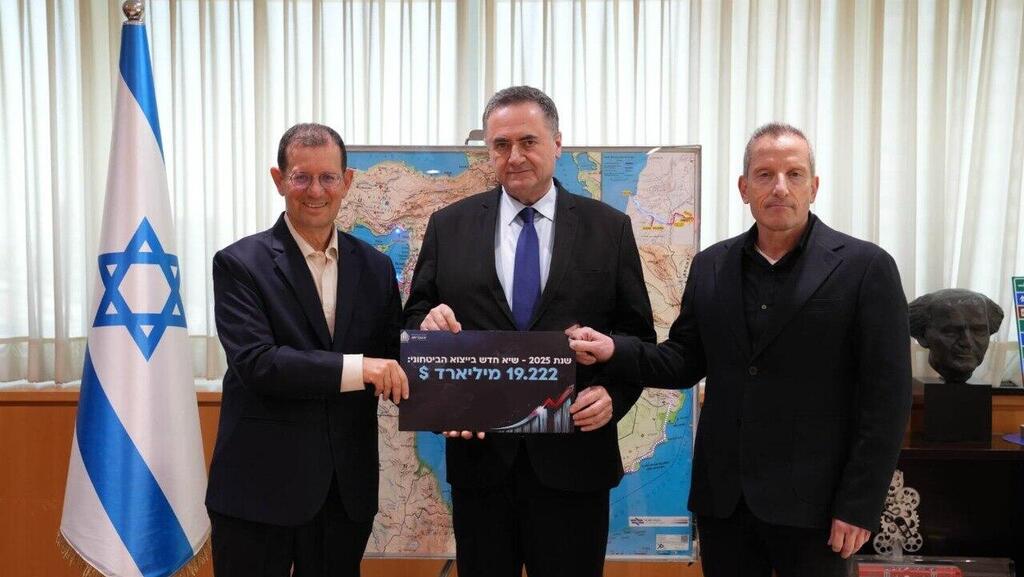
Defense Ministry Director-General Maj. Gen. (res.) Amir Baram, Defense Minister Israel Katz and SIBAT Director Brig. Gen. (res.) Yair Kulas
(Photo: Defense Ministry)
Brig. Gen. (res.) Yair Kulas, head of the Defense Export and International Cooperation Directorate (SIBAT), said the figures tell a straightforward story.
“Many countries around the world have increased their defense budgets and are interested in Israeli industry. We have demonstrated a unique capability — supplying the IDF with munitions for a full-scale military campaign while simultaneously signing major contracts with governments overseas. The record level of GTG agreements is not merely an economic figure; it reflects growing international confidence in the State of Israel,” he said.